

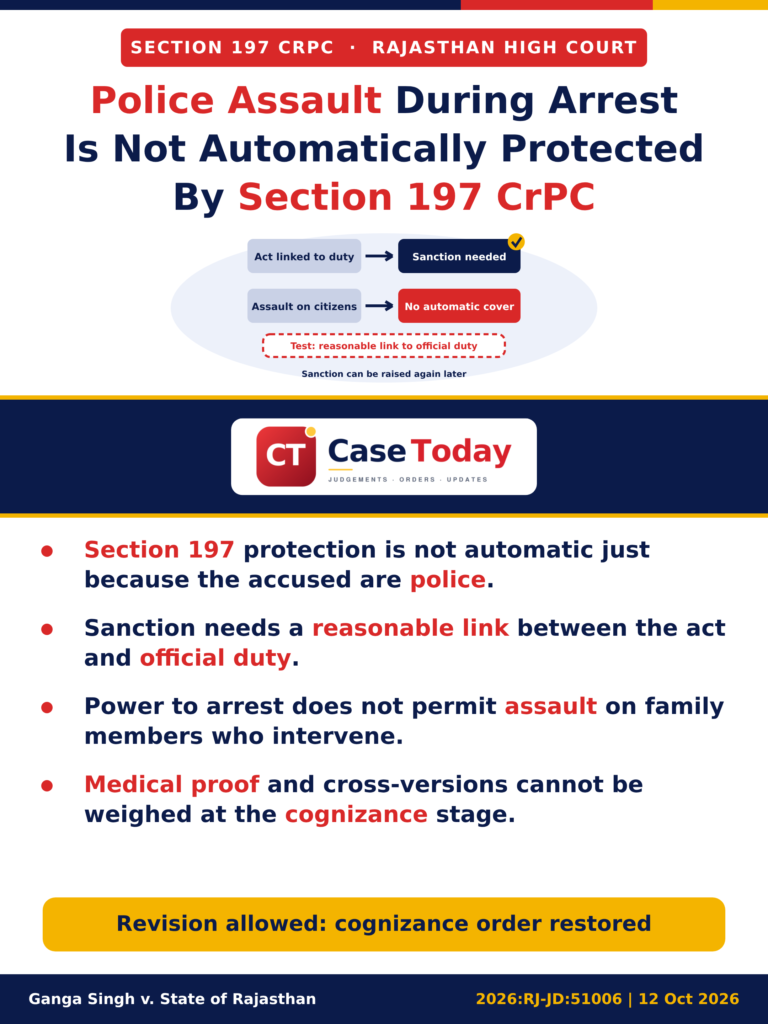
Police Assault During Arrest Is Not Automatically Protected
By Section 197 CrPC : Rajasthan High Court
Case: Ganga Singh v. State of Rajasthan & Ors. (S.B. Criminal Revision Petition No. 1276/2014) – Order
Court: High Court of Judicature for Rajasthan at Jodhpur
Citation: 2026:RJ-JD:51006
Coram: Justice Farjand Ali
Date of Order: 12 October 2026
HEADNOTE
Keywords: Code of Criminal Procedure, 1973 – Section 197 – Prior Sanction – Police Personnel – Execution of Warrant – Official Duty – Reasonable Nexus – Abuse of Authority – Cognizance – Sections 200 and 202 CrPC – Revisional Jurisdiction – Sections 452, 323, 325 and 120-B IPC – Matajog Dobey v. H.C. Bhari – B. Saha v. M.S. Kochar – D. Devaraja v. Owais Sabeer Hussain – Dr. S.M. Mansoori v. Surekha Parmar
- Police assault during an arrest is not automatically protected by Section 197 CrPC: The mere fact that the accused are police personnel who went to a house to execute a warrant does not bring the case within Section 197 CrPC. Protection applies only if the act complained of has a reasonable and direct connection with official duty. Allegations of assault on the complainant and his mother must be examined for that connection and cannot be brushed aside at the threshold (paras 5, 10, 14).
- Section 197 protection is neither absolute nor automatic: Section 197 safeguards public servants from vexatious prosecution for acts done in, or purporting to be in, the discharge of official duty. But the words “acting or purporting to act” cannot be stretched to cover acts wholly extraneous to the lawful use of authority (Matajog Dobey; B. Saha v. M.S. Kochar; P.K. Pradhan) (paras 5–6).
- The power to arrest does not allow punitive or retaliatory violence: The police may use only such force as is reasonably necessary in the lawful execution of their functions, and cannot administer punishment on their own. The line between exercising official authority and abusing it must be scrupulously maintained. An incident occurring during an official assignment is not by itself enough to show the nexus (paras 7, 10).
- Whether sanction is needed is fact-specific and can be examined after evidence: Following D. Devaraja, D.T. Virupakshappa and Dr. S.M. Mansoori, the need for sanction depends on the nature and quality of the act and its closeness to official function, not on the accused’s designation. In Mansoori, a similar plea of police assault was held premature at the early stage, and sanction could be examined after evidence (paras 8–9).
- Cognizance stage: no conclusive medical proof and no weighing of rival versions: At the stage of taking cognizance, the Court only checks whether the complaint and the preliminary inquiry evidence disclose sufficient grounds to proceed. Absence of conclusive medical proof of the broken tooth, a comparison of injury reports, and a cross-version or FIR by the police cannot defeat a specific complaint at the threshold (paras 11–12).
- The sanction question remains open for a later stage: Apart from nexus, the requirements about the status and removability of the public servant must also be satisfied, and the revisional court did not examine them. The accused may still raise the question of sanction later if the material on record warrants it (para 13).
BRIEF FACTS
The petitioner filed a private complaint alleging that police personnel came to his house asking about his brother, and when he questioned the purpose of their visit, they assaulted him. His mother intervened to rescue him and was allegedly struck on the mouth with a danda by one accused, breaking a tooth, while the others bit her hand and assaulted her. He said he was then forcibly taken to the police station, beaten again and made to sign blank papers. After recording statements under Sections 200 and 202 CrPC, the Additional Chief Judicial Magistrate No. 2, Bikaner, took cognizance on 17.04.2010 against the accused for offences under Sections 452, 323, 325 and 120-B IPC.
In Criminal Revision No. 135/2010, the Sessions Judge, Bikaner, by order dated 07.10.2013, set aside the cognizance order and discharged the accused, mainly because they were police officials acting in discharge of official duty and prior sanction under Section 197 CrPC was therefore indispensable. The petitioner challenged this in the High Court, arguing that Section 197 was extended merely because the accused were police personnel who visited the house to execute a warrant, that assaulting the complainant and his mother cannot be official duty, and that the revisional court substituted its own assessment of disputed facts at the threshold. The order records only the petitioner’s submissions, not those of the respondents.
KEY FINDINGS OF THE COURT
Note: The findings highlighted in yellow are the main findings of the Court most relied upon for the judgment.
- The Sessions Judge erred in applying Section 197 only because the accused were police personnel on a warrant visit. The Court held that protection cannot be presumed from official designation. The Sessions Judge set aside the cognizance order without properly examining the nature of the alleged acts and their nexus with official duty, so the order suffered from legal infirmity (paras 13–14).
- The alleged assault on the complainant’s mother and others cannot be treated as automatically protected. Even assuming the first visit was under a lawful warrant, that does not legitimise every act that followed. The authority to apprehend a person is not authority to assault his family members or those who intervene, and such conduct, if established, would be an abuse of official position. Physical violence not justified by lawful necessity cannot be elevated to an official function (paras 10, 13).
- The revisional court wrongly weighed medical proof and rival versions at the threshold. It relied on the absence of conclusive medical proof of the tooth injury and made a comparative appreciation of injury reports, accepting the defence version as conclusive. This was not warranted while testing a cognizance order, and a cross-version or police FIR does not make the private complaint false (paras 11–12).
- Other statutory requirements of Section 197 were not examined. The impugned order did not show a satisfactory examination of the status and removability of the accused public servants, apart from the nexus with official duty (para 13).
- The determination is limited and the sanction plea stays open. The Court said its finding is confined to the legality of the revisional order and that the accused can raise the sanction question at an appropriate stage, on the evidence that comes on record (paras 13, 15).
RESULT
Case Title: Ganga Singh v. State of Rajasthan & Ors.
Citation: 2026:RJ-JD:51006
Appearance: Mr. D.S. Gharsana for the petitioner; Mr. Narendra Gehlot for the respondents.