

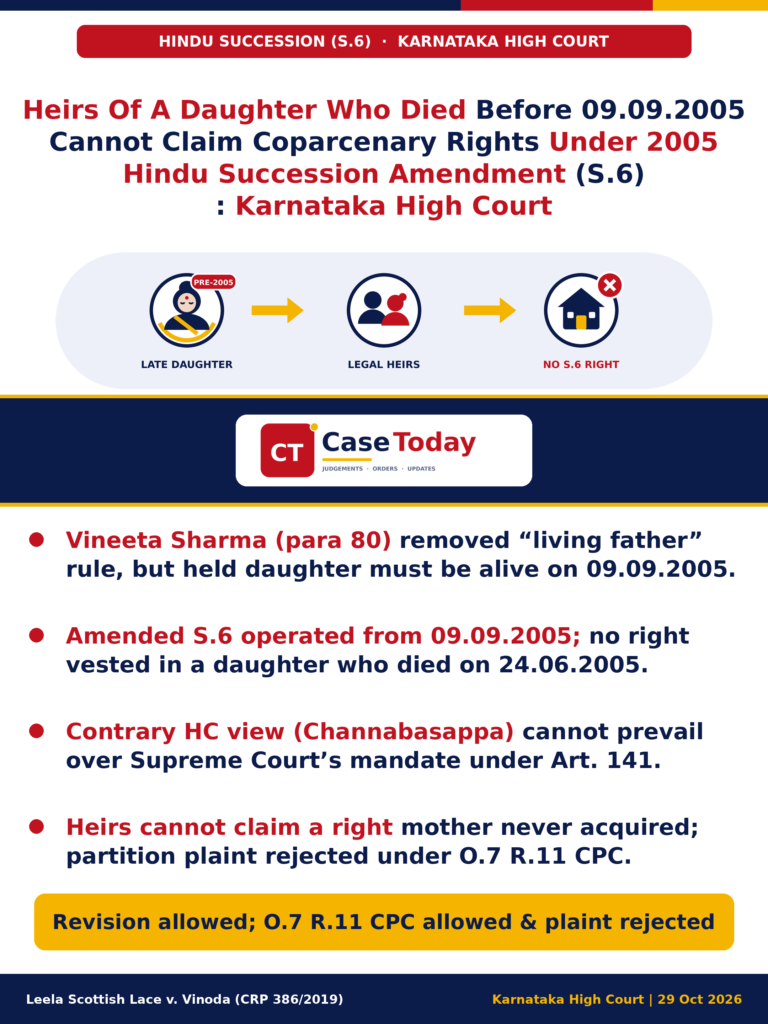
Heirs Of A Daughter Who Died Before 09.09.2005 Cannot Claim Coparcenary Rights Under 2005 Hindu Succession Amendment (S.6) : Karnataka High Court
Case: Leela Scottish Lace Limited & Anr. v. Smt. Vinoda & Ors., Civil Revision Petition No. 386 of 2019 (NC: 2026:KHC:60058)
Court: High Court of Karnataka at Bengaluru
Coram: Hon’ble Smt. Justice Lalitha Kanneganti
Date of Judgment: 29.10.2026
HEADNOTE
Keywords: Hindu Succession (Amendment) Act, 2005 – Amended Section 6 – Coparcenary Rights Of Daughter – Daughter Must Be Alive On 09.09.2005 – Heirs Of Predeceased Daughter Cannot Claim Partition – Vineeta Sharma v. Rakesh Sharma (Para 80) – Article 141 – Order VII Rule 11 CPC – Rejection Of Plaint
- Daughter Must Be Living On 09.09.2005 To Acquire Coparcenary Rights Under Amended Section 6: Relying on paragraph 80 of Vineeta Sharma v. Rakesh Sharma, (2020) 9 SCC 1, while the Supreme Court dispensed with the requirement that the father be alive on 09.09.2005, it expressly held that the daughter must be living on 09.09.2005. Because substituted Section 6 became operative only on 09.09.2005, no coparcenary right vested in a daughter who died prior to that date, and her children or grandchildren cannot claim through her a right she never acquired (paras 16–20).
- Supreme Court’s Declaration Prevails Under Article 141 Over Contrary High Court View: The co-ordinate bench ruling in Channabasappa v. Parvatevva (recognizing rights of heirs of a daughter who died before 09.09.2005) is inconsistent with para 80 of Vineeta Sharma; under Article 141 of the Constitution, the Supreme Court’s express requirement of the daughter’s survival on 09.09.2005 must prevail (paras 18–19).
- Partition Plaint Liable To Rejection Under Order VII Rule 11 CPC: Where a bare perusal of the plaint shows the plaintiffs’ mother died on 24.06.2005 (before 09.09.2005), the plaintiffs have no legal right to claim partition, examining earlier sale deeds serves no purpose, and the plaint must be rejected under Order VII Rule 11 CPC (paras 20–21).
BRIEF FACTS
Respondents No. 1 to 5 (plaintiffs) filed O.S. No. 6992/2012 seeking partition and separate possession of Suit Schedule A and B ancestral properties, along with a declaration that sale deeds dated 10.04.2001, 06.09.2001, Release Deed dated 15.11.2007, and Sale Deed dated 03.05.2012 were not binding on them. They claimed their share through their deceased mother, Gouramma (daughter of late Muniyappa).
Undisputedly, Muniyappa died in 1954, his widow died on 22.09.2002, and the plaintiffs’ mother Gouramma died on 24.06.2005—prior to the commencement of the Hindu Succession (Amendment) Act, 2005 on 09.09.2005. Petitioners (Defendant Nos. 4 and 5) filed I.A. No. V under Order VII Rule 11(a) and (d) CPC seeking rejection of the plaint. On 01.06.2019, the Trial Court dismissed the application holding that limitation and entitlement required full-fledged trial, prompting this Civil Revision Petition under Section 115 CPC.
KEY FINDINGS OF THE COURT
Note: The findings highlighted in yellow are the main findings most relied upon by the Court.
- Vineeta Sharma removed the “living father” test, not the “living daughter” test. While birth is the foundation of a daughter’s coparcenary status, substituted Section 6 became operative on 09.09.2005. In para 80 of Vineeta Sharma, the Supreme Court expressly held that “the daughters should be living on 9-9-2005.” No coparcenary right under the 2005 Amendment could vest in a daughter who died before 09.09.2005 (paras 17–19).
- Heirs cannot claim a statutory right their mother never acquired. Since the plaintiffs’ mother died on 24.06.2005, no coparcenary right under amended Section 6 devolved upon her; consequently, her children and grandchildren cannot claim partition through her, and challenging prior sale deeds serves no purpose (para 20).
- Co-ordinate bench view in Channabasappa cannot override Article 141. Because Channabasappa v. Parvatevva is inconsistent with the express declaration in para 80 of Vineeta Sharma, the Supreme Court’s mandate prevails under Article 141 of the Constitution. On a bare perusal of the plaint, the suit discloses no legal right and the plaint must be rejected under Order VII Rule 11 CPC (paras 18–19, 21).
RESULT
Case Title: Leela Scottish Lace Limited & Anr. v. Smt. Vinoda & Ors.
Reference: Civil Revision Petition No. 386 of 2019 | NC: 2026:KHC:60058
Appearance: For Petitioners: Sri Dhyan Chinnappa, Senior Counsel, for Sri Shirish Krishna & Sri Joseph Anthony, Advocates. For Respondents No. 2 to 5: Sri H. Sunilkumar, Advocate.