

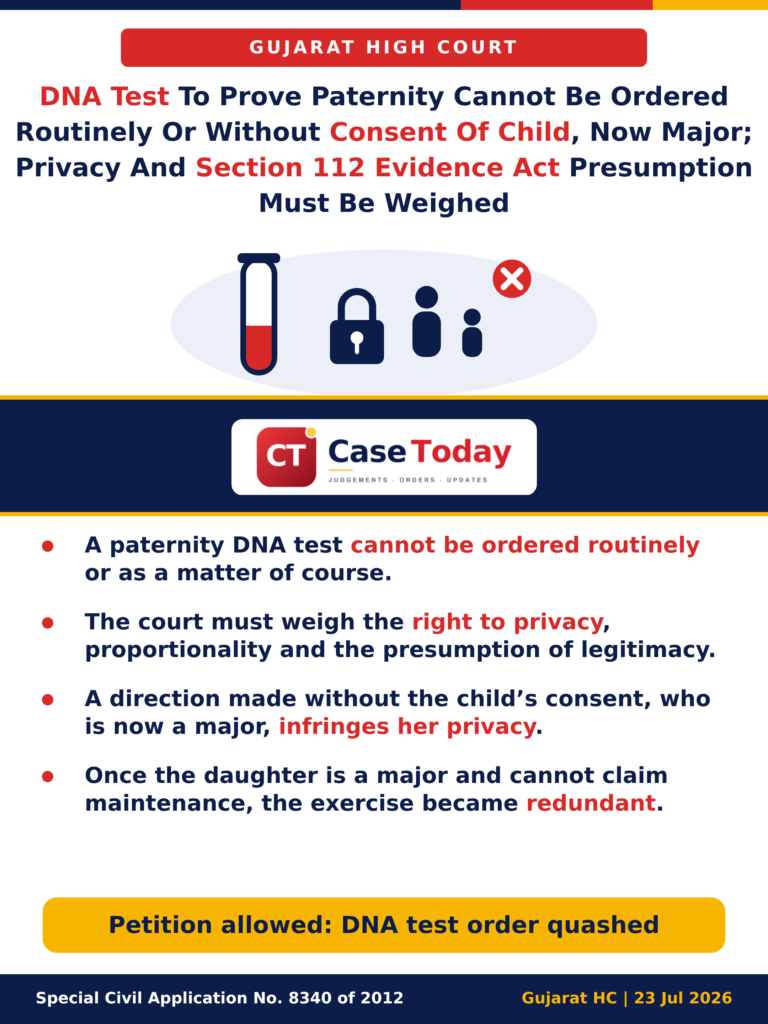
DNA Test To Prove Paternity Cannot Be Ordered Routinely Or Without Consent Of Child, Now Major;
Privacy And Section 112 Evidence Act Presumption Must Be Weighed : Gujarat High Court
Case: Husband v. Wife & Daughter (Parties Anonymized), R/Special Civil Application No. 8340 of 2012
Court: High Court of Gujarat at Ahmedabad
Coram: Hon’ble Mr. Justice J. C. Doshi
Date of Judgment: 23.07.2026
HEADNOTE
Keywords: DNA Test – Paternity – Right To Privacy & Proportionality – Hindu Adoption and Maintenance Act, 1956 (Section 20) – Proof Of Marriage Required First – Consent Of Daughter – Major Married Daughter Loses Right To Maintenance – Ashok Kumar, Puttaswamy & R. Rajendran
- No Routine DNA Test — Right To Privacy & Consent Paramount: Applying Ashok Kumar v. Raj Gupta, (2022) 1 SCC 20, K.S. Puttaswamy v. Union of India, (2019) 1 SCC 1, and R. Rajendran v. Kamar Nisha, 2025 LiveLaw (SC) 1086, courts cannot direct a DNA test in a routine manner or without the consent of the daughter, as doing so violates her constitutional right to privacy and carries serious societal consequences (paras 10, 12–15).
- Marriage Must Be Proved First Before Seeking Paternity DNA Test: Where the defendant denied the marriage, the plaintiff-wife was first required to enter the witness box and lead evidence to prove her marriage before seeking a DNA test to determine paternity (paras 8, 12, 15).
- Paternity Exercise Redundant Once Daughter Is Major & Married: In a maintenance suit under the Hindu Adoption and Maintenance Act, 1956, once the daughter becomes a major and gets married, she loses her right to claim maintenance from her father, rendering the DNA paternity test redundant (paras 11, 15).
BRIEF FACTS
In 1994, Plaintiff No. 1 (claiming to be the legally wedded wife) filed Special Civil Suit No. 485 of 1994 (later Family Suit No. 1532 of 2010) under the Hindu Adoption and Maintenance Act, 1956 seeking maintenance for herself and her then 15-month-old daughter (Respondent No. 2) from the Defendant. The Defendant denied both the marriage and paternity. Although the High Court in earlier revision proceedings directed the suit to be decided by December 1998, Plaintiff No. 1 never entered the witness box to prove her marriage.
On 06.01.2010, Plaintiff No. 1 filed application Exh. 217 seeking a DNA blood test of the Defendant to establish paternity of Respondent No. 2. On 11.05.2012, the Family Court, Vadodara allowed Exh. 217 and directed the Defendant to provide a blood sample, warning of an adverse inference on refusal. The Defendant challenged this order before the High Court, pointing out that he is now 78 years old with a below-knee leg amputation and that Respondent No. 2 is now a 32-year-old married woman settled in the USA.
KEY FINDINGS OF THE COURT
Note: The findings highlighted in yellow are the main findings most relied upon by the Court.
- DNA test ordered without daughter’s consent violates her right to privacy. Respondent No. 2 never consented to a DNA test and never approached the Court after attaining majority. Applying the proportionality test in Ashok Kumar and K.S. Puttaswamy, and the safeguards in R. Rajendran v. Kamar Nisha, the Family Court erred in ordering a DNA test routinely, placing the daughter’s privacy and societal status at stake without her consent (paras 9–10, 12–15).
- Plaintiff-wife had to prove marriage first before raising paternity. Despite a 1998 deadline to conclude the 1994 suit, Plaintiff No. 1 filed the DNA test application in 2010 without ever entering the witness box or leading evidence to prove her marriage with the Defendant (paras 8, 12, 15).
- Paternity test became redundant once daughter attained majority and married. Because Respondent No. 2 is now a 32-year-old married woman residing in the USA, she has lost her right to claim maintenance from her father under HAMA, rendering the paternity exercise redundant (paras 8, 11, 15).
RESULT
Case Title: Husband v. Wife & Daughter (Parties Anonymized)
Reference: R/Special Civil Application No. 8340 of 2012
Appearance: For Petitioner: Mr. R. D. Dave, Advocate. For Respondents: Mr. Nirav Thakkar for Mr. Bhavin J. Satwara, Advocates.