

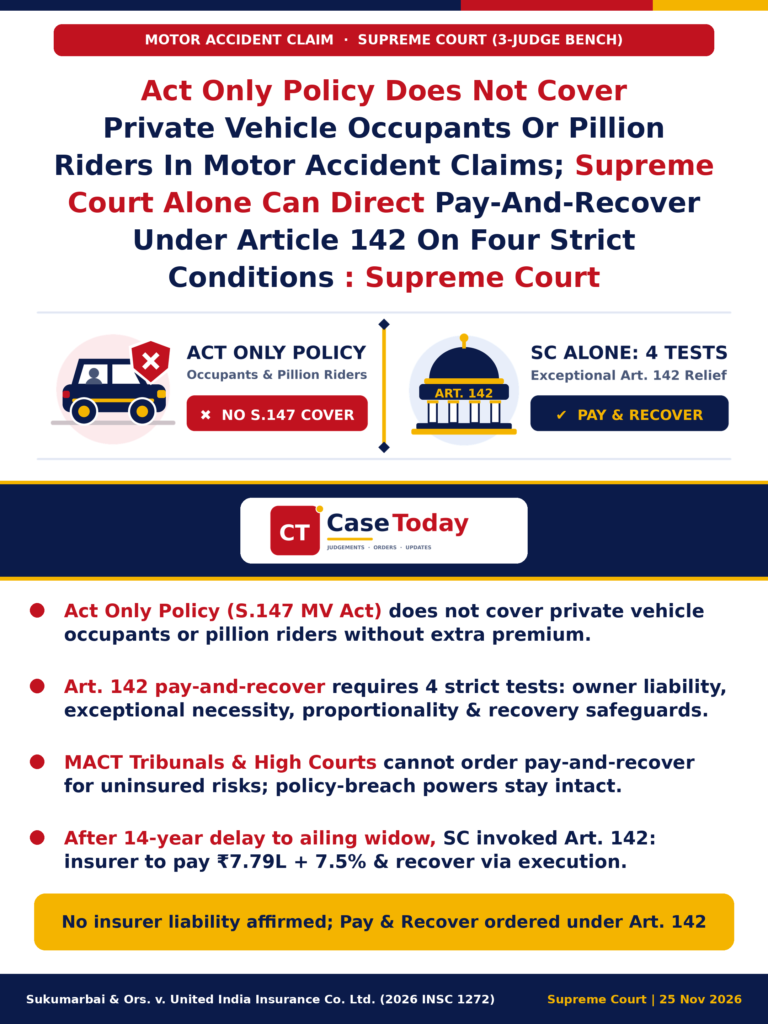
Act Only Policy Does Not Cover Private Vehicle Occupants Or Pillion Riders In Motor Accident Claims; Supreme Court Alone Can Direct Pay-And-Recover Under Article 142 On Four Strict Conditions : Supreme Court
Case: Sukumarbai & Ors. v. United India Insurance Company Ltd. & Anr., Civil Appeal arising out of SLP (C) No. 3249 of 2020 (2026 INSC 1272)
Court: Supreme Court of India (3-Judge Bench)
Coram: Hon’ble Mr. Justice Vikram Nath, Hon’ble Mr. Justice Sandeep Mehta, and Hon’ble Mr. Justice Aparesh Kumar Singh
Date of Judgment: 25.11.2026
HEADNOTE
Keywords: Motor Vehicles Act, 1988 – Section 147 Compulsory Third-Party Insurance – Act Only Policy – Gratuitous Occupant Of Private Vehicle & Pillion Rider Not Covered Without Extra Premium – Article 142 Of The Constitution – Pay And Recover For Uninsured Risks – Parvathneni Reference Resolved – Four Cumulative Threshold Conditions – MACT Tribunals & High Courts Barred From Exercising Article 142-Like Jurisdiction
- Act Only Policy Does Not Cover Private Vehicle Occupants Or Pillion Riders Under Section 147 MV Act: Merely being neither the insured nor the insurer does not confer compulsory statutory coverage. Reaffirming Asha Rani, Baljit Kaur, Tilak Singh, and Sudhakaran K.V., compulsory insurance under Section 147 MV Act does not automatically extend to gratuitous occupants of private vehicles or pillion riders on two-wheelers under an Act Only Policy unless additional coverage is contracted under the policy (paras 31–36, 94).
- Article 142 Pay-And-Recover For Uninsured Risks Permissible Only On Four Cumulative Conditions: Resolving the Parvathneni reference in light of Shilpa Sailesh, absence of statutory or contractual liability is not an absolute bar to Article 142 pay-and-recover relief, provided four cumulative tests are met: (i) established & enforceable liability of the vehicle owner, (ii) exceptional necessity to prevent substantial injustice, (iii) necessity and proportionality, and (iv) procedural fairness with effective recovery safeguards (paras 66–83, 94–96).
- Tribunals & High Courts Cannot Order Pay-And-Recover Where Risk Is Uninsured: Article 142 vests exclusively in the Supreme Court. Motor Accident Claims Tribunals and High Courts cannot invoke extraordinary pay-and-recover jurisdiction where no statutory or contractual liability exists—though their power to order pay-and-recover for breaches of policy conditions in covered risks remains intact (para 81).
- Exceptional Article 142 Relief Granted After 14-Year Delay To Ailing Widow: Affirming that the insurer had no statutory or contractual liability, the Court exercised Article 142 given over 14 years of non-payment and the widow’s advanced age and medical infirmities, directing the insurer to satisfy the outstanding award and recover directly from the owner via execution without a separate suit (paras 84–98).
BRIEF FACTS
On 15.04.2012, Suryakant Pandurang Nikam was returning from a marriage ceremony in a private Tata Sumo jeep driven rashly by its owner, Abdul Gazi (Respondent No. 2), when the vehicle lost control on the Tandulja-Ambajogai road, struck a bridge railing, and overturned, resulting in his death. On 26.07.2012, his wife (Sukumarbai) and two sons filed MACP No. 197 of 2012 under Section 166 of the MV Act before the MACT, Latur.
On 28.08.2017, the Tribunal held the owner negligent, noted that the jeep had been hired with no additional passenger premium under its Act Only Policy, yet awarded ₹7,79,800/- with 7.5% annual interest with a “pay and recover” direction against United India Insurance Company Ltd. On 05.08.2019, the Bombay High Court (Aurangabad Bench) maintained the quantum against the owner but exonerated the insurer and set aside the pay-and-recover direction, holding Article 142 powers were unavailable to Tribunals or High Courts. The claimants appealed to the Supreme Court, where a three-Judge Bench also addressed the pending larger-Bench questions from National Insurance Co. Ltd. v. Parvathneni and the 25.08.2022 reference in SLP (C) No. 3433 of 2020.
KEY FINDINGS OF THE COURT
Note: The findings highlighted in yellow are the main findings most relied upon by the Court.
- No compulsory statutory coverage for gratuitous private-vehicle occupants or pillion riders under an Act Only Policy. Treating every stranger to the insurance contract as compulsorily covered under “any person” in Section 147(1)(b)(i) would render the express statutory inclusions for goods owners and public service vehicle passengers redundant. While such occupants may be third parties vis-à-vis another negligent vehicle, they are not automatically covered by the Act Only Policy of the very vehicle they travel in absent additional contractual coverage (paras 13–17, 31–36, 94).
- Article 142 pay-and-recover power survives Parvathneni reservations but is strictly disciplined by four cumulative requirements. Guided by Shilpa Sailesh, Anita Kushwaha (access to justice), and equitable restitution/subrogation, the Supreme Court may exceptionally direct an unliable insurer to satisfy an award and recover from the owner only when four cumulative conditions are satisfied: (1) established enforceable liability of the owner, (2) exceptional necessity to prevent substantial injustice, (3) necessity and proportionality, and (4) procedural fairness with an effective recovery mechanism (paras 52–80, 82–83, 94–96).
- Exclusivity of Article 142 to the Supreme Court; distinction from policy-breach cases preserved. MACT Tribunals and High Courts cannot exercise Article 142-like pay-and-recover power where the risk was never insured under statute or contract; however, their power to direct pay-and-recover in cases of policy condition breaches (e.g., invalid driving licence under Swaran Singh and Shamanna) remains unaffected (paras 23–24, 45–46, 81).
- Exceptional Article 142 relief warranted on facts after 14+ years of unpaid compensation. Because the owner’s negligence and ₹7,79,800/- award stood undisturbed, over 14 years had elapsed since the 2012 accident, and the widow had no independent income and suffered age-related medical infirmities, Article 142 intervention was necessary and proportionate while protecting the insurer’s direct execution recovery right (paras 84–98).
RESULT
Case Title: Sukumarbai & Ors. v. United India Insurance Company Ltd. & Anr.
Reference: Civil Appeal arising out of SLP (C) No. 3249 of 2020 | 2026 INSC 1272
Appearance: Not specified in the judgment copy.