

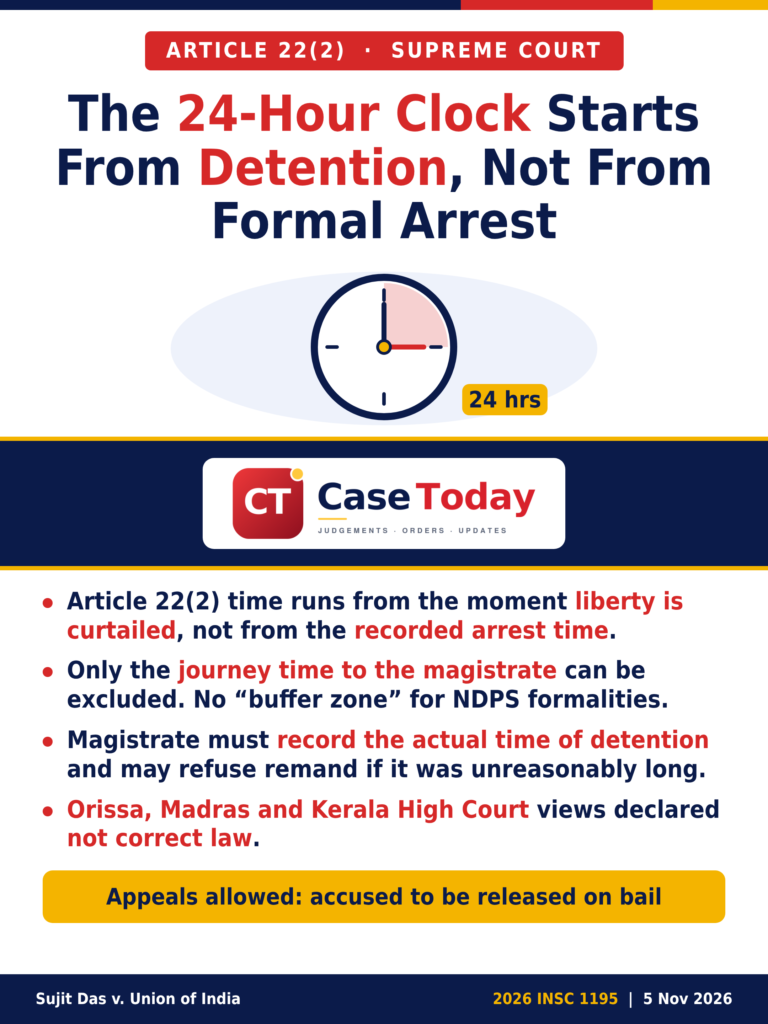
The 24-Hour Clock To Produce An Accused Before A Magistrate
Starts From Detention, Not Formal Arrest : Supreme Court
Case: Sri Sujit Das & Ors. etc. v. Union of India (Criminal Appeals arising out of SLP (Crl.) Nos. 12451–12453 of 2026)
Citation: 2026 INSC 1195
Coram: Justice Ujjal Bhuyan and Justice Atul S. Chandurkar (Judgment authored by Justice Bhuyan)
Date of Judgment: 5 November 2026
HEADNOTE
Keywords: Constitution of India, Article 22(2) – Article 21 – 24-Hour Rule – Detention and Arrest – Section 58 BNSS (Section 57 CrPC) – Narcotic Drugs and Psychotropic Substances Act, 1985 – Sections 37, 42, 50 and 67 – NDPS (Seizure, Storage, Sampling and Disposal) Rules, 2022, Rule 3 – Production before Magistrate – Remand – Custodial Violence
- Clock starts from detention: The 24 hours under Article 22(2) commence from the date and time of detention, when the person’s liberty stands curtailed, and not from the time of formal arrest recorded by the authority.
- No other exclusion: Only the time necessary for the journey from the place of arrest to the magistrate’s court may be excluded. The Constitution does not allow any “buffer zone” for enquiry, search, seizure or other NDPS formalities.
- Detention and arrest are one: In the expression “arrested and detained in custody”, the two words are joined by “and” and mean the same thing. The Constitution does not recognise detention separate from arrest.
- Breach means release: If detention continues beyond 24 hours without production before a magistrate, the person must be released forthwith.
- Reasonable period within 24 hours: Section 58 BNSS (Section 57 CrPC) imposes a second limit. Detention must not exceed what is reasonable in the circumstances, even within the 24 hours.
- Duty of the magistrate: At production, the magistrate must record the actual date and time of detention, check compliance, and may decline remand if detention was longer than reasonable.
- Article 21 and Section 37 NDPS: Where there is a violation of Article 21, the rigour of Section 37 NDPS Act gives way. The Court expressed reservations about contrary observations in Sukhwinder Singh @ Gora.
BRIEF FACTS
The three appellants, Sujit Das, Suman Das and Rupak Sarkar (with a fourth accused, Raju Das), were accused in Case No. 04/CL/NDPS/DPF/AGT/2025-26 under Sections 21(C), 22(C), 23(C), 25, 25A, 28 and 29 of the NDPS Act. On secret information, a Customs (DPF) team in Tripura intercepted a truck and its occupants at about 2:00 pm on 29.09.2025 and recovered 11.03 kg of methamphetamine (Yaba) tablets. Further quantities were found at the Customs office, making a total of 60.79 kg, against a commercial quantity of 50 grams. The accused were formally shown arrested at 11:00 am and 11:15 am on 30.09.2025 and were produced before the Magistrate at 4:45 pm on 30.09.2025.
The Special Judge rejected their bail on 30.03.2026, and the Tripura High Court rejected it on 29.04.2026, relying on Section 37 NDPS and State of Punjab v. Sukhwinder Singh @ Gora. In the Supreme Court, the appellants argued that the 24 hours ran from interception at 2:00 pm on 29.09.2025, so their production was late. The Investigating Officer’s compliance affidavit and the Additional Solicitor General defended a distinction between “detention” for search and “arrest”, relying on the Kerala, Madras and Orissa High Courts.
KEY FINDINGS OF THE COURT
Note: The findings highlighted in yellow are the main findings of the Court most relied upon for the judgment.
- 24 hours run from detention, not formal arrest. The Court held that “arrested and detained in custody” in Article 22(2) is conjunctive, so the two words mean one and the same thing, and the Constitution does not recognise any detention dehors arrest. Following Justice Krishna Iyer’s remarks in Niranjan Singh on “informal custody” and other “terminological dubieties”, it held that the period begins the moment a person is held and his liberty is effectively curtailed (paras 31, 58–59, 61, 64).
- No buffer zone; only journey time is excluded. NDPS formalities under Sections 42, 50 and 67 and Rule 3 of the 2022 Rules do not prevent production before a magistrate within 24 hours, and further procedure can continue after remand. The Court held that the views of the Orissa High Court (Aryaman Pattnayak), Madras High Court (Kannan) and Kerala High Court (Arun K. Thomas), which separated detention from arrest, do not lay down the correct law. It said there is “no such thing” as temporary disruption of liberty, and called a buffer zone unconstitutional (paras 37–43, 57, 69(iv)).
- Breach on the facts; arrest vitiated. The appellants were under the control of the search team from 2:00 pm on 29.09.2025, so they had to be produced before 2:00 pm on 30.09.2025, but were produced at 4:45 pm. There was also an unexplained gap of 18 hours between the end of the search (5:00 pm on 29.09.2025) and the formal arrest (11:00 am on 30.09.2025), which cannot be a reasonable period under Section 58 BNSS. Their continued detention was therefore illegal and unconstitutional (paras 65–68).
- Reasonableness and the magistrate’s duty. The Court held that Section 57 CrPC (Section 58 BNSS) carries two limits: 24 hours, and a reasonable period within it. Remand is “never a mechanical exercise”, and the magistrate must record the actual time of detention and may refuse remand (paras 18, 60, 69(v)–(vii)).
- Article 21 overrides Section 37 NDPS. The Court had reservations about observations in Sukhwinder Singh @ Gora that Article 21 must be exercised within Section 37, as many decisions (K.A. Najeeb, Satender Kumar Antil, Vijay Singh and others) hold that Article 21 prevails over Section 37. It noted such observations may be hit by the per incuriam principle but left the point there, since that was a coordinate Bench. Article 22(2) was not in issue in that case (paras 48–49).
- Interpreting fundamental rights. Relying on Sakal Papers, M. Nagaraj, I.R. Coelho and Jaishri Laxmanrao Patil, the Court held that a fundamental right must be read broadly and purposively, and that a statute cannot guide the reading of the Constitution (paras 50–56).
- Coordinate Bench. The Single Judge of the Kerala High Court in Arun K. Thomas took a view contrary to a coordinate Bench in Biswajit Mandal, and should have referred the matter to the Chief Justice for a larger Bench (para 42).
RESULT
Case Title: Sri Sujit Das & Ors. etc. v. Union of India
Citation: 2026 INSC 1195
Appearance: For Appellants: Mr. Rouf Rahim, Sr. Adv. For Respondent: Mr. Raghavendra P. Shankar, Additional Solicitor General.