

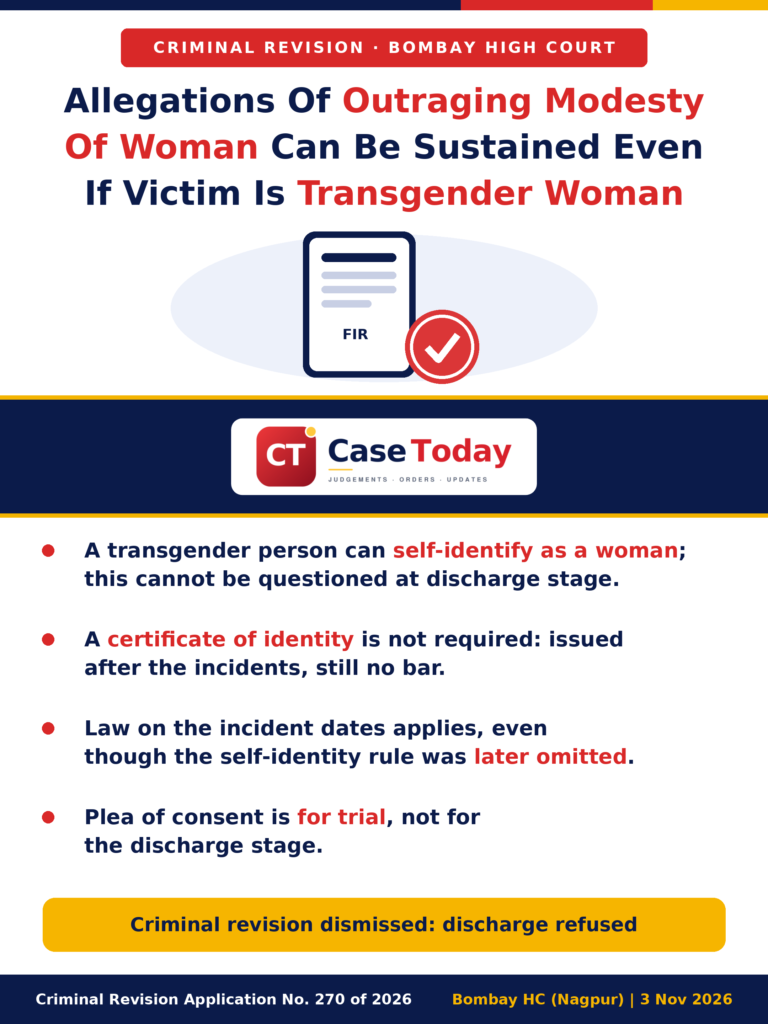
Allegations Of Outraging Modesty Of Woman Can Be Sustained Even If Victim Is
Transgender Woman : Bombay High Court
Case: Criminal Revision Application No. 270 of 2026 – Judgment
Court: High Court of Judicature at Bombay, Nagpur Bench
Citation: 2026:BHC-NAG:15063
Coram: Justice Mehroz K. Pathan
Date of Judgment: 3 November 2026 (reserved on 27 October 2026)
HEADNOTE
Keywords: Outraging Modesty – Sexual Harassment – Transgender Person – Self-Identification of Gender – Certificate of Identity – Discharge – Transgender Persons (Protection of Rights) Act, 2019 – Amendment Act, 2026 – NALSA v. Union of India
- Self-identification of gender: Relying on National Legal Services Authority v. Union of India, (2014) 5 SCC 483, it is for the transgender person to self-identify her gender, and this self-determination cannot be questioned at least at the stage when the accused seeks discharge.
- Certificate of identity not a precondition: Under Section 2(k) of the Transgender Persons (Protection of Rights) Act, 2019, a person may identify as a transgender man or woman even without a certificate of identity. A certificate issued after the incidents does not preclude invoking the penal provisions of the Act.
- Law as it stood on the date of the incidents: Section 4(2) of the 2019 Act (right to self-perceived gender identity), omitted by the Amendment Act, 2026 (assent 30.03.2026), was in force on the incident dates and on registration of the FIR. The acts attributed to the accused are judged by the law as it stood then.
- Outraging modesty of a woman: The allegations of outraging the modesty of a woman can be sustained even where the victim is a transgender person who identifies herself as a woman.
- Consent is for trial: The plea that the relationship was consensual, even if the allegations are taken as true, is a matter to be evaluated during trial; discharge was rightly refused.
BRIEF FACTS
The complainant, a transgender person who identifies as a woman and is stated to have taken hormonal treatment, lodged a report on 01.11.2025 alleging that the accused proposed marriage and, under that pretext, committed forcible sexual intercourse on 28.10.2025 and again on 30.10.2025, abusing her in filthy language. A case was registered under Sections 75, 296 and 351(2) of the Bharatiya Nyaya Sanhita, 2023, read with Section 18(D) of the Transgender Persons (Protection of Rights) Act, 2019.
The Additional Sessions Judge rejected the accused’s discharge application under Section 250 BNSS by order dated 06.07.2026. In revision, the accused argued that Section 75 BNS requires the victim to be a woman, that the complainant obtained the transgender certificate on 12.02.2026, after the incidents, that the relationship was consensual and on a promise of marriage, and that the BNS has no provision corresponding to Section 377 IPC (Navtej Singh Johar). The State said the offences are prima facie made out and that a transgender person can self-identify.
KEY FINDINGS OF THE COURT
Note: The findings highlighted in yellow are the main findings of the Court most relied upon for the judgment.
- Late certificate is no bar. Section 5 of the 2019 Act only provides an enabling mechanism to obtain a certificate. The certificate was issued on 12.02.2026, after the incidents, but its absence at the time of the offence does not preclude the penal provisions, and Section 18(D) was rightly invoked (paras 10, 12).
- Self-determination holds at the discharge stage. The FIR shows the complainant identified herself as a woman. Following NALSA and the pre-amendment Section 4 of the 2019 Act, that self-determination cannot be questioned at the stage of discharge (paras 11, 13–15).
- Amendment Act, 2026 does not help the accused. Section 4(2) was in existence on the incident dates and the FIR date, so the acts constituted an offence under the law as it stood then. Whether the prosecution can prove the offence is for trial (para 12).
- Prima facie case under Section 75 BNS and Section 18(D). The FIR discloses direct allegations of outraging modesty, and the charge-sheet shows sufficient evidence to proceed (paras 16–17).
- Consent plea left to trial. The submission that the relationship was consensual is a matter for evaluation during trial (para 17).
- Not separately dealt with. The Court did not discuss the Navtej Singh Johar and Section 377 IPC argument (para 7), or Sections 296 and 351(2) BNS. Para 16 refers to “Section 75 of BNSS”, which appears to be a typographical error for BNS.
RESULT
Citation: 2026:BHC-NAG:15063
Appearance: Adv. Anil Thakkar for the applicant; Ms. Swati V. Kolhe, APP, for the respondent/State.
Case title: Criminal Revision Application No. 270 of 2026