

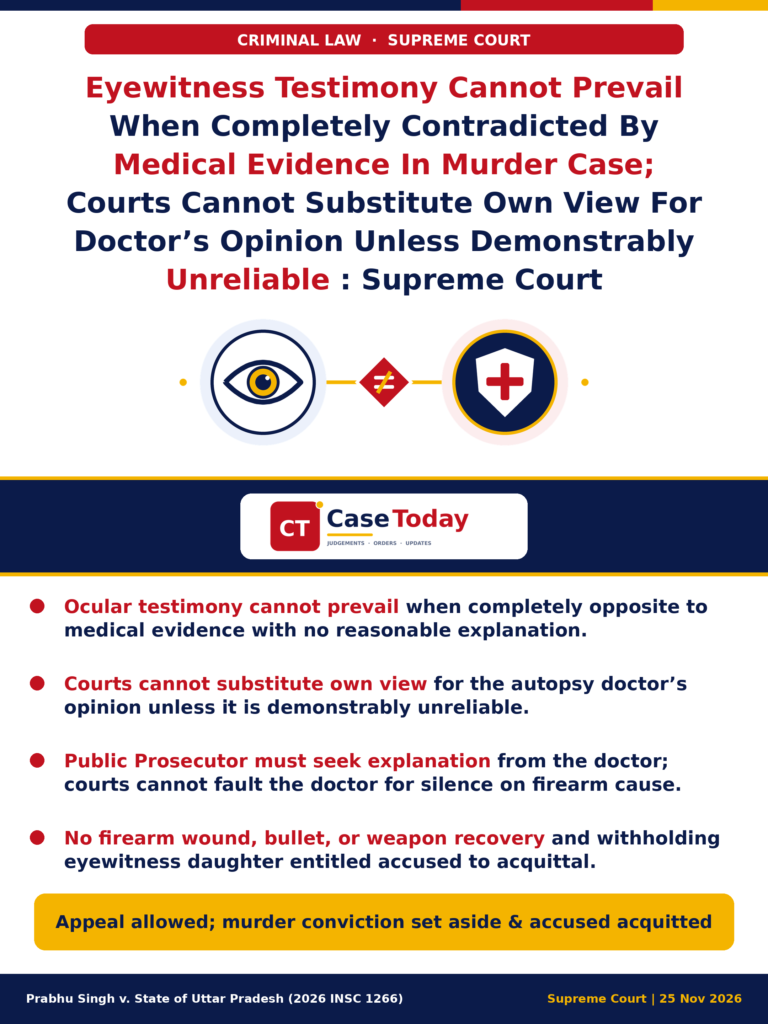
Eyewitness Testimony Cannot Prevail When Completely Contradicted By Medical Evidence In Murder Case; Courts Cannot Substitute Own View For Doctor’s Opinion Unless Demonstrably Unreliable : Supreme Court
Case: Prabhu Singh v. State of Uttar Pradesh, Criminal Appeal No. 1000 of 2015 (2026 INSC 1266)
Court: Supreme Court of India
Coram: Hon’ble Mr. Justice Prashant Kumar Mishra and Hon’ble Mr. Justice Shree Chandrashekhar
Date of Order: 25.11.2026
HEADNOTE
Keywords: Criminal Law – Murder (Section 302 r/w Section 34 IPC) – Ocular Evidence vs. Medical Evidence – Direct Contradiction Between Eyewitness Account Of Gunshot & Autopsy Finding Of Blunt Lacerated Wound With No Firearm Injury – Court Cannot Substitute Own View For Medical Expert’s Opinion – Duty Of Public Prosecutor To Seek Explanation From Doctor – Benefit Of Doubt – Acquittal
- Eyewitness Testimony Cannot Prevail When Completely Opposite To Medical Evidence; Courts Cannot Substitute Own View For Doctor’s Opinion: Medical evidence can be ignored only where an inconsistency with ocular evidence is explainable. Where eyewitness accounts (alleging fatal gunshot to forehead) are completely opposite to medical evidence (finding no firearm or entry/exit wound, only a blunt lacerated wound), the prosecution fails to prove guilt beyond reasonable doubt; a court may reject medical opinion only if demonstrably unreliable, and cannot substitute its own view for that of the medical expert (paras 7, 10).
- Duty Of Public Prosecutor To Question Post-Mortem Doctor, Not Fault Doctor For Silence: The High Court committed a serious legal error in faulting the autopsy doctor for not giving reasons why the forehead injury could not be caused by a bullet. It is a fundamental rule of criminal trial that the Public Prosecutor must cross-examine and seek explanation from the doctor and prove by expert evidence that the injuries were possible by the alleged weapon (paras 8, 10).
- Total Absence Of Firearm Corroboration & Investigative Lapses Deepen Doubt: No entry or exit wound was found on the deceased, no bullet was recovered from the body or crime spot, crime weapons were never recovered, the third assailant remained unidentified, and an eyewitness daughter (Radha) was withheld without examination alongside a casual police investigation (paras 3, 8, 10).
- Accused Entitled To Benefit Of Doubt When Prosecution Fails To Clear Contradictions: Applying Krishnegowda v. State of Karnataka, H.P. Administration v. Om Prakash, and K. Gopal Reddy v. State of A.P., where a huge gap and lingering doubt remain over the accused’s participation, the conviction under Section 302/34 IPC must be set aside (paras 7, 9–12).
BRIEF FACTS
On 15.11.1986 around 3:00 PM, Gajram Singh was walking to his agricultural field with his wife Smt. Makhmala (PW1) and daughters Veena (PW2) and Radha when co-accused Diwan Singh allegedly shot him in the forehead with a country-made pistol, and appellant Prabhu Singh along with an unidentified assailant emerged from a sugarcane field to inflict multiple stab injuries. An FIR (Crime No. 101 of 1986) was registered at 5:15 PM the same day. While PW5 Chandra Devi turned hostile and Radha was not examined, PW1 and PW2 consistently deposed that Diwan Singh fired a pistol shot into Gajram Singh’s head/forehead killing him on the spot.
However, PW3 Dr. J.K. Jain, who conducted the autopsy on 17.11.1986, recorded eight incised wounds (caused by a sharp weapon) and one muscle-deep lacerated wound (6 cm x 2.5 cm) on the left forehead (caused by a blunt weapon), with no firearm injury, entry wound, or exit wound. Despite this contradiction, the Trial Court (judgment dated 10.04.1991 in S.T. No. 265 of 1987) discarded the doctor’s opinion, opined that the forehead laceration could have been caused by a gunshot, and convicted the accused under Section 302 read with Section 34 IPC. Following Diwan Singh’s death during appeal, the Allahabad High Court confirmed Prabhu Singh’s conviction on 20.04.2015 (Criminal Appeal No. 730 of 1991), leading to this appeal.
KEY FINDINGS OF THE COURT
Note: The findings highlighted in yellow are the main findings most relied upon by the Court.
- Ocular testimony cannot mechanically override medical evidence when both are completely irreconcilable. Relying on Krishnegowda & Ors. v. State of Karnataka, the Court clarified that medical evidence may be bypassed only when an inconsistency with ocular testimony admits of a reasonable explanation. Where eyewitnesses insist on a forehead gunshot while the autopsy reveals zero firearm injury and only a blunt muscle-deep laceration, the prosecution fails to establish the charge beyond reasonable doubt (paras 7, 10).
- Courts cannot substitute their own opinion for the medical expert’s; duty lies on the Public Prosecutor to seek explanation. A court may refuse to act on medical opinion only if it is demonstrably unreliable, and cannot substitute its own view for that of the doctor. The High Court erred in faulting the autopsy doctor for not explaining why Injury No. 1 was not caused by a bullet, overlooking the fundamental rule that the Public Prosecutor must question the doctor and establish weapon-injury compatibility (paras 8, 10).
- Complete absence of ballistic corroboration and serious investigative lapses. Neither was any bullet extracted from the forehead or recovered from the crime scene, nor were any entry/exit wounds found. Further, the crime weapons were never recovered, the third assailant remained unidentified, eyewitness daughter Radha was withheld, and the investigation was casual (paras 8, 10).
- Lingering contradictions entitle the accused to benefit of doubt. Citing Himachal Pradesh Administration v. Shri Om Prakash and K. Gopal Reddy v. State of Andhra Pradesh, the Court held that the prosecution failed to clear the suspicious cloud over the truth, leaving a lingering doubt regarding the appellant’s participation (paras 9–11).
RESULT
Case Title: Prabhu Singh v. State of Uttar Pradesh
Reference: Criminal Appeal No. 1000 of 2015 | 2026 INSC 1266
Appearance: Not specified in the order copy.