

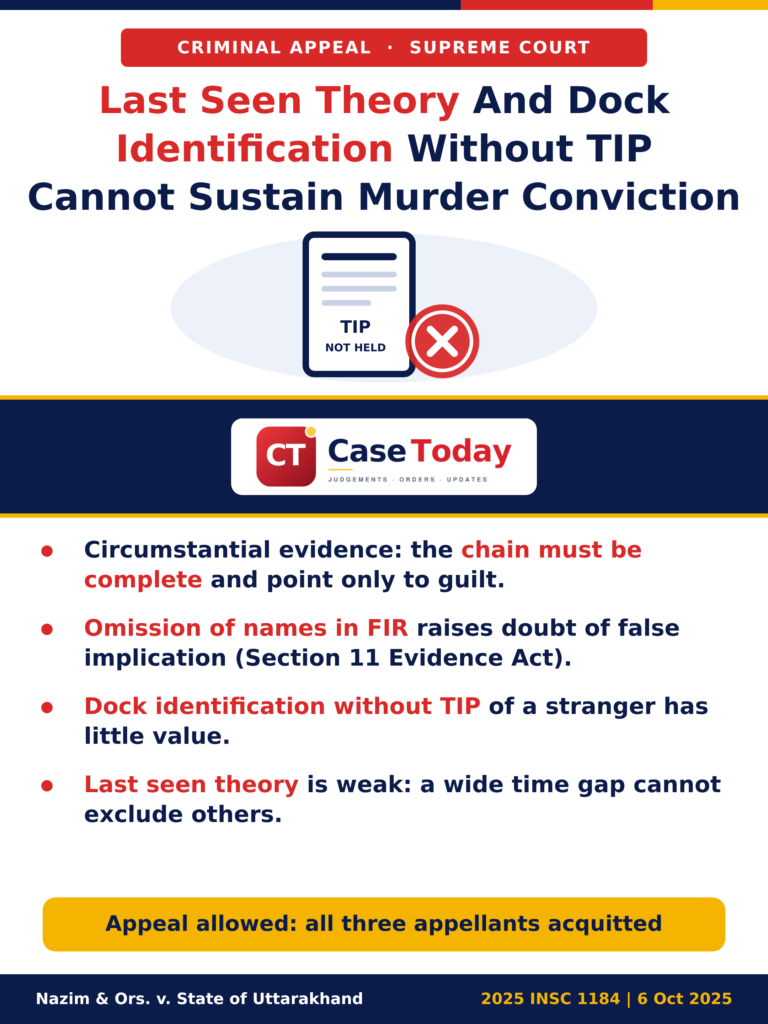
Last Seen Theory And Dock Identification Without TIP
Cannot Sustain Murder Conviction : Supreme Court
Case: Nazim & Ors. v. State of Uttarakhand (Criminal Appeal No. 715 of 2018) – Judgment
Court: Supreme Court of India
Citation: 2025 INSC 1184
Coram: Justice M. M. Sundresh and Justice Satish Chandra Sharma (Judgment by Justice Satish Chandra Sharma)
Date of Judgment: 6 October 2025
HEADNOTE
Keywords: Indian Penal Code, 1860 – Sections 302, 201 and 120-B – Circumstantial Evidence – Five Golden Principles – Omission of Names in FIR – Section 11 Evidence Act – Last Seen Theory – Dock Identification – Test Identification Parade (TIP) – Inconclusive DNA Report – Benefit of Doubt – Sharad Birdhichand Sarda – P. Sasikumar
- Chain of circumstances must be complete: In a case of circumstantial evidence, the circumstances must be fully established and form a chain so complete that it is consistent only with guilt and excludes every other hypothesis (Sharad Birdhichand Sarda). If two views are possible, the view favourable to the accused must be adopted.
- Omission of names in FIR: Where the complainant knew the accused but did not name them in the FIR, and gave no explanation, it is relevant under Section 11 of the Evidence Act (Ram Kumar Pandey). It raises a legitimate inference of false implication and strikes at the root of the prosecution case.
- Belated disclosure by a witness: A witness who claims to have overheard a conspiracy but stayed silent before the complainant and the police, and omitted it even from the FIR he scribed, is unreliable. Such a disclosure made first in Court is an afterthought.
- Dock identification without TIP: Where the witness did not know the accused and no Test Identification Parade (TIP) was held, dock identification has little value and Courts must be very cautious (P. Sasikumar).
- Last seen theory is weak evidence: It applies only where the time gap is so small that no other person could have committed the crime. It needs corroboration and cannot be applied indirectly (State of U.P. v. Satish; Hatti Singh; Chattar Singh; Krishan Kumar).
- Neutral scientific evidence and doubtful recovery: An inconclusive DNA report cannot be brushed aside as inconsequential, and a recovery without independent witnesses is doubtful. Suspicion, however strong, cannot take the place of proof, so the benefit of doubt goes to the accused.
BRIEF FACTS
On 5 June 2007, a ten-year-old boy, Muntiyaz Ali, went to guard his family’s mango orchard near Kishanpur and did not return. His father, Nanhe Khan (PW-1), found his body the next morning with a rope around his neck, his hands tied and a bloody axe nearby. FIR No. 966 of 2007 was registered at Police Station Jaspur under Section 302 IPC. The complainant named six co-villagers with whom he had enmity. Nazim and Aftab were not named.
After investigation, a chargesheet was filed under Sections 302, 201, 377 and 120-B IPC. On 05.04.2014, the Additional Sessions Judge, Kashipur acquitted five accused and convicted Nazim, Aftab and Arman Ali under Sections 302, 201 and 120-B IPC, with life imprisonment. The conviction rested on PW-2 (who said he overheard a plan for revenge on 04.06.2007), PW-3 (last seen) and PW-4. The Uttarakhand High Court dismissed their appeal on 15.11.2017, and they appealed to the Supreme Court.
KEY FINDINGS OF THE COURT
Note: The findings highlighted in yellow are the main findings of the Court most relied upon for the judgment.
- Names of Nazim and Aftab were missing in the FIR. PW-1 and PW-2 knew them but did not name them, and gave no explanation. The High Court brushed this aside, which the Supreme Court called untenable. In a case based only on circumstantial evidence, this omission weighs heavily in favour of the accused (paras 28–30).
- PW-2 was unreliable and his story an afterthought. He said he overheard a plan at a marriage feast, but told no one, not even when he scribed the FIR at PW-1’s dictation or signed the seizure memos. The claim that a murder plan was openly discussed is improbable, and defence witnesses said the feast was on 03.06.2007 (paras 31–33).
- Dock identification without TIP, and a weak last seen theory. PW-3 and PW-4 identified the accused first in Court, and no TIP was held. PW-3’s line of sight was obstructed and his wife and son were not examined. PW-4’s sighting was not in the FIR. The sightings were in the morning and evening of 05.06.2007 and the body was found the next morning, a gap too wide to exclude others (paras 34–48).
- Medical and forensic evidence did not link the accused. The doctor (PW-8) proved homicidal death, but not the weapon or the accused. The DNA report was neutral and the High Court wrongly dismissed it. The rope was recovered with no independent witnesses (paras 49–53).
- Motive was speculative and juvenility not decided. No concrete evidence of motive was led. The Court did not decide the plea that Nazim and Aftab were juveniles, but noted its summary rejection by the Juvenile Justice Board (paras 54–56).
RESULT
Case Title: Nazim & Ors. v. State of Uttarakhand
Citation: 2025 INSC 1184
Appearance: Counsel are not named in the judgment.