

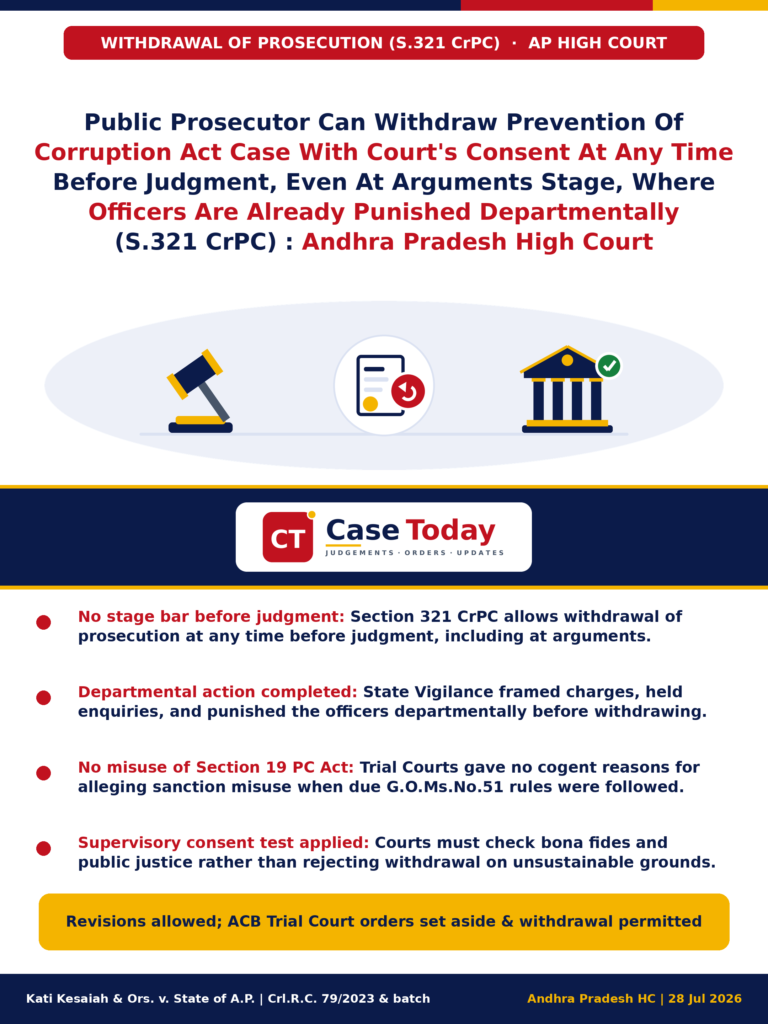
Prosecution Can Withdraw Prevention Of Corruption Act Case With Court’s Consent At Any Time Before Judgment, Even At Arguments Stage, Where Officers Are Already Punished Departmentally (S.321 CrPC) : Andhra Pradesh High Court
Case: Kati Kesaiah & Ors. v. The State of Andhra Pradesh (with connected matters: Chirumamilla Venkateswara Rao, K. Ramesh, and Vejendla Purna Sudhakara Rao), Criminal Revision Case Nos. 79, 75, 208 and 263 of 2023 (arising out of orders dated 18.01.2023, 03.01.2023, and 19.01.2023 passed by Special Judges for Trial of SPE & ACB Cases, Rajamahendravaram and Vijayawada)
Court: High Court of Andhra Pradesh at Amaravati
Coram: Hon’ble Dr. Justice Y. Lakshmana Rao
Date of Order: 28.07.2026
HEADNOTE
Keywords: Code of Criminal Procedure, 1973 – Section 321 (Withdrawal from prosecution) – Sections 397 & 401 (Revision) – Prevention of Corruption Act, 1988 – Section 19 (Sanction for prosecution) – ACB cases – Filing at stage of arguments – Departmental enquiry and punishment imposed – G.O.Ms.No.51 procedure
- No Stage Bar Under Section 321 CrPC Before Pronouncement Of Judgment: Section 321 CrPC expressly enables the Public Prosecutor, with the consent of the Court, to withdraw from prosecution at any time before judgment is pronounced. Rejecting a withdrawal application solely because it was filed at the stage of arguments is legally unsustainable (paras 5, 35).
- Consent Justified Where Sanctioning Authority Followed Due Procedure & Imposed Departmental Punishment: Where the State Government (competent sanctioning authority under Section 19 of the Prevention of Corruption Act) decided to proceed departmentally, framed charges, conducted enquiries, imposed punishments, and recommended withdrawal after following G.O.Ms.No.51 without any objection from complainants, refusing consent without cogent reasons on an unsubstantiated assumption of misuse of Section 19 PC Act is improper (paras 35–36).
- Scope Of Supervisory Judicial Consent Under Section 321 CrPC: Surveying Supreme Court precedents including State of Kerala v. K. Ajith, Bairam Muralidhar, and Sheonandan Paswan, the Court reiterated that the Court’s role is supervisory to ensure bona fides and furtherance of public justice, not to conduct a substantive reappraisal of evidentiary merits (paras 7–34).
BRIEF FACTS
The four petitioners (public servants working as Assistant Engineer, Assistant Divisional Engineer, MPDO, and Retd. Assistant Director of Agriculture) faced separate ACB prosecutions in C.C. Nos. 27/2018, 11/2015, 18/2018, and 23/2013 before the Special Judges for Trial of SPE & ACB Cases at Rajamahendravaram and Vijayawada. Pursuant to Government of Andhra Pradesh, Energy (Vigilance) Department Memos dated 25.01.2022 and 22.02.2022, the State decided to proceed against the officers departmentally instead of prosecuting them criminally; draft articles of charge were framed, departmental enquiries were conducted, and final punishment orders were passed (paras 1–2, 36).
Thereafter, applications under Section 321 CrPC seeking consent to withdraw from prosecution were filed following G.O.Ms.No.51. However, by orders dated 03.01.2023, 18.01.2023, and 19.01.2023, the Special Courts dismissed the applications primarily because they were filed at the stage of arguments and on the ground that permitting withdrawal would amount to misuse of Section 19 of the Prevention of Corruption Act, 1988. Aggrieved, the petitioners preferred these Criminal Revision Cases under Sections 397 and 401 CrPC (paras 2–3, 5).
KEY FINDINGS OF THE COURT
Note: The findings highlighted in yellow are the main findings most relied upon by the Court.
- Section 321 CrPC prescribes no stage limitation before judgment is pronounced. A plain reading of Section 321 CrPC permits withdrawal at any time before pronouncement of judgment; therefore, dismissing the applications merely because they were moved at the stage of arguments was legally unsustainable (paras 5, 35).
- Departmental enquiries completed, punishments imposed, and due procedure followed under G.O.Ms.No.51. The Special Public Prosecutor for ACB fairly conceded compliance with G.O.Ms.No.51 and applicable Rules. As the State Government—being the competent sanctioning authority under Section 19 PC Act—had already conducted departmental enquiries and imposed punishments, and the Trial Courts gave no cogent reasons showing misuse of Section 19 PC Act or procedural breach, refusal of consent was unjustified (paras 4, 35–36).
- Settled Supreme Court jurisprudence on Section 321 CrPC reaffirmed. Reviewing fourteen Supreme Court decisions (including K. Ajith, Bairam Muralidhar, Abdul Karim, Subhash Chander, and Sheonandan Paswan), the Court underscored that while the Public Prosecutor must act independently in furtherance of public justice, judicial consent is supervisory and cannot be withheld on unsustainable grounds (paras 7–34, 37).
RESULT
Case Title: Kati Kesaiah & Ors. v. The State of Andhra Pradesh
Reference: Crl.R.C. Nos. 79, 75, 208 and 263 of 2023 | High Court of Andhra Pradesh at Amaravati
Appearance: For Petitioners: Sri Posani Venkateswarlu, Senior Counsel, appearing for Sri T.V.S. Prabhakara Rao and Sri Posani Akash. For Respondents: Sri S. Syam Sunder Rao, Special Public Prosecutor for ACB.