

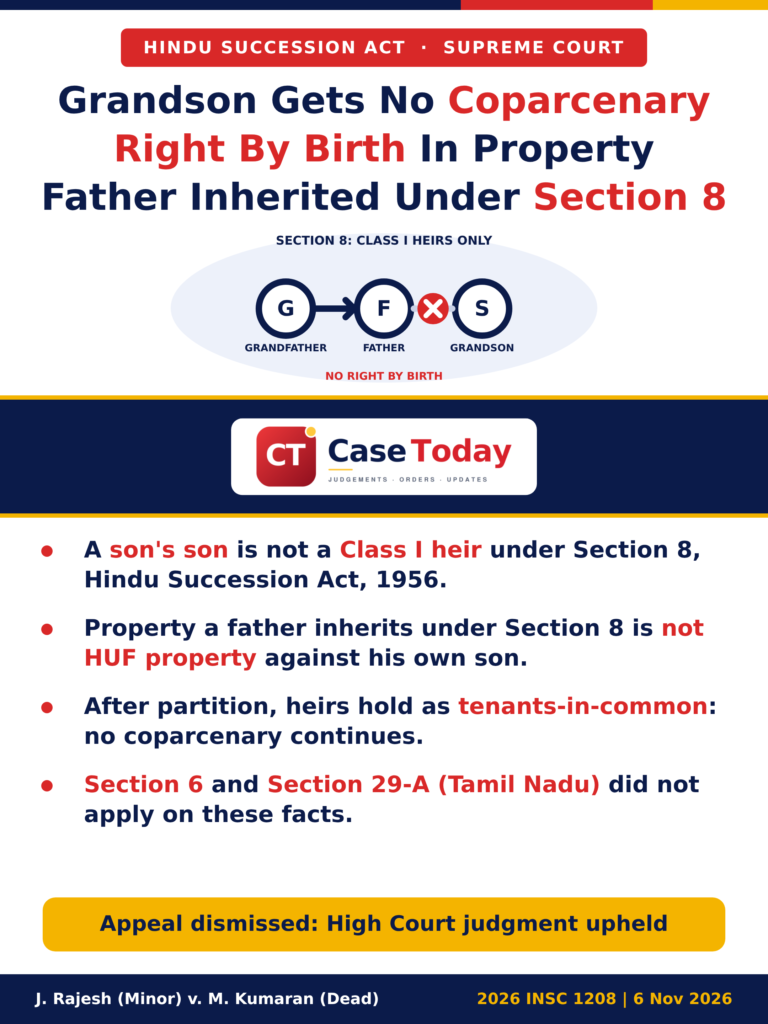
Grandson Gets No Coparcenary Right By Birth
In Property Father Inherited Under Section 8 : Supreme Court
Case: J. Rajesh (Minor) through his mother and natural guardian J. Gomathi v. M. Kumaran (Dead) through LRs. & Ors. (Civil Appeal No. 7020 of 2012) – Judgment
Court: Supreme Court of India
Citation: 2026 INSC 1208
Coram: Justice Augustine George Masih and Justice Sunita Agarwal (Judgment by Justice Sunita Agarwal)
Date of Judgment: 6 November 2026
HEADNOTE
Keywords: Hindu Succession Act, 1956 – Sections 4, 6, 8 and 19 – Class I Heirs – Son’s Son (Grandson) – Coparcenary by Birth – Joint Family Property – Partition – Tenants-in-common – Section 29-A Tamil Nadu Amendment Act, 1989 – CWT v. Chander Sen – Radha Bai v. Ram Narayan – Bhanwar Singh v. Puran
- Grandson is not a Class I heir: A son’s son is not mentioned as an heir in Class I of the Schedule to Section 8 of the Hindu Succession Act, 1956. He therefore cannot get any right in his grandfather’s property under that provision.
- Property inherited under Section 8 is not HUF property against the heir’s own son: When a father inherits property under Section 8, he does not hold it as karta of his own undivided family. It does not constitute HUF property as against his son (CWT v. Chander Sen). The express words of Section 8 must prevail.
- Old Hindu law right of birth was not saved: The right of a son’s son in his grandfather’s property during his father’s lifetime, which existed under personal Hindu law before 1956, was not expressly saved by the 1956 Act. Section 8 is a self-contained provision.
- Partition ends coparcenary: After partition among Class I heirs, each heir becomes the exclusive owner of his share. They hold as tenants-in-common and not as joint tenants, and joint coparcenary does not continue. The father could deal with his share on his own.
- Section 6 and Section 29-A Tamil Nadu Amendment not attracted: The grandfather’s date of death was not disclosed and the partition suit was filed in 1993. The appellant was not a surviving coparcener on the grandfather’s death, so Section 6 and Section 29-A (equal coparcenary rights of daughters) did not apply.
- Suit against the father’s alienation fails: The compromise decree and the sale deeds were never challenged, and the suit for partition was filed during the father’s lifetime on the premise of a right by birth. There was no question of devolution upon the appellant.
BRIEF FACTS
J. Rajesh, a minor born on 06.01.1994, sued through his mother in O.S. No. 1698 of 1997 (City Civil Court, Chennai) for partition and possession of half share in 1811 sq. ft. of land. He claimed it was joint family property of his grandfather, N. Ramakrishnan, inherited by his father (first defendant), and that he became a coparcener by birth. His father was alive, and remained ex parteuntil his death in 2024.
The first defendant’s sister, G. Lalitha, had filed C.S. No. 1728 of 1993 for partition of N. Ramakrishnan’s property. It was decreed on a compromise dated 03.02.1994, under which the first defendant got the 1811 sq. ft. land. He then sold it to defendant Nos. 2 and 3 by sale deeds dated 03.04.1997 and 17.04.1997. The compromise decree and the sale deeds were not challenged. The Trial Court passed a preliminary decree of partition, the First Appellate Court set it aside, and the High Court upheld that view on 11.08.2010. The appellant came to the Supreme Court.
KEY FINDINGS OF THE COURT
Note: The findings highlighted in yellow are the main findings of the Court most relied upon for the judgment.
- A grandson cannot claim a right by birth in property inherited by his father under Section 8. A son’s son is excluded from Class I heirs. Following CWT v. Chander Sen, the Court held that the property devolved on the Class I heirs of N. Ramakrishnan and did not constitute HUF property of the father’s branch including his son. It would otherwise create two classes among Class I heirs (paras 23, 34–35, 38).
- Partition ended the joint family character of the property. Under the compromise decree, each heir became exclusive owner of the share allotted to him or her, holding as tenants-in-common. Succession opened on N. Ramakrishnan’s death, before the appellant was born, so there was no devolution of interest upon the appellant. The father’s share became his exclusive individual property (paras 35–36, 41).
- Section 6 and Section 29-A (Tamil Nadu) did not apply. The appellant was not a “surviving coparcener” on the death of the grandfather, and the partition suit of 1993 was by Class I heirs. The Tamil Nadu amendment on equal coparcenary rights of daughters did not help the appellant (para 39).
- Settled line of authority followed. The Court followed Chander Sen, Bhanwar Singh v. Puran and Radha Bai v. Ram Narayan, which hold that a divided son gets absolute rights with full power of alienation, and the grandson is excluded (paras 23–33).
- Conduct of the suit. The appellant did not challenge the partition decree or the sale deeds, and sued in 1997, during his father’s lifetime, on the premise of coparcenary rights by birth (paras 37, 40).
RESULT
Case Title: J. Rajesh (Minor) v. M. Kumaran (Dead) through LRs. & Ors.
Citation: 2026 INSC 1208
Appearance: Mr. K. Paari Vendhan, learned counsel, for the appellant; Mr. K.K. Mani, learned counsel, for the respondents. Other counsel are not named in the judgment
J.RAJESH(MINOR) THR. HIS MOTHER AND NATURAL GUARDIAN J. GOMATHI