

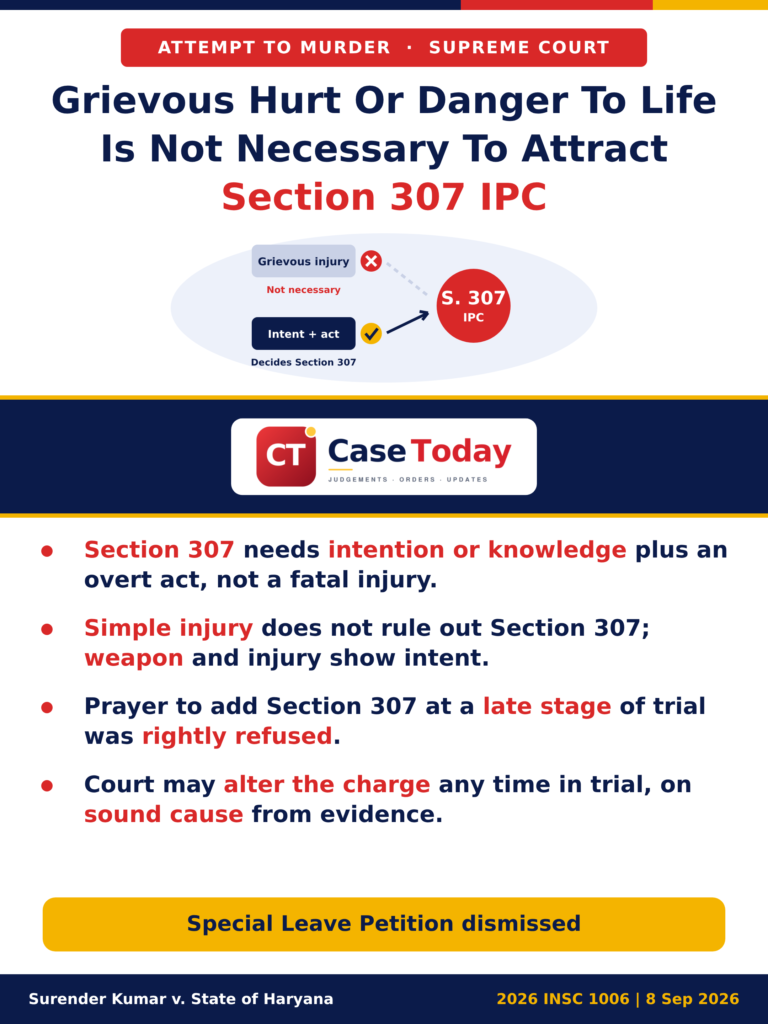
Grievous Hurt Or Danger To Life Is Not Necessary
To Attract Section 307 IPC : Supreme Court
Case: Surender Kumar v. State of Haryana & Ors. (Special Leave Petition (Crl.) No. 14611 of 2026) – Order
Court: Supreme Court of India
Citation: 2026 INSC 1006
Coram: Justice J. B. Pardiwala and Justice K. Vinod Chandran
Date of Order: 8 September 2026
HEADNOTE
Keywords: Indian Penal Code, 1860 – Section 307 – Attempt to Murder – Intention or Knowledge – Overt Act – Grievous Hurt – Simple Hurt – Medical Board – Alteration of Charge – Late Stage of Trial – Sections 147, 148, 149, 323, 325 and 506 IPC – State of Madhya Pradesh v. Kashiram – Chimanbhai Jagabhai Patel v. State of Gujarat
- Grievous hurt or danger to life is not a necessary ingredient of Section 307 IPC: The Court held that the grievousness of the injuries, or the possibility that the injury could have led to death, is not a necessary ingredient to attract Section 307 IPC. What matters is the intention or knowledge with which the act was done.
- One test of culpability, two limbs of punishment: Section 307 has one test of culpability: an act done with such intention or knowledge that, if death were caused, the offender would be guilty of murder. The first limb of punishment is imprisonment up to ten years and fine. The second limb applies if hurtis caused: imprisonment for life or the first-limb punishment. Hurt, grievous or simple, is not a precondition to attract Section 307.
- Intent coupled with an overt act is enough: Following State of Madhya Pradesh v. Kashiram, it is sufficient if there is intent coupled with some overt act. Under Chimanbhai Jagabhai Patel v. State of Gujarat, the ingredients are the overt act, the intention or knowledge to cause death or an injury likely to cause death, and no excuse for running that risk.
- A simple or minor injury does not rule out Section 307: Intention or knowledge is a question of fact discerned from the circumstances. The nature and gravity of the injury and the nature of the weapon can lead to an inference of intent and knowledge (Saleem, Kanha, Jage Ram). The nature of hurt is relevant but cannot, on that sole basis, result in a finding of attempt to murder.
- Late application to add Section 307 was rightly refused: The trial had substantially proceeded. Both medical certificates were available when the chargesheet was filed. No complaint about the absence of Section 307 was made at the stage of cognizance, and no case of intention or knowledge was raised at the initial stage or while evidence was led. Rejection of the application was justified.
- Court may alter the charge at any time during trial: The Special Leave Petition was dismissed, but the Court made clear that it is the Court’s prerogative to alter the charge at any time while the trial continues, provided there is sound and justifiable cause emanating from the evidence led before the Court.
BRIEF FACTS
A dispute over waterlogging caused by draining of rainwater led to an assault by armed accused on the petitioner, his brother and his uncle. An FIR was lodged under Sections 147, 148, 149, 323, 325 and 506 IPC at Police Station Nissing, Karnal, six accused were arrayed, charges were framed and the trial began. A neurosurgeon from a private hospital (PW5) deposed that the petitioner’s brother had a fracture on the right parietal bone with underlying haemorrhagic contusion, which in his opinion could have been dangerous to life. The Medical Officer of the Primary Health Centre, Sagga (PW6) left the gravity of the injury to the treating surgeon. At the investigation stage, on the accused’s request, a Medical Board examined the injured and found the injuries grievous but not dangerous to life.
After the prosecution witnesses were examined, the petitioner applied for alteration of the charge to Section 307 IPC. The Judicial Magistrate First Class, Karnal dismissed it, holding that the Medical Board’s report prevails. The Sessions Court upheld this in revision, noting that the FIR was first registered under Section 307 but the section was deleted after the Medical Board’s opinion, that the first informant did not allege an intention to kill, and that two accused were also injured. The High Court agreed, reasoning that the private neurosurgeon’s opinion was superseded by the Medical Board of the Government Medical College, Karnal. The petitioner approached the Supreme Court.
KEY FINDINGS OF THE COURT
Note: The findings highlighted in yellow are the main findings of the Court most relied upon for the judgment.
- Grievousness of injury or possibility of death is not an ingredient of Section 307. Culpability under Section 307 lies in an act done with the intention or knowledge that it could result in death. Hurt, grievous or simple, is not a precondition; if hurt is caused, a graver punishment applies (paras 7–8).
- Intent with an overt act is sufficient; injury and weapon help infer intent. Relying on Kashiram, Chimanbhai Jagabhai Patel, Pasupuleti Siva Ramakrishna Rao, Saleem, Kanha and Jage Ram, the Court held that a bodily injury capable of causing death is not necessary and that a simple injury does not rule out intention to kill. Intent is discerned from the circumstances (paras 9–10).
- The application to add Section 307 came too late. The trial had proceeded substantially, both medical certificates were available at the chargesheet stage, and the injured did not complain at cognizance that Section 307 was missing. No intention or knowledge was raised at the initial stage or while evidence was led, so rejection was justified (para 12).
- Nature of hurt alone cannot prove attempt to murder. The nature of hurt, though relevant, cannot on that sole basis result in a finding of attempt to murder. The Sessions Court’s finding that no intention or knowledge was allegedcould be a reason for not bringing in Section 307 (para 11).
- Power to alter the charge remains during trial. The Court clarified that it may alter the charge at any time while the trial is continuing, if there is sound and justifiable cause arising from the evidence led (para 13).
RESULT
Case Title: Surender Kumar v. State of Haryana & Ors.
Citation: 2026 INSC 1006
Appearance: Counsel are not named in the order.