

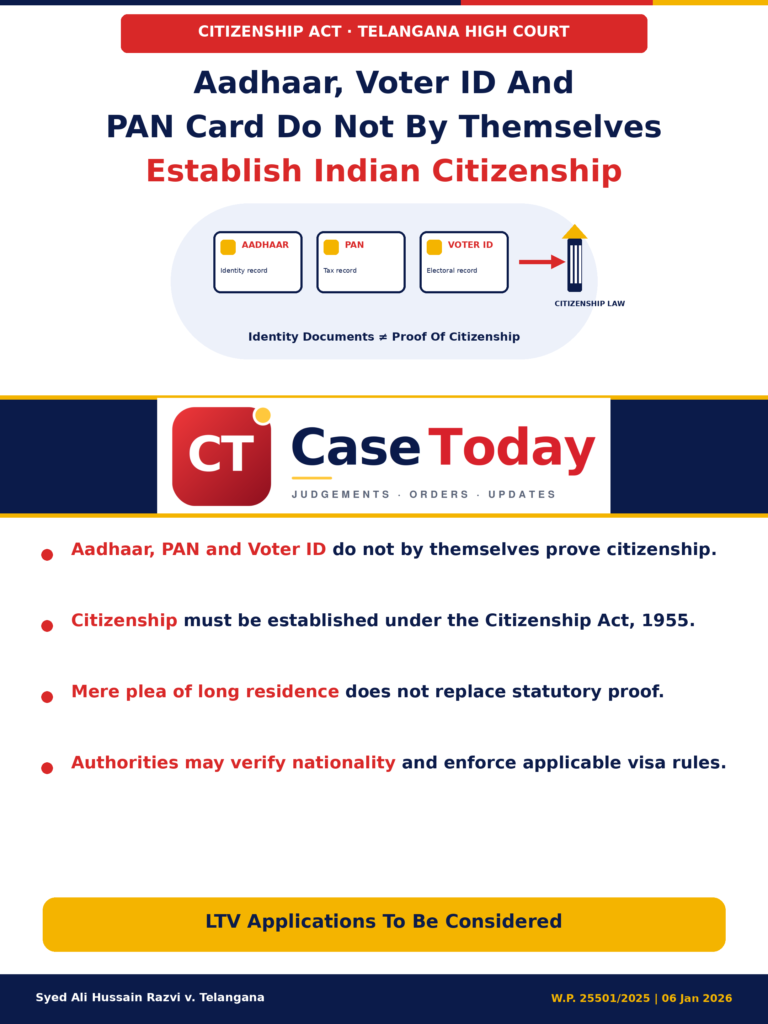
Aadhaar, Voter ID And PAN Card Do Not By Themselves
Establish Indian Citizenship : Telangana High Court
Case: Syed Ali Hussain Razvi v. The Government of Telangana and others (Writ Petition No. 25501 of 2025) – Order
Court: High Court of Judicature for the State of Telangana
Citation: Not stated in the order
Coram: Justice Nagesh Bheemapaka
Date of Order: 6 January 2026
HEADNOTE
Keywords: Citizenship Act, 1955 – Indian Citizenship – Citizenship by Birth – Aadhaar Card – Voter ID – PAN Card – Driving Licence – Educational Certificates – Foreigners Act, 1946 – Foreigners Order, 1946 – Long Term Visa (LTV) – Principles of Natural Justice – Statutory Verification
- Identity documents do not by themselves establish citizenship: Aadhaar Card, Voter ID Card, PAN Card, Driving Licence and educational certificates cannot, by themselves, confer or establish Indian citizenship. Citizenship has to be determined under the statutory framework of the Citizenship Act, 1955. The Court noted that the petitioner had not produced conclusive statutory proof such as a certificate of registration, naturalization, or a valid Indian passport (para 5).
- Citizenship claim must be tested under the statutory framework: The petitioner claimed Indian citizenship by birth, stating that he was born in Hyderabad. The respondents relied on official records which recorded him as a Pakistani national born in Karachi in 1991 and whose name appeared in his mother’s Pakistani passport. The Court treated his citizenship status as disputed and found no conclusive statutory proof before it (paras 2, 3, 5 and 7).
- Mere plea of long residence does not bar verification: The petitioner relied on his long residence in Hyderabad and the absence of earlier notice. The Court held that the absence of notice over the previous 30 years could not override the statutory obligation of authorities to act when discrepancies or violations came to light, including under the Government of India Order dated 28.04.2025 (para 7).
- Ongoing statutory verification was not held arbitrary: The Court found that the officials’ visits formed part of an ongoing statutory verification and compliance process relating to nationality and visa regulations. On the facts pleaded by the respondents, those visits could not be equated with coercive or punitive action without due process (paras 5 and 6).
- No blanket restraint against statutory authorities: Since the petitioner’s mother’s status was itself pending consideration in W.P. No. 27342 of 2013 and the petitioner’s own status was disputed, he could not obtain a blanket direction preventing authorities from performing their statutory duties under the Foreigners Act, 1946, the Foreigners Order, 1946 and the Visa Manual, 2019 (para 7).
- LTV applications directed to be considered: As the petitioner and his mother had applied afresh for Long Term Visas in July 2025 pursuant to the Government of India Order dated 28.04.2025, the respondents were directed to consider those applications and pass appropriate orders in accordance with the applicable guidelines as early as possible (paras 8 and 9).
BRIEF FACTS
The petitioner, Syed Ali Hussain Razvi, approached the Telangana High Court alleging that the Inspector of Police, Pakistan Branch, repeatedly visited his residence, compelled him to apply for a Long Term Visa (LTV), and threatened prosecution without issuing notice. He claimed that he was born in Hyderabad on 17.07.1992, had lived in Hyderabad for about 31 years, and was married to an Indian citizen. He asserted that he had never applied for a passport and that his mother, who was born in Hyderabad, had married a Pakistani citizen and later returned to India. He sought protection against alleged harassment and interference with his marital and family life (paras 1 and 2).
The respondents disputed his claim of Indian citizenship. Their records stated that the petitioner was recorded as Imran Abid @ Imran Hussain, a Pakistani national born in Karachi in 1991, whose name appeared in his mother’s Pakistani passport. They also pointed to discrepancies in his identity particulars and stated that he and his mother had applied afresh for LTVs in July 2025 pursuant to the Government of India Order dated 28.04.2025. The Court considered the rival claims and the official records placed before it (paras 3 to 5).
KEY FINDINGS OF THE COURT
Note: The findings highlighted in yellow are the main findings of the Court most relied upon for the order.
- Aadhaar and other identity documents do not establish citizenship by themselves. The petitioner did not produce conclusive statutory proof of citizenship under the Citizenship Act, 1955. Aadhaar, Voter ID, PAN, Driving Licence and educational certificates could not, by themselves, confer or establish citizenship (para 5).
- The respondents’ official records raised a genuine dispute about nationality and identity. The records relied upon by the respondents described the petitioner as a Pakistani national born in Karachi in 1991, with his name included in his mother’s Pakistani passport. The Court also noted discrepancies in the identity particulars appearing in the re-application and other records (paras 3.4, 5 and 7).
- The verification process was part of statutory compliance, not established coercive action. The Court held that the visits by officials, in the facts pleaded by the respondents, were for ensuring compliance with visa regulations and could not be equated with coercive or punitive action without due process (para 6).
- The absence of earlier notice did not prevent authorities from acting on later-discovered discrepancies. The alleged absence of notice for nearly 30 years could not override the statutory obligation to act when discrepancies or violations came to light, particularly in view of the Government of India Order dated 28.04.2025 (para 7).
- The LTV applications must nevertheless be considered. Since the petitioner and his mother had applied afresh for LTVs in July 2025, the respondents were directed to consider the applications and pass appropriate orders in accordance with the applicable guidelines as early as possible (para 8).
RESULT
Case Title: Syed Ali Hussain Razvi v. The Government of Telangana and others
Citation: Not stated in the order
Appearance: Smt. G. Uma Rani appeared for the petitioner. The order refers to the learned Government Pleader for Home for the respondents; the Government Pleader’s name is not stated.
Syed Ali Hussain Razvi v. The Government of Telangana and others