

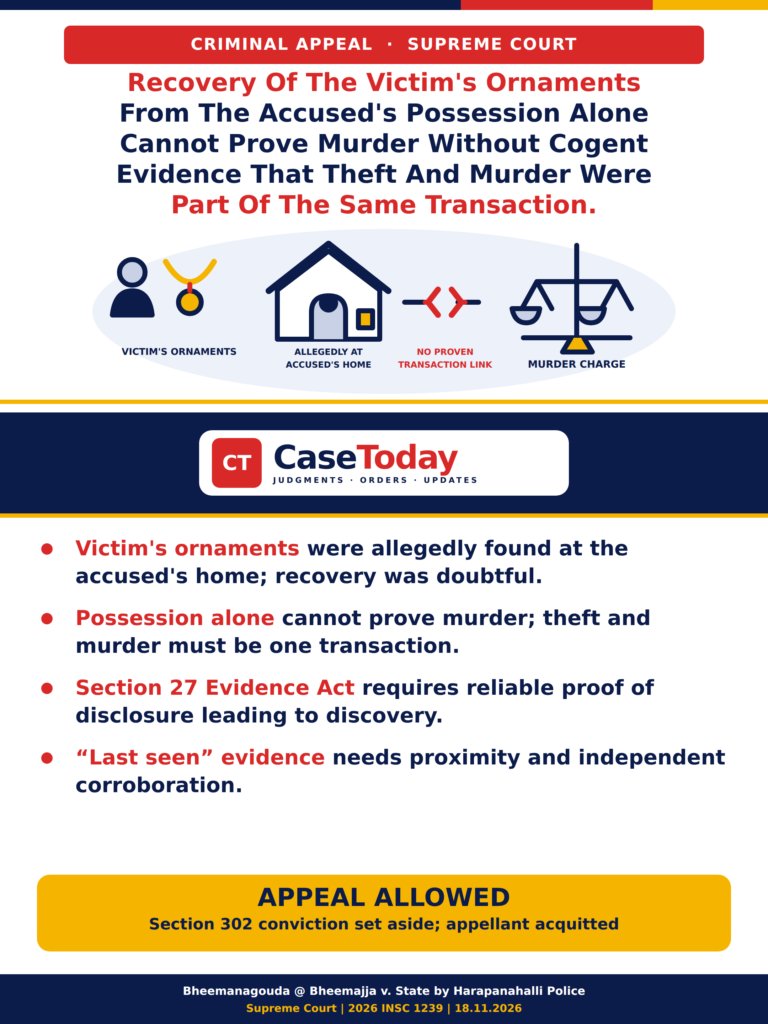
Recovery Of The Victim’s Ornaments From The Accused’s Possession Alone
Cannot Prove Murder Without Cogent Evidence That Theft And Murder Were Part Of The Same Transaction : Supreme Court
Case: Bheemanagouda @ Bheemajja v. State by Harapanahalli Police, Criminal Appeal No. 5402 of 2026 (arising out of SLP (Crl.) No. 13798 of 2025) – Judgment
Court: Supreme Court of India (Criminal Appellate Jurisdiction)
Citation: 2026 INSC 1239
Coram: Justice Prashant Kumar Mishra and Justice Vipul M. Pancholi (Judgment by Justice Vipul M. Pancholi)
Date of Judgment: 18.11.2026
HEADNOTE
Keywords: Sections 27 and 114, Illustration (a), Indian Evidence Act, 1872 – Sections 302 and 201, Indian Penal Code, 1860 – Circumstantial Evidence – Recovery of Ornaments – Same Transaction – Last Seen Together – Motive – Benefit of Doubt – Sanwat Khan v. State of Rajasthan – Raj Kumar @ Raju v. State (NCT of Delhi)
- Recovery From The Accused Alone Does Not Prove Murder: The prosecution alleged that the victim’s gold and silver ornaments were recovered from the accused’s house, from a trunk, following his disclosure. The Supreme Court found the alleged recovery doubtful and noted that the prosecution had not proved that these were the ornaments she wore when last seen alive. In law, unexplained possession may support a presumption under Section 114, Illustration (a), of the Evidence Act concerning theft or receipt of stolen property; it cannot prove murder without cogent evidence that theft and murder formed part of the same transaction (paras 13.1–13.5).
- Section 27 Discovery Must Be Proved: The prosecution must provide cogent evidence of a disclosure by the accused leading to discovery. In the absence of supporting independent evidence, and given the infirmities in the seizure evidence, the essential requirements of Section 27 of the Evidence Act were not satisfied (para 13.1).
- “Last Seen” Is Not Enough By Itself: The circumstance requires proximity and independent corroborative material. Here, the witnesses’ statements under Section 161 Cr.P.C. were recorded after an unexplained delay of 58 days; the “last seen” circumstance was not conclusively established (paras 11–11.2).
- Motive Cannot Rest On Conjecture: General knowledge of an alleged relationship did not prove the suggested motive. No witness said the appellant suspected the deceased of intimacy with another man or that they quarrelled over it (para 10.2).
- Discovery Of Body Raised Doubt: The informant who allegedly reported the body was not traced or examined, and the inquest and post-mortem records showed no limestone trace on the deceased or her clothing. This circumstance cast doubt on the prosecution version (paras 12–12.2).
- Incomplete Circumstantial Chain Entitles Benefit Of Doubt: The circumstances did not form a complete and unbroken chain pointing conclusively to guilt beyond reasonable doubt. The appellant was entitled to benefit of doubt (para 15).
BRIEF FACTS
On 05.09.2013, a woman’s body was found inside an iron drum near a lime furnace at Harapanahalli and later identified as Sharadamma. The prosecution alleged that the appellant strangled her, took the gold and silver ornaments she was wearing, and placed her body in the drum. After his arrest, police claimed that, following his disclosure, they recovered a bag of gold and silver ornaments from a trunk at the appellant’s house; relatives identified them as the deceased’s. The Supreme Court later found the recovery doubtful and noted that the prosecution had not established that these were the ornaments she wore when last seen alive (paras 3.1–3.5, 13.1–13.3).
The Sessions Court convicted the appellant under Section 302 IPC, relying on the alleged recovery of ornaments, but acquitted him under Section 201 IPC. The Karnataka High Court affirmed the murder conviction, relying also on “last seen” testimony. The Supreme Court assessed the alleged motive, delayed witness statements, discovery of the body and recovery evidence in the appellant’s appeal (paras 5–6, 9–13).
KEY FINDINGS OF THE COURT
Note: The findings highlighted in yellow are the main findings most relied upon by the Court.
- The deceased woman’s ornaments were allegedly recovered from the appellant’s house, but the recovery was doubtful. The Court also found that the prosecution had not established that these were the ornaments she wore when last seen alive. In law, the presumption under Section 114, Illustration (a), concerns theft or receipt of stolen property; without cogent proof that theft and murder formed part of the same transaction, possession cannot establish murder under Section 302 IPC (paras 13.1–13.5).
- The alleged Section 27 discovery was not reliably established. No independent witness gave cogent evidence of the appellant’s disclosure leading to discovery. The seizure witnesses and record had material infirmities, so the statutory prerequisites were not met (para 13.1).
- The unexplained 58-day delay undermined the “last seen” evidence. The Trial Court had rejected the testimony; the High Court did not address the delay or explain its contrary conclusion. The circumstance was not conclusively established (paras 11.1–11.2).
- The alleged motive was conjectural. No witness testified that the appellant suspected the deceased of a relationship with another person or that they quarrelled on that account (para 10.2).
- The prosecution failed to prove a complete chain of circumstances. The circumstances did not establish guilt beyond reasonable doubt; the appellant was entitled to benefit of doubt (para 15).
RESULT
Case Title: Bheemanagouda @ Bheemajja v. State by Harapanahalli Police
Citation: 2026 INSC 1239
Appearance: For the Appellant: Mr. A. Sirajudeen, learned Senior Advocate. For the State: Mr. Avishkar Singhvi, learned Additional Advocate General.