

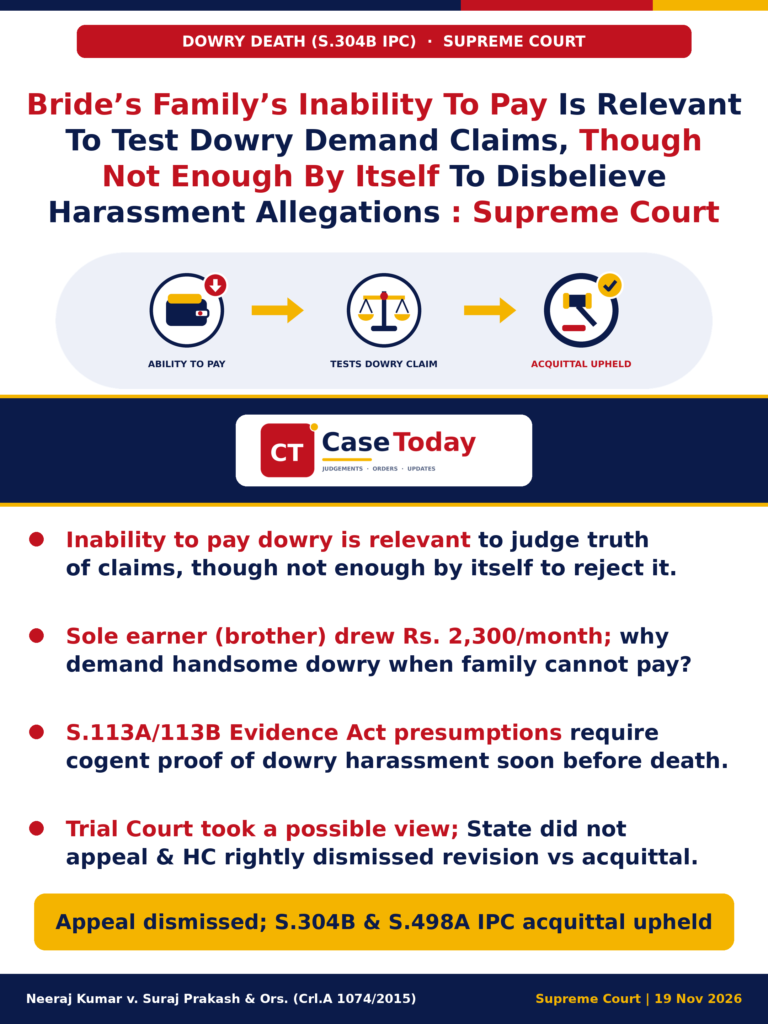
Bride’s Family’s Inability To Pay Is Relevant To Test Dowry Demand Claims, Though Not Enough By Itself To Disbelieve Harassment Allegations : Supreme Court
Case: Neeraj Kumar v. Suraj Prakash & Ors., Criminal Appeal No. 1074 of 2015
Court: Supreme Court of India
Coram: Hon’ble Mr. Justice Manoj Misra and Hon’ble Mr. Justice Vijay Bishnoi
Date of Judgment: 19.11.2026
HEADNOTE
Keywords: Dowry Death – Sections 304B & 498A IPC – Sections 113A & 113B Indian Evidence Act, 1872 – Financial Capacity Of Bride’s Family Relevant To Test Dowry Demand – Not Sufficient By Itself To Disbelieve Harassment Allegations – Presumption Requires Foundational Proof – Resolved Marital Differences – Revision Against Acquittal
- Financial Capacity Of Bride’s Family Is Relevant To Test Dowry Demand Claims, Though Not Enough By Itself To Disbelieve Harassment: While lack of capacity to pay dowry may not, by itself, be sufficient to disbelieve an accusation of dowry harassment, it is a relevant factor while assessing the correctness of the allegation—because why would a person raise a handsome dowry demand when he knows the other family has no capacity to fulfil it (para 12).
- Presumptions Under Sections 113A & 113B Evidence Act Require Foundational Proof: Death within seven years of marriage does not automatically trigger statutory presumptions under Sections 113A or 113B of the Evidence Act; cogent evidence of dowry demand and harassment soon before death must be proved. Earlier marital differences over suspicion of pre-marital pregnancy, later resolved with two more children born in wedlock, cannot raise a Section 113A presumption for Section 306 IPC (paras 10–12).
- No Interference In Revision Against Possible View Of Acquittal: Where the Trial Court took a possible, non-perverse view in acquitting the accused and the State preferred no appeal, the High Court rightly declined to interfere in its limited revisional jurisdiction (paras 4, 12).
BRIEF FACTS
The appellant-complainant challenged the Delhi High Court’s order dismissing his criminal revision against the Trial Court’s judgment acquitting the respondents (husband and family members) of offences under Sections 304B (dowry death) and 498A (cruelty) IPC. The deceased had died of ante-mortem burn injuries within seven years of marriage, with no other injury referable to use of force found in the postmortem or review opinion. Notably, the State did not file any appeal against acquittal.
The Trial Court found the evidence of dowry demand unreliable, noting that the deceased’s brother—the sole earning member in her family—drew a meagre salary of Rs. 2,300/- per month, that no witness spoke of any dowry demand at marriage, that panchayat documents resolving earlier differences reflected no dowry demand, and that initial marital discord stemmed from the husband’s suspicion that the wife was pregnant prior to marriage (a divorce plea was later withdrawn and two more children were born). The High Court found no perversity and dismissed the revision, leading to this appeal.
KEY FINDINGS OF THE COURT
Note: The findings highlighted in yellow are the main findings most relied upon by the Court.
- Inability to pay dowry is relevant to test the truth of dowry allegations. Lack of financial capacity to pay dowry, though not sufficient by itself to disbelieve an allegation of dowry harassment, is a relevant factor in assessing the correctness of the claim—since a person would ordinarily not make a handsome demand knowing the other family has no capacity to fulfil it (para 12).
- No Section 113A or 113B presumption without foundational facts. Even though death occurred within seven years of marriage, Section 113B requires cogent evidence of dowry demand and harassment soon before death, which was not proved. Earlier differences over suspected pre-marital pregnancy, later resolved with two more children born, could not trigger Section 113A for Section 306 IPC (paras 10–12).
- Possible view of acquittal warrants no interference in revision. Since the Trial Court’s appreciation of evidence was a possible, non-perverse view, no cogent evidence existed to prove murder, the State filed no appeal, and revisional jurisdiction is limited, the High Court’s refusal to interfere called for no disturbance (para 12).
RESULT
Case Title: Neeraj Kumar v. Suraj Prakash & Ors.
Reference: Criminal Appeal No. 1074 of 2015
Appearance: For Appellant: Mr. Abinash Kumar Mishra, AOR. For Respondents: Mr. Rajesh Mahajan, Sr. Adv., with Mr. M.L. Yadav, Mr. Mukesh Kumar, Mr. Srajan Shankar Kulshreshtha, Ms. Adya Nanda, Advs., and Mr. Vishwa Pal Singh, AOR.