

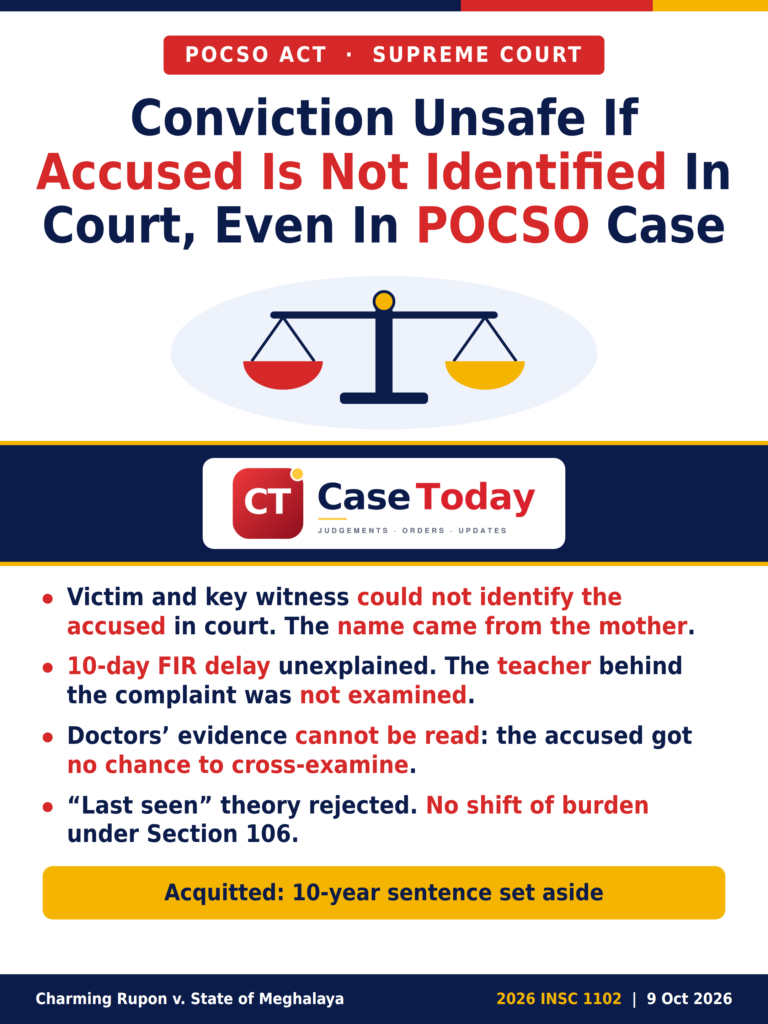
Case: Charming Rupon v. State of Meghalaya (Criminal Appeal arising out of SLP (Crl.) No. 11881 of 2022)
Citation: 2026 INSC 1102
Coram: Justice Vikram Nath and Justice Sandeep Mehta (Judgment authored by Justice Mehta)
Date of Judgment: 9 October 2026
HEADNOTE
Keywords: Protection of Children from Sexual Offences Act, 2012 – Section 6 – Identification of Accused – Child Witness with Intellectual Disability – Delay in FIR – Omissions in FIR – Non-examination of Material Witness – Adverse Inference – Denial of Cross-examination – Section 106 Evidence Act, 1872 – Last Seen Theory – Plea of Alibi – Benefit of Doubt
- Identity of accused: Even after giving due latitude to a child witness with intellectual disability, a conviction is unsafe where the victim and the key witness fail to identify the accused in court, admit that the name was supplied by the informant, and no scientific or independent evidence connects the accused to the offence.
- Delay and omissions in FIR: Where a material fact later relied upon by the prosecution is missing from a delayed FIR and appears for the first time during trial, it is a material improvement that makes the testimony doubtful and unsafe.
- Non-examination of material witness: The prosecution must examine a witness whose evidence goes to the root of the matter. Withholding the teacher, whose information led to the FIR, justifies an adverse inference against the prosecution.
- Untested medical evidence: Where the defence counsel was absent and the Court neither deferred the cross-examination nor provided legal aid, or did not offer cross-examination at all, the medical witnesses’ evidence cannot be read in evidence.
- Section 106, Evidence Act: The burden does not shift to the accused merely because he was seen near the house. Last seen together must be proved, and it was not.
- Alibi: Credible defence evidence supporting a plea of alibi cannot be lightly brushed aside by the Courts.
BRIEF FACTS
The appellant, Charming Rupon, was tried for the offence under Section 6 of the POCSO Act in connection with FIR No. 261(6)15/2015 at Police Station Khliehriat, East Jaintia Hills. The prosecution alleged that on 28 May 2015 he sexually assaulted his minor relative, a girl with 40% intellectual disability, when she was alone at home. She went to her cousin (PW-2), who told the victim’s mother (PW-1) the next day. The matter was reported to the police only on 8 June 2015, after the victim disclosed it to her school teacher, who was not examined at trial.
The Special Judge (POCSO), East Jaintia Hills, convicted him on 7 December 2021 and sentenced him to 10 years’ rigorous imprisonment with a fine of Rs. 1 lakh. A Division Bench of the Meghalaya High Court dismissed his appeal on 29 March 2022. The accused had pleaded innocence and led defence evidence to prove alibi. He approached the Supreme Court by special leave.
KEY FINDINGS OF THE COURT
Note: The findings highlighted in yellow are the main findings of the Court most relied upon for the judgment.
- Accused was not identified. PW-2 admitted she did not know the accused by name or face, and both she and the victim could not identify him in court. Both said the name was told to them by PW-1, who was not an eyewitness. The victim also admitted meeting the Public Prosecutor, who told her what to say, raising a doubt of tutoring. The Court gave due latitude to the victim’s disability but held it would still be unsafe to rely on her testimony (paras 34–38, 43–48).
- Adverse inference for withholding the teacher. The teacher’s disclosure prompted the FIR, and her evidence would have shown what the child actually said and why the FIR was delayed. The prosecution gave no explanation for not examining her. Relying on Takhaji Hiraji v. Thakore Kubersing Chamansing (2001) 6 SCC 145, the Court drew an adverse inference (paras 56–59).
- Medical evidence could not be read. PW-3’s deposition remained untested because the defence counsel was out of station, and the trial Court neither deferred the cross-examination nor provided legal aid. PW-8 was not even offered cross-examination. The Court held that the testimony of both could not be read in evidence (paras 39–42).
- Delay, unnatural conduct and omissions in FIR. PW-1’s conduct in not acting on her niece’s report or checking her disabled child was unnatural. The FIR did not mention that she had seen the accused near the house or that PW-2 told her about the incident the next day. Following Amar Nath Jha v. Nand Kishore Singh and Ram Kumar Pandey v. State of M.P., these were material improvements that made her testimony doubtful (paras 30–33, 50–54).
- Section 106 does not apply. The “last seen” theory was farfetched. PW-1 only saw the accused plucking leaves in the garden before she left, and nowhere said the victim was with him. It was also absent from the FIR, so there was no shifting of burden (para 49).
- Inconsistent relationship and alibi. The victim described the accused as her father’s eldest brother, while PW-1 described a different relationship. The defence led credible evidence of alibi, which the Courts below brushed aside without justification (paras 45, 55, 60).
- Cumulative doubt. Taken together, the unnatural conduct, delay, failure of identification, contradictory relationship versions, withheld teacher and alibi evidence made it wholly unsafe to sustain the conviction. The prosecution failed to prove guilt beyond reasonable doubt (paras 61–62).
RESULT
Appeal allowed. The conviction and sentence dated 7 December 2021 and the High Court judgment dated 29 March 2022 were set aside. The appellant was acquitted on benefit of doubt and directed to be released forthwith, if not wanted in any other case (paras 62–65).
Case Title: Charming Rupon v. State of Meghalaya
Citation: 2026 INSC 1102
Appearance: For Appellant: Shri Gaurav Agrawal, Sr. Adv. For Respondent: Shri Amit Kumar, Advocate General, Meghalaya.