

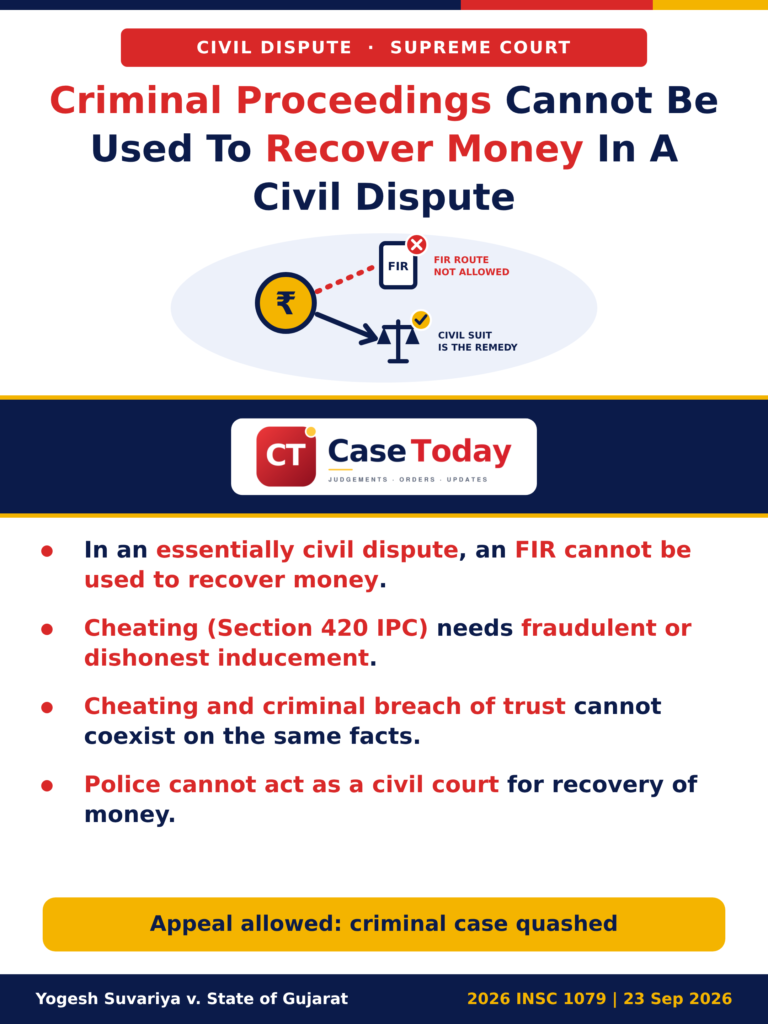
Criminal Proceedings Cannot Be Used
To Recover Money In A Civil Dispute : Supreme Court
Case: Yogesh Premjibhai Suvariya & Anr. v. State of Gujarat & Anr. (Criminal Appeal arising out of SLP (Crl.) No. 6908 of 2026) – Order
Court: Supreme Court of India
Citation: 2026 INSC 1079
Coram: Justice Ujjal Bhuyan and Justice Atul S. Chandurkar
Date of Order: 23 September 2026
HEADNOTE
Keywords: Indian Penal Code, 1860 – Sections 405, 406, 415, 420 and 114 – Cheating – Criminal Breach of Trust – Civil Dispute – Abuse of Process of Court – Quashing of Criminal Proceedings – Section 161 CrPC – Delhi Race Club v. State of U.P. – Lalit Chaturvedi v. State of U.P. – G. Saminathan v. State
- Criminal proceedings cannot be used to recover money in a civil dispute: If the complainant says a particular amount is due to him, he should file a civil suit for recovery. Resorting to a criminal case to recover money that is withheld in an essentially civil dispute is not the object of criminal proceedings, and continuing it is an abuse of the process of the Court.
- Police cannot act as a civil court: Money cannot be recovered in a civil dispute by lodging an FIR and seeking the help of the police. The police have no power to recover money or act as a civil court (Lalit Chaturvedi; Shailesh Kumar Singh).
- Cheating needs dishonest inducement: For Section 420 IPC, the ingredients of Section 415 IPC must be established. The essential element is fraudulent or dishonest inducement, or intentional inducement, to deliver property. Without it, the offence of cheating is not made out (G. Saminathan).
- Cheating and criminal breach of trust cannot coexist: The two offences are independent and distinct and cannot coexist in the same set of facts. They are antithetical to each other (Delhi Race Club).
- Essentially civil disputes: When the dispute between the parties is essentially civil in nature, a case of cheating or criminal breach of trust per se would not arise.
- Quashing even after charge is sustained: The Supreme Court set aside the High Court order that sustained the charge under Section 420 read with Section 114 IPC and quashed the criminal case.
BRIEF FACTS
The appellants are Directors of Shivamy Enterprises Pvt. Ltd., which has bought steel bars from Hans Ispat Ltd. since 2006 and resold them. The informant is an employee of Hans Ispat Ltd. He lodged FIR No. I-8/2012 at Police Station Anjar, Kutch East, saying the appellants bought 293 metric tonnes of TMT bars worth Rs. 1,19,00,000 in November 2011, issued 10 post-dated cheques that were dishonoured, and left the bills unpaid. The police filed a chargesheet under Sections 406, 420 and 114 IPC (Criminal Case No. 584 of 2012).
The Magistrate rejected the appellants’ discharge application on 08.02.2016. The High Court dismissed their revision as not maintainable, but the Supreme Court held it maintainable on 18.12.2024 and sent it back. By order dated 17.03.2026, the Gujarat High Court discharged the appellants under Section 406 IPC but sustained the charge under Section 420 read with Section 114 IPC. The appellants said the dispute was civil: Rs. 2 crore they had deposited with Hans Ispat was not returned, so they withheld payment of Rs. 1.19 crore to set off the dues. The Supreme Court stayed the trial on 24.04.2026.
KEY FINDINGS OF THE COURT
Note: The findings highlighted in yellow are the main findings of the Court most relied upon for the judgment.
- The dispute was essentially civil, and no civil suit was filed. The informant’s own statement under Section 161 CrPC admitted that Rs. 2 crore was paid by the appellants to the company when the Barnala Group owned it. The appellants insisted on repayment and adjusted the dues. The Court held that the dispute is pre-eminently civil, yet no civil suit was instituted (paras 21–22, 27).
- Using criminal proceedings to recover money is an abuse of process. Relying on Delhi Race Club, Lalit Chaturvedi and Shailesh Kumar Singh, the Court held that the complainant should have filed a civil suit. The criminal case was meant to recover the amounts withheld, which cannot be the object of a criminal proceeding (paras 23–25, 27–28).
- A civil dispute does not by itself make out cheating or criminal breach of trust. Following G. Saminathan, the Court said that where the dispute is essentially civil, cheating or criminal breach of trust per se would not arise. The ingredients of Section 415 IPC, fraudulent or dishonest inducement, must be established for Section 420 IPC (paras 20, 26).
- Cheating and criminal breach of trust are distinct offences. They are independent and antithetical, and cannot coexist in the same set of facts. The Court also quoted the call for police officers to be trained in the fine distinction between the two (para 23.1).
- Orders of the High Court and Magistrate set aside. The Court set aside the High Court order dated 17.03.2026 and the Magistrate’s order dated 08.02.2016, and quashed Criminal Case No. 584 of 2012 (paras 29–31).
RESULT
Case Title: Yogesh Premjibhai Suvariya & Anr. v. State of Gujarat & Anr.
Citation: 2026 INSC 1079
Appearance: Mr. Nikhil Goel, Senior Counsel, for the appellants; Mr. Prashant Bhagwati, learned counsel, for the State of Gujarat. None appeared for Respondent No. 2 (de facto complainant), though served.