

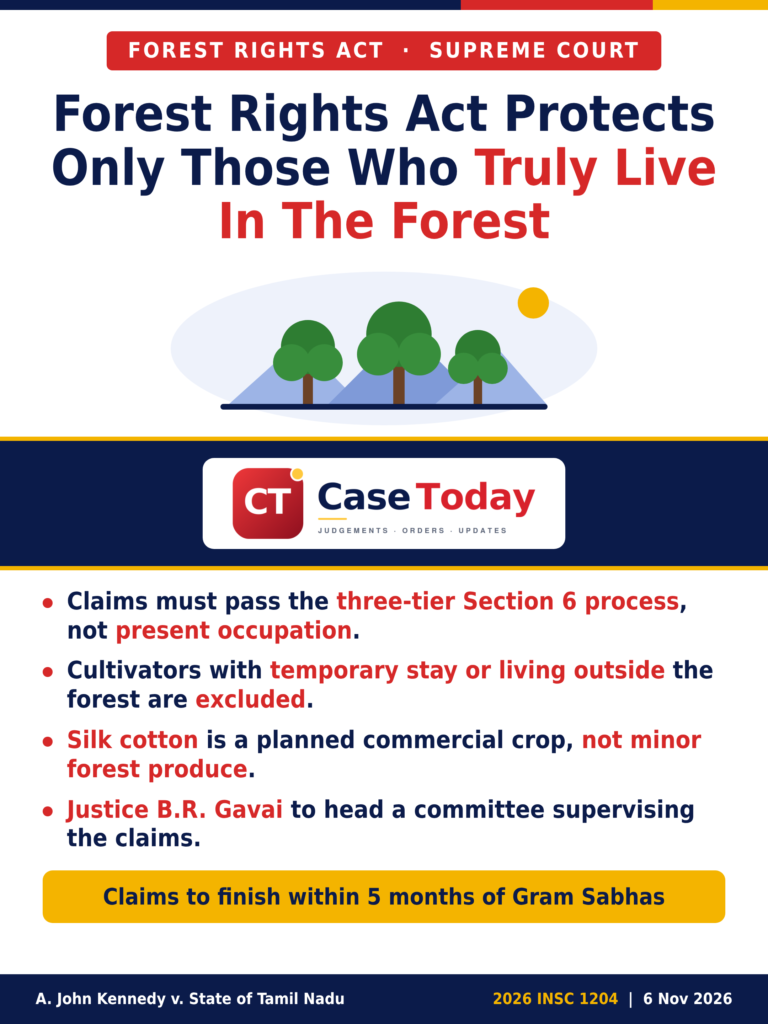
Forest Rights Act Protects Only Those Who Truly Live
In The Forest : Supreme Court
Case: A. John Kennedy & Ors. v. State of Tamil Nadu & Ors. (Civil Appeal Nos. 6395–6397 of 2025, with Contempt Petition (C) arising out of Writ Petition (C) No. 202 of 1995) – Order
Citation: 2026 INSC 1204
Coram: Justice Vikram Nath and Justice Sandeep Mehta (Order authored by Justice Mehta)
Date of Order: 6 November 2026
HEADNOTE
Keywords: Scheduled Tribes and Other Traditional Forest Dwellers (Recognition of Forest Rights) Act, 2006 – Sections 2(c), 2(i), 2(o), 3(1)(c), 3(2) and 6 – Forest Dwelling Scheduled Tribes – Other Traditional Forest Dwellers – Minor Forest Produce – Silk Cotton – Three-tier Claims Mechanism – Tiger Reserve – Eviction and Rehabilitation
- Strict process: Claims of persons asserting rights as Forest Dwelling Scheduled Tribes (FDST) or Other Traditional Forest Dwellers (OTFD) must be decided with strict adherence to Section 6 of the FRA, 2006 and the Rules, and not on the basis of present occupation. The benefit is confined to those who satisfy Sections 2(c) and 2(o).
- Primary residence is essential: A claimant must primarily reside in the forest and depend on it. Persons with only temporary residence in the forest, or residing outside the forest boundary, cannot qualify merely because they cultivate forest land.
- Minor forest produce: Minor forest produce under Section 2(i) must be naturally occurring plant produce. Planned cultivation of a commercial crop such as silk cotton is not minor forest produce, and no right to it is recognised under Section 3(1)(c) (prima facie view).
- Primacy of the tiger habitat: Since Megamalai is a Tiger Sanctuary/Reserve, the sanctity of the critical tiger habitat has to be given primacy over claims to encroach on the forest.
- State responsible for delay: The State is primarily responsible for the delay in receiving and deciding claims, as the process started only after the Court took cognizance.
- Supervision: A Special Committee headed by Justice B.R. Gavai, former Chief Justice of India, will scrutinise the orders on claims and supervise their disposal.
BRIEF FACTS
By its order of 29 May 2026, the Supreme Court issued directions for time-bound eviction, rehabilitation and ecological restoration in the forest areas of the Agasthyamalai landscape, including a division-wise eviction plan, removal of encroachments, action against identified Government servants, and a bar on new non-forestry activities or diversion proposals until compliance. Later applications raised the implementation of the Forest Rights Act, 2006 for people living in or cultivating land in the Megamalai region. On 19 August 2026, the Court asked Tamil Nadu to respond on silk cotton cultivation, pattas granted by the Collector, the 118 Government servants identified as encroachers, and the status of FRA claims.
The State said silk cotton had long been cultivated with tacit sanction, that no pattas were issued on Reserved Forest land, and that about 40 Gram Sabhas had received around 1,600 claims, with the process needing about four months. The State’s own chart showed 4,594 persons occupying 5,072.64.3 hectares, of which 3,637.83.2 hectares were under silk cotton. Of these, 1,595 were permanent residents in the forest (Category I), 232 had temporary residence (Category II) and 2,767 lived outside the forest boundary (Category III). The Amicus Curiae argued that the 1978 forest settlement and the Madras High Court’s judgment of 17 March 2022 could not be reopened, and that only genuine claimants should be considered.
KEY FINDINGS OF THE COURT
Note: The findings highlighted in yellow are the main findings of the Court most relied upon for the judgment.
- Claims must follow the Section 6 process, not present occupation. The FRA is a beneficial law that recognises the rights of those who have lived in forests for generations, but its benefit is confined to those who satisfy Sections 2(c) and 2(o). An OTFD must have primarily resided in and depended on the forest for at least three generations (75 years) before 13 December 2005. Persons who do not meet these requirements are liable to be removed in accordance with law (paras 43–55).
- Categories II and III are excluded. Persons who cultivate with only temporary residence in the forest (Category II) and those who live outside the forest boundary (Category III) cannot qualify as FDST or OTFD on the basis of cultivation alone. They stand excluded from consideration under the FRA (paras 64, 70(i)).
- Silk cotton is not minor forest produce. The Court found only promoted, planned cultivation of a commercial crop, not traditional collection of produce, and observed that minor forest produce must be naturally occurring. Planned commercial cultivation in forest areas is prima facie completely impermissible, and the State’s reliance on historical cultivation cannot create a forest right. The CEC will examine who finances this cultivation, because those living outside the forest could hardly cultivate inside it unaided, and will give its opinion on silk cotton’s status (paras 57–67).
- Timelines and State’s delay. The State was given a last opportunity of 30 days to form the remaining Gram Sabhas, and claims must be decided through the three-tier mechanism within five months of their constitution. The Special Committee should conclude scrutiny within two months after that (paras 52–54, 70(ii), 70(vi)).
- Special Committee. It is headed by Justice B.R. Gavai, assisted by an officer of the Central Empowered Committee (CEC) and the Principal Chief Conservator of Forests, Tamil Nadu. It will receive monthly progress reports and report to the Court in a sealed cover. The Chairperson’s honorarium is Rs. 25 lakh in each of four instalments, borne by the State (paras 68–70).
- NHAI application. NHAI sought to process a fresh diversion proposal for the NH-744 Puliara–Edamon tunnel section. The Court directed the CEC to consider it and file a response before the next hearing, keeping Section 3(2) of the FRA in view (paras 73–77).
- State Law Department. It was impleaded as a respondent, and the monitoring responsibility under paragraph 66(iii) of the 29 May 2026 order was reassigned to the Environment, Climate Change and Forests Department through the Principal Chief Conservator of Forests (paras 78–82).
RESULT
Case Title: A. John Kennedy & Ors. v. State of Tamil Nadu & Ors.
Citation: 2026 INSC 1204
Appearance: Mr. Jaideep Gupta, Sr. Adv. (Dept. of Revenue, Tamil Nadu); Mr. Sriram Panchu, Sr. Adv. (Dept. of Social Justice, Tamil Nadu); Mr. K. Parmeshwar, Amicus Curiae; Mr. K.M. Nataraj, ASG (NHAI); Ms. Vrinda Bhandari (State Law Department).