

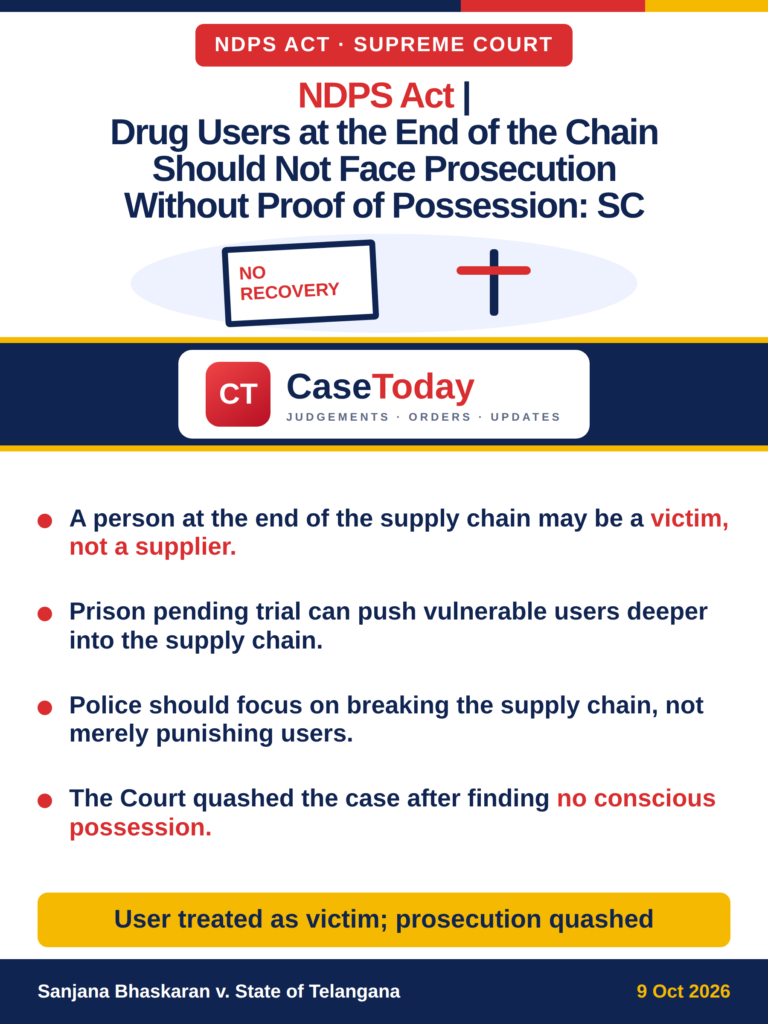
NDPS Act | Supreme Court Says Drug Users at the End of the Chain Should Not Be Prosecuted Without Proof of Possession
Case: Sanjana Bhaskaran v. State of Telangana & Anr. — Criminal Appeal arising out of SLP (Crl.) No.3435 of 2026
Court: Supreme Court of India | Date: 9 October 2026
Bench: Justice J.B. Pardiwala and Justice K. Vinod Chandran
HEADNOTE
Keywords: NDPS Act; conscious possession; no recovery; co-accused confession; search safeguards; marijuana user; victim at end of supply chain; quashing of prosecution
- The supply chain, not merely the user, must be the focus. The Court warned that prosecuting a user who may be a victim can produce harmful consequences.
- Incarceration can deepen the problem. Sending such persons to prison pending trial may expose them to associations that push them further into the supply chain.
- Law enforcement should target availability and supply. The Court stressed breaking the supply chain rather than merely punishing a user without proof of conscious possession.
- Result: The appellant’s case was quashed and no de-addiction direction was imposed.
BRIEF FACTS
The appellant was alleged to have received a packet from two persons near an educational institution. The packet allegedly contained marijuana. The prosecution also relied on statements of co-accused and the appellant’s alleged confession.
However, no contraband was recovered from the appellant or from the bag she carried. The Court also found that the police should have informed her of the right to be examined before a Magistrate before conducting the search. The alleged sellers were found with a much larger quantity, while the appellant was described as the last person in the supply chain.
ISSUE
Whether an alleged user at the end of the narcotics supply chain should face prosecution when the evidence does not prove conscious possession or a direct role in supplying drugs.
KEY FINDINGS OF THE COURT
- A user may be a victim, not a supplier. Courts and police should distinguish the end user from those who sell and supply narcotics.
- Prosecution still requires proof. The absence of recovery from the appellant and lack of evidence of conscious possession made further prosecution pointless.
- Prison may worsen vulnerability. Incarceration pending trial can create associations that draw a user deeper into the supply chain.
- The Court chose quashing over automatic treatment. It found no complicity and did not force the appellant into a de-addiction process.