

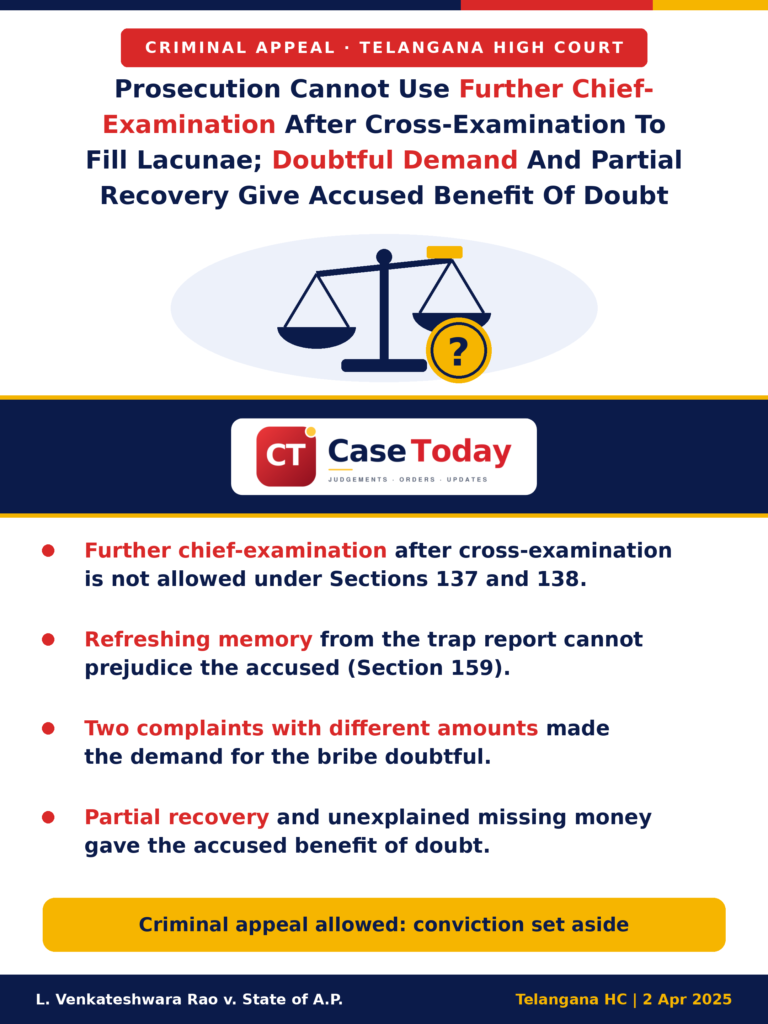
Prosecution Cannot Use Further Chief-Examination After Cross-Examination To Fill Lacunae;
Doubtful Demand And Partial Recovery Give Accused Benefit Of Doubt : Telangana High Court
Case: L. Venkateshwara Rao v. State of Andhra Pradesh (Criminal Appeal No. 1567 of 2010, arising from C.C. No. 43 of 2005) – Judgment
Court: High Court for the State of Telangana at Hyderabad
Citation: Not yet assigned
Coram: Justice K. Surender
Date of Judgment: 2 April 2025
HEADNOTE
Keywords: Prevention of Corruption Act, 1988 – Sections 7 and 13(1)(d) r/w 13(2) – Trap Case – Demand and Acceptance – Further Chief-Examination – Sections 137, 138 and 159 Evidence Act – Refreshing Memory – Benefit of Doubt
- Further chief-examination is not permitted: Once the examination-in-chief is complete and the witness has been cross-examined, the question of further chief-examination does not arise under Sections 137 and 138 of the Indian Evidence Act. Re-examination is confined to explaining matters referred to in cross-examination, and the prosecution cannot use further chief-examination to fill lacunae.
- Refreshing memory must not prejudice the accused: A witness may refresh memory from an earlier panchanama or proceedings under Section 159 of the Evidence Act, but not to the prejudice of the accused. The Special Judge erred in letting the independent mediator read the post-trap report after he said he could not remember who produced the file.
- Two complaints with different amounts: Where the complainant admitted giving two complaints, one for Rs. 500 (Ex.P1, 03.11.2003) and one for Rs. 1,000 (Ex.D1, 04.11.2003), with no reason given for the second, and the prosecution suppressed it, the demand itself becomes doubtful.
- Irregularities in the trap: The accompanying witness was picked up from a bus stop and his name was missing in the first mediators’ report, and there was no explanation why the independent mediator or another witness was not sent with the complainant to witness the transaction.
- Partial recovery: Only Rs. 300 of the Rs. 500 was recovered, and the explanation for the missing Rs. 200 (said to be thrown in a river) was questionable.
- Benefit of doubt: In view of the discrepancies and inconsistencies, the benefit of doubt was extended to the appellant and the conviction was set aside.
BRIEF FACTS
The appellant, a Special Revenue Inspector in the Mandal Revenue Officer’s office, was convicted by the Special Judge in C.C. No. 43 of 2005 on 07.12.2010 under Section 7 and Sections 13(1)(d) read with 13(2) of the Prevention of Corruption Act, 1988, and sentenced to rigorous imprisonment for six months and one year. The prosecution case was that he demanded Rs. 500 from the complainant (P.W.1, a general power of attorney holder) for issuing pahani copies.
On 04.11.2003 a trap was laid. The complainant paid Rs. 500, the appellant allegedly gave Rs. 200 to P.W.3, who passed it to the Deputy MRO (P.W.4), and Rs. 300 was recovered from the appellant with positive hand tests. The appellant said no work was pending with him, he was on leave on 03.11.2003, and the Rs. 300 was P.W.3 repaying a loan, in a trap really meant for P.W.4. He filed this appeal against the conviction.
KEY FINDINGS OF THE COURT
Note: The findings highlighted in yellow are the main findings of the Court most relied upon for the judgment.
- Further chief-examination after cross-examination is contrary to the Evidence Act. The course adopted by the prosecution and permitted by the Special Judge was not in accordance with Sections 137 and 138. Re-examination is confined, and the prosecution cannot overcome that limit by further chief-examination (paras 20–24).
- The demand for the bribe was doubtful. The complainant admitted both Ex.P1 (Rs. 500) and Ex.D1 (Rs. 1,000) and gave no reason for the second complaint, which the prosecution suppressed. The register showed the appellant on leave on 03.11.2003, the date of the alleged demand (paras 10–11, 26).
- Irregularities in the trap and partial recovery. Several discrepancies raised doubts about how the trap was laid and the events on the trap day, including the picked-up witness, no explanation for not sending an independent witness with the complainant, only Rs. 300 recovered, and the questionable explanation for the missing Rs. 200 (paras 12, 26).
- Refreshing memory under Section 159. A witness can refresh memory from earlier proceedings, but not to the prejudice of the accused, and the independent mediator’s changed version after reading the post-trap report was not accepted (paras 19–21).
- Defence version. The independent circumstantial witness whose presence the prosecution witnesses admitted (examined as D.W.1) supported the appellant’s account that P.W.3 handed over Rs. 300 as loan repayment (paras 13, 25).
- Not separately decided. The Court did not discuss the decisions cited for the appellant (C.M. Girish Babu, Punjabrao, Hari Dev Sharma) or the statutory presumption in a corruption case, and rested the acquittal on the doubts in para 26.
RESULT
Case Title: L. Venkateshwara Rao v. State of Andhra Pradesh
Citation: Not yet assigned
Appearance: Sri M.B. Thimma Reddy for the appellant; Sri T. Bala Mohan Reddy, Special Public Prosecutor, for the respondent.