

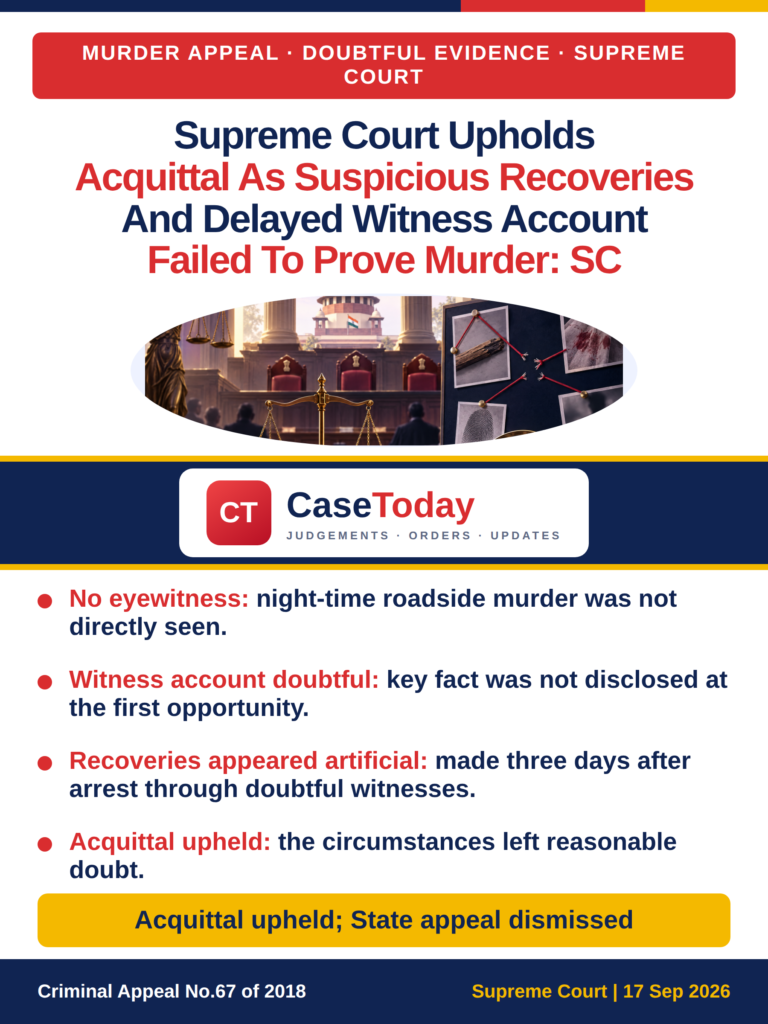
Supreme Court Upholds Acquittal As Suspicious Recoveries And Delayed Witness Account Failed To Prove Murder: SC
Case: State of Himachal Pradesh v. Varinder Verma @ Jatti & Anr. (Criminal Appeal No.67 of 2018; 2026 INSC 1028)
Court: Supreme Court of India
Bench: Hon’ble Mr. Justice Manoj Misra and Hon’ble Mr. Justice Vijay Bishnoi
Order pronounced: 17 September 2026
HEADNOTE
- No eyewitness existed. The murders occurred at night beside a public road, and no one saw the accused with the deceased.
- Witness evidence was inconclusive. The alleged sighting in darkness was doubtful, and the key witness did not disclose the incriminating story at the first opportunity.
- Recoveries appeared artificial. Blood-stained clothes and wooden sticks were recovered three days after arrest through interested or unexamined witnesses.
- Acquittal upheld. The prosecution case left reasonable doubt and failed to establish a complete chain of circumstances.
BRIEF FACTS
Two persons, Om Prakash and Ganga Ram, were found dead beside a public road at night on 6 June 2009. The FIR was lodged against unknown persons and did not express suspicion against anyone.
The trial court convicted Varinder Verma and Dev Raj under Sections 302/34 IPC, relying on alleged sightings, motive, blood-stained clothes and recovery of wooden sticks. The Himachal Pradesh High Court acquitted them by extending the benefit of doubt. The State challenged that acquittal before the Supreme Court.
LEGAL ISSUE
Whether the prosecution proved a complete and conclusive chain of circumstantial evidence establishing that the accused, and no one else, committed the murders beyond reasonable doubt.
KEY FINDINGS OF THE COURT
- The Supreme Court upheld the acquittal. The prosecution evidence did not exclude reasonable hypotheses consistent with innocence.
- Delayed disclosure weakened the key witness. A witness who allegedly knew a grave incriminating fact but remained silent at the first opportunity became less reliable.
- Recoveries were not conclusive. The blood-group match did not establish that the blood belonged to the deceased, and the recovery evidence appeared stage-managed.
- Suspicion cannot replace proof. The State’s appeal was dismissed because the circumstantial chain was incomplete.
REASONING
The Court reiterated that in a case based on circumstantial evidence, each incriminating circumstance must be proved beyond reasonable doubt; the circumstances must be consistent only with guilt; and the chain must be so complete that it excludes every reasonable hypothesis consistent with innocence.
The Court found the alleged sighting doubtful because it occurred in darkness and the witness did not say that the accused were carrying sticks or speaking to the deceased. The related witness was also an interested witness and did not disclose the alleged incriminating fact to the informant when he first reached the scene.
The recoveries of clothes and sticks were made three days after arrest and through witnesses whose credibility was questioned. The Court held that the recoveries appeared stage-managed and artificial. The blood-group match, without the accused’s blood samples or DNA profiling, did not conclusively connect the clothes to the deceased.
RESULT
Case title: State of Himachal Pradesh v. Varinder Verma @ Jatti & Anr.