

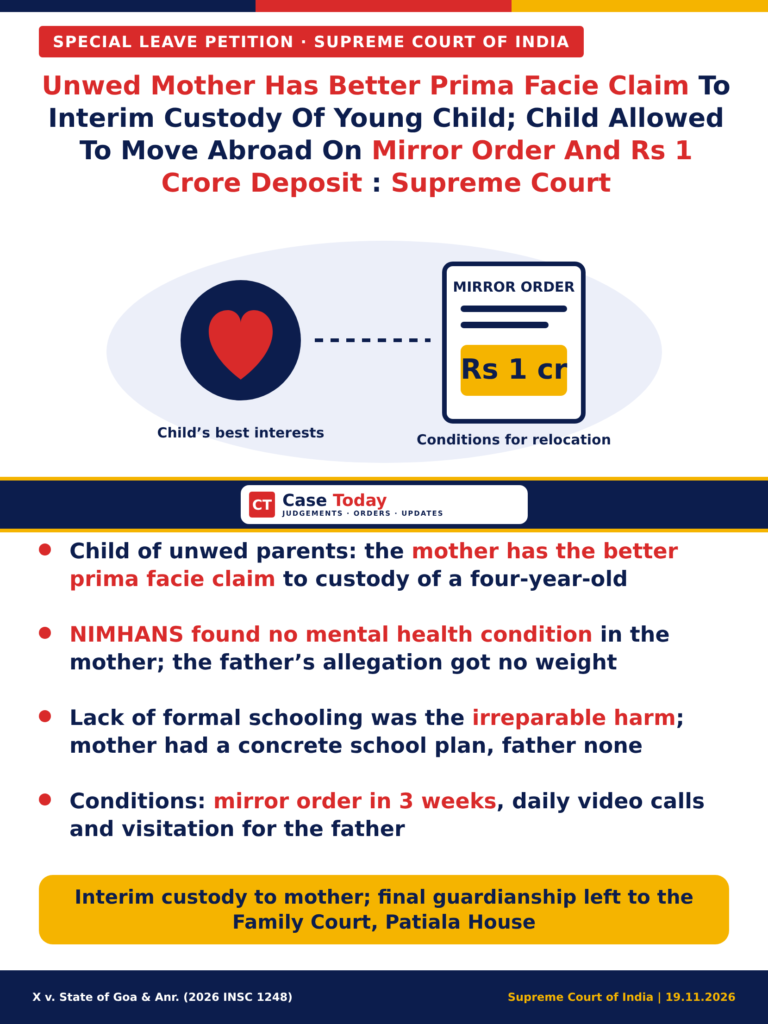
Unwed Mother Has Better Prima Facie Claim To Interim Custody Of Young Child; Child Allowed To Move Abroad On Mirror Order And Rs 1 Crore Deposit : Supreme Court
Case: X v. State of Goa & Anr. (Special Leave Petition (Crl.) No. 11625 of 2026); 2026 INSC 1248 (Reportable)
Court: Supreme Court of India (Criminal Appellate Jurisdiction)
Coram: Justice Nongmeikapam Kotiswar Singh (author of the judgment) and Justice N.V. Anjaria
Date of Judgment: 19.11.2026
HEADNOTE
Keywords: Child custody – Interim custody – Child of unwed parents – Parens patriae – Habeas corpus – Triple test (prima facie case, balance of convenience, irreparable harm) – Best interests of the child – Guardians and Wards Act, 1890 – Hindu Minority and Guardianship Act, 1956 – Mirror order – Relocation of child abroad – Parental alienation – Article 136 and Article 142 of the Constitution
- Pending guardianship petition does not make habeas petition infructuous: The later filing of a guardianship petition does not render the habeas corpus petition infructuous, and the Court exercises parens patriae jurisdictionwithout a hyper-technical approach in child custody matters, while leaving the final custody decision to the jurisdictional Family Court (paras 40–46, 60–61).
- Interim custody is decided on the triple test: Interim custody is evaluated on prima facie case, balance of convenience and irreparable harm, with the best interests of the child as the paramount consideration (paras 63–64, 74–76).
- Prima facie claim of the unwed mother: For a child born to unwed parents, the mother has a better prima facie claim of custody of a very young child; the Guardians and Wards Act, 1890 contains no provision disabling her, and this accords with international jurisprudence, as surveyed in X1 v. State (NCT of Delhi), (2015) 10 SCC 1 (paras 65–68).
- Rootedness: A very young child who has moved between cities cannot be said to be rooted in any one place; stability comes from the persons around the child, not geography, so relocation does not by itself cause irreparable harm (paras 109–114).
- Mental health allegations: Unless there is very serious, proven conduct making a parent unworthy, custody is decided on the best interests of the child; allegations of mental illness contradicted by the NIMHANS assessment carry no weight (paras 115–116, citing Rohith Thammana Gowda).
- Safeguards for relocation: The child may be taken abroad only after a mirror order from the foreign court and a deposit of Rs. 1 crore, with a parenting plan securing the other parent’s access, daily video calls, visitation and periodic reports against parental alienation (paras 123–133, Directions A–Q).
BRIEF FACTS
The parties are unmarried parents of a boy born on 15.07.2022. The mother ordinarily lives and works in Singapore and the father is a lawyer in India. After the relationship broke down, the father kept the child with him and, according to the mother, obstructed her access, including moving the child between cities. She filed a habeas corpus petition before the Bombay High Court at Goa in February 2026 and later this Special Leave Petition against an adjournment in that case. During the proceedings the father started guardianship proceedings, and Guardianship Petition No. 37 of 2026 is now pending before the Family Court, Patiala House Courts, New Delhi (paras 3–23, 41–42).
The Supreme Court tried mediation without success and, by order dated 11.08.2026, directed the parents and the child to undergo individual and family assessments at NIMHANS, Bengaluru. The mother sought interim custody with leave to take the child to Singapore for school. The father opposed it, wanted the child educated in India, questioned the Court’s jurisdiction, and alleged mental health issues against the mother (paras 24–38, 106).
The questions were whether the Court could decide interim custody despite the pending guardianship petition, and which parent should have interim custody and whether the child could be relocated to Singapore.
KEY FINDINGS OF THE COURT
Note: The findings highlighted in yellow are the main findings most relied upon by the Court.
- The mother has the better prima facie claim. Preference in law is to give custody to the mother in a dispute over a child of tender age born outside wedlock, and the Guardians and Wards Act has no provision disabling her. The Court did not decide whether the father meets any higher threshold for guardianship (paras 65–68).
- Irreparable harm lay in the lack of formal schooling, not in relocation. The child’s roots in any one place were overstated; the NIMHANS report showed the child is comfortable with either parent and that the absence of structured schooling is detrimental. The mother produced concrete admission plans and fee records, while the father showed no admission documents (paras 109–114, 117–121).
- No mental health condition found in the mother. The NIMHANS report found no diagnosable mental health condition currently or in her lifetime, and no behaviour detrimental to the child, so the father’s contentions were given no weight (paras 115–116).
- Balance of convenience. The mother had been litigating in India at the risk of her employment, and compelling her to stay would be unfair; the father, a lawyer with resources, would face comparatively less inconvenience in travelling to maintain contact (paras 69–73).
- Mirror order and security. Because the child would be out of reach of Indian courts, the Court required a mirror order from a Singapore court and a Rs. 1 crore fixed deposit, relying on comity of courts and the Singapore legal system (paras 126–133).
- Transfer under Article 142. The habeas corpus petition (W.P. No. 478 of 2026 (F)) was transferred from the Bombay High Court at Goa to the Supreme Court to avoid duplication (para 134).
- Final decision left to the Family Court. The order is only interim and does not influence the Family Court, which is to decide the guardianship petition on its own in accordance with law (para 136).
RESULT
Case Title: X v. State of Goa & Anr.
Reference: Special Leave Petition (Crl.) No. 11625 of 2026; 2026 INSC 1248
Appearance: For the Petitioner (mother): Ms. Geetha Luthra, learned Senior Advocate. For Respondent No. 2 (father): Mr. Gopal Sankaranarayanan, learned Senior Advocate