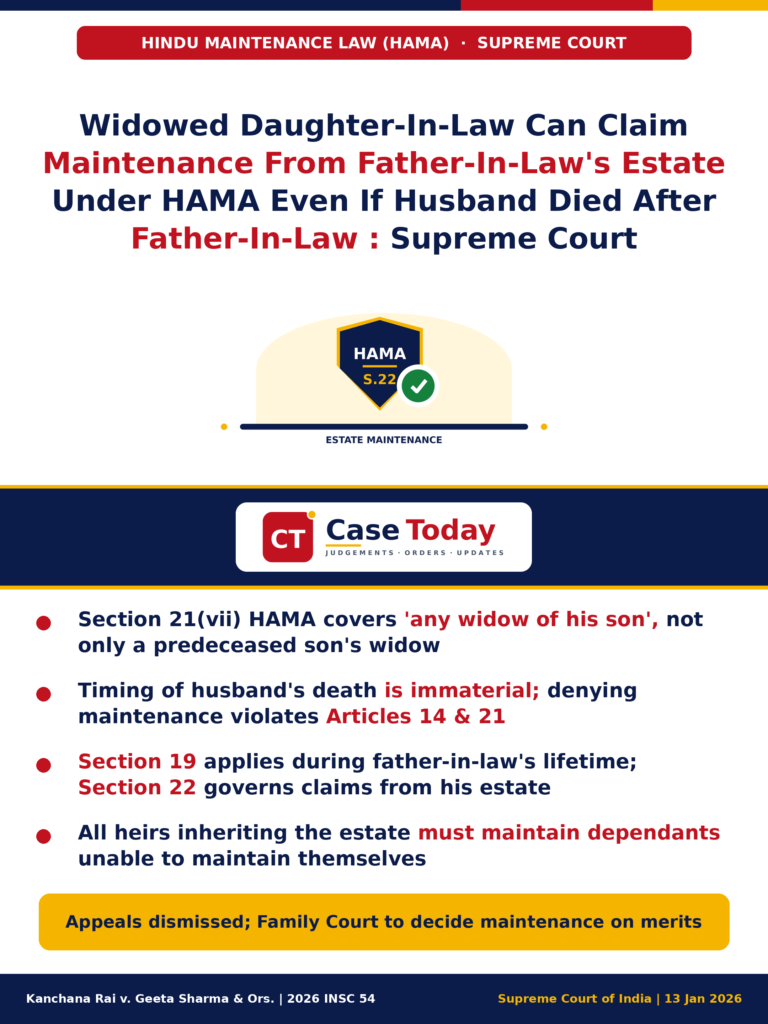
Widowed Daughter-In-Law Can Claim Maintenance From Father-In-Law’s Estate Under HAMA Even If Husband Died After Father-In-Law : Supreme Court
Case: Kanchana Rai v. Geeta Sharma & Ors. (with Uma Devi v. Geeta Sharma & Ors.), Civil Appeals arising out of SLP(C) Nos. 1544–1545 of 2026 & SLP(C) No. 1737 of 2026 | 2026 INSC 54
Court: Supreme Court of India
Coram: Hon’ble Mr. Justice Pankaj Mithal and Hon’ble Mr. Justice S.V.N. Bhatti
Date of Judgment: 13.01.2026
HEADNOTE
Keywords: Hindu Adoptions and Maintenance Act, 1956 (HAMA) – Section 21(vii) (Dependants – ‘Any widow of his son’) – Section 22 (Maintenance of dependants from estate) – Section 19 (Maintenance during father-in-law’s lifetime) – Literal interpretation – Constitution of India – Articles 14 & 21
- “Any Widow Of His Son” Under Section 21(vii) HAMA Is Not Restricted To A Predeceased Son’s Widow: The legislature deliberately used the words “any widow of his son” without prefixing “predeceased”. A daughter-in-law who becomes a widow after the death of her father-in-law is a “dependant” under Section 21(vii) and can claim maintenance from his estate under Section 22, provided she is unable to maintain herself from her husband’s or children’s estate (paras 10–16, 22, 29).
- Restrictive Classification Violates Articles 14 & 21 Of The Constitution: Distinguishing between widowed daughters-in-law solely on whether their husbands died before or after the father-in-law is manifestly arbitrary under Article 14 and offends the right to live with dignity under Article 21 (paras 23–24).
- Distinction Between Section 19 & Section 22 HAMA: Section 19 casts an obligation on a father-in-law to maintain his widowed daughter-in-law during his lifetime, whereas Section 22 governs maintenance of dependants out of the father-in-law’s estate after his death, binding all heirs who succeed to the estate (paras 12–13, 28).
BRIEF FACTS
Late Dr. Mahendra Prasad died on 27.12.2021, allegedly leaving a registered Will dated 18.07.2011 bequeathing his properties to the two sons of his predeceased son Devinder Rai (husband of appellant Kanchana Rai), while excluding his other two sons, Ranjit Sharma and Rajeev Sharma. Ranjit Sharma subsequently passed away on 02.03.2023 (para 3).
Ranjit Sharma’s widow, Geeta Sharma (Respondent No. 1), applied before the Family Court for maintenance from her late father-in-law’s estate under the Hindu Adoptions and Maintenance Act, 1956. The Family Court dismissed the petition as not maintainable since her husband was alive when Dr. Mahendra Prasad died. On 20.08.2025, the High Court set aside that dismissal, held her to be a dependant, and directed the Family Court to decide the quantum on merits. Kanchana Rai and Uma Devi (alleged live-in partner) appealed to the Supreme Court (paras 4–6).
KEY FINDINGS OF THE COURT
Note: The findings highlighted in yellow are the main findings most relied upon by the Court.
- Plain literal meaning of Section 21(vii) includes every widowed daughter-in-law regardless of when she became a widow. Applying the cardinal rule of literal interpretation (Crawford v. Spooner, B. Premanand, and Vinod Kumar), the Court held that courts cannot insert the word “predeceased” before “son” in Section 21(vii). The time of the son’s death is immaterial (paras 15–22).
- Denying maintenance based on timing of husband’s death violates Articles 14 and 21. Both categories of widowed daughters-in-law face identical financial vulnerability; excluding one based on a fortuitous circumstance is arbitrary under Article 14 and risks destitution contrary to Article 21 and traditional Hindu law principles (paras 23–26).
- Section 22 binds all heirs inheriting the estate after the father-in-law’s death. Unlike Section 19 (which operates during the father-in-law’s lifetime), Section 22 obligates anyone succeeding to the deceased Hindu’s estate (by Will or intestacy) to maintain dependants who received no share (paras 12–13, 28).
RESULT
Case Title: Kanchana Rai v. Geeta Sharma & Ors. (with Uma Devi v. Geeta Sharma & Ors.)
Reference: 2026 INSC 54 | Civil Appeals arising out of SLP(C) Nos. 1544–1545 of 2026 & SLP(C) No. 1737 of 2026
Appearance: For Appellants: Dr. Abhishek Manu Singhvi and Shri V. Giri, Senior Counsel. For Contesting Respondents: Shri Vikas Singh, Senior Counsel.