

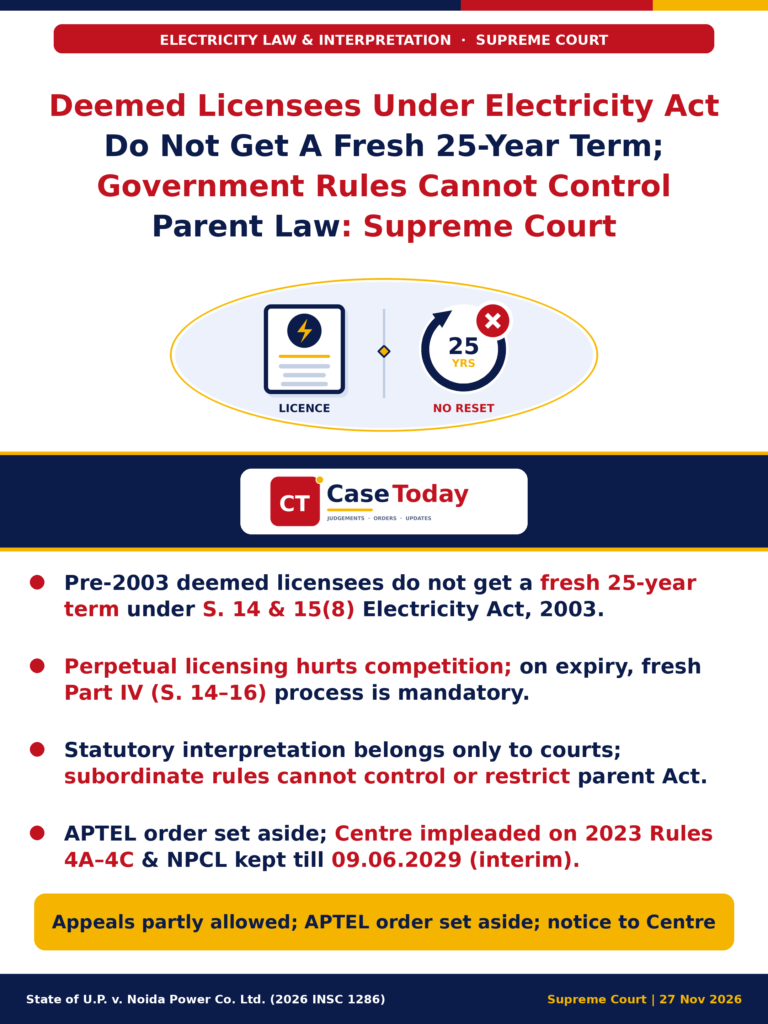
Deemed Licensees Under Electricity Act Do Not Get A Fresh 25-Year Term; Government Rules Cannot Control Parent Law: Supreme Court
Case: The State of Uttar Pradesh v. Noida Power Company Limited & Anr., Civil Appeal No. 410 of 2023 (with C.A. No. 8979 of 2024 & C.A. Nos. 8980–8982 of 2024) (2026 INSC 1286)
Court: Supreme Court of India
Coram: Hon’ble Mr. Justice Pamidighantam Sri Narasimha and Hon’ble Mr. Justice Alok Aradhe
Date of Judgment: 27.11.2026
HEADNOTE
Keywords: Electricity Act, 2003 – Part IV – Sections 14 (First Proviso), 15(8) & 16 – Repealed Electricity Act, 1910 – Deemed Licensee – No Fresh 25-Year Term From Commencement Of 2003 Act – Perpetual Licensing Anathema To Competition – Fresh Part IV Procedure Mandatory On Expiry – Electricity (Amendment) Rules, 2023 – Rules 4A, 4B & 4C – Subordinate Legislation Cannot Control Or Oust Meaning Of Parent Statute – APTEL Judgment Set Aside – Notice To Union Of India & Interim Continuation Till 09.06.2029
- Deemed Licensees Do Not Get A Fresh 25-Year Term From Commencement Of Electricity Act, 2003: Setting aside APTEL’s judgment dated 23.08.2022, the Supreme Court held that neither Section 15(8) nor the first proviso to Section 14 of the Electricity Act, 2003 grants a perpetual licence or entitles a pre-2003 deemed licensee to a fresh 25-year term from 10.06.2003 regardless of its original tenure (paras 1–2, 5, 10).
- Perpetual Licensing Is Anathema To Healthy Competition; Fresh Part IV Procedure Mandatory On Expiry: Reiterating that the 2003 Act contains no explicit automatic-renewal clause and aims to promote competition and consumer welfare, upon expiry of every licence (whether deemed or granted under the 2003 Act, except the Appropriate Government or Damodar Valley Corporation), the fresh licensing procedure under Sections 14, 15, and 16 must be followed so the regulatory commission can evaluate performance and select the most eligible licensee (paras 7–9).
- Subordinate Legislation / Government Rules Cannot Control Or Oust Meaning Of Parent Statute: Noting that Rules 4A, 4B, and 4C inserted by the Electricity (Amendment) Rules, 2023 (w.e.f. 30.06.2023) do not align with the Court’s reading of the 2003 Act, and surveying Hanlon v. The Law Society, J.K. Steel, Jeevan Chandrabhan Idnani, and Pernod Ricard, the Court laid down five principles holding that interpreting statutes is the exclusive province of constitutional courts; subordinate legislation merely reflects the Executive’s understanding, cannot decide, control, restrict, or oust the parent statute’s meaning, and may only serve as an aid where the Act is ambiguous (paras 11–21).
- Union Of India Impleaded To Examine 2023 Rules; Interim Licence Continuation Granted Till 09.06.2029: Since Rules 4A–4C were not directly challenged and came into force on 30.06.2023 before NPCL’s original licence expired on 30.08.2023, the Court allowed the appeals in part, set aside APTEL’s judgment, impleaded the Union of India (Ministry of Power) to examine Rules 4A–4C, directed interim continuation of NPCL’s licence till 09.06.2029, and listed the matter on 14.12.2026 (paras 2, 12, 22–25).
BRIEF FACTS
Respondent No. 1, Noida Power Company Limited (NPCL), was granted a 30-year electricity distribution licence under the repealed Electricity Act, 1910 on 30.08.1993, due to expire on 30.08.2023. During its subsistence, the Electricity Act, 2003 commenced on 10.06.2003. In multiple tariff orders between 2010 and 2019 (never challenged by NPCL), the Uttar Pradesh Electricity Regulatory Commission (UPERC) consistently recognized 30.08.2023 as the licence expiry date, and on 26.11.2020 approved NPCL’s MYT business plan only till 30.08.2023 while barring long/medium-term power purchase agreements beyond expiry. UPERC also issued an EOI notification on 08.06.2022 for a fresh licence.
On appeal by NPCL, APTEL stayed UPERC’s EOI and, by judgment dated 23.08.2022, rejected NPCL’s claim of a perpetual licence but reset its tenure by granting a 1-year transition from 10.06.2003 under the first proviso to Section 14 plus a fresh 25-year term under Section 15(8), extending expiry to 09.06.2029. Challenging APTEL’s ruling, the State of Uttar Pradesh and end-consumer Rama Shankar Awasthi appealed to the Supreme Court. Meanwhile, on 30.06.2023, the Central Government notified the Electricity (Amendment) Rules, 2023 inserting Rules 4A, 4B, and 4C providing a 25-year term from commencement for deemed licensees and deemed 25-year renewals.
KEY FINDINGS OF THE COURT
Note: The findings highlighted in yellow are the main findings most relied upon by the Court.
- Deemed licensees cannot claim a fresh 25-year term from the 2003 Act’s commencement; perpetual licensing is anathema to competition. Holding that the Electricity Act, 2003 is a complete code containing no explicit stipulation for automatic renewal, the Court ruled that Section 15(8) neither creates a perpetual licence till revocation nor resets a pre-2003 deemed licensee’s tenure to a fresh 25 years from 10.06.2003. Upon expiry of any licence (barring the Appropriate Government or Damodar Valley Corporation), the competitive fresh licensing process under Sections 14, 15, and 16 must be followed to assess performance and protect consumers (paras 7–10).
- Statutory interpretation belongs exclusively to the Judiciary; subordinate rules cannot control or restrict the parent Act. Observing that newly inserted Rules 4A–4C of the Electricity Rules, 2005 (notified on 30.06.2023) do not align with the Court’s reading of the 2003 Act, the Court synthesized UK (Hanlon v. The Law Society) and Indian (J.K. Steel, Jeevan Chandrabhan Idnani, Pernod Ricard) precedents into five core principles: subordinate legislation merely reflects the Executive’s understanding, cannot control, restrict, or oust the parent Act’s meaning, and adopting it uncritically would substitute the rule-making authority for constitutional courts and ignore the risk of ultra vires rules (paras 12–21).
- Union of India impleaded to test 2023 Rules; interim continuation of NPCL’s licence granted till 09.06.2029. Because Rules 4A–4C were not directly challenged and the Union had not yet been heard on their vires—and because those Rules took effect on 30.06.2023 before NPCL’s original licence expired on 30.08.2023—the Court impleaded the Union of India (Ministry of Power), served copies on the Solicitor General, directed interim continuation of NPCL’s licence till 09.06.2029, and listed the appeals for 14.12.2026 (paras 2, 12, 22–25).
RESULT
Case Title: The State of Uttar Pradesh v. Noida Power Company Limited & Anr.
Reference: Civil Appeal No. 410 of 2023 (with C.A. No. 8979/2024 & C.A. Nos. 8980–8982/2024) | 2026 INSC 1286
The State of Uttar Pradesh v. Noida Power Company Limited & Anr