

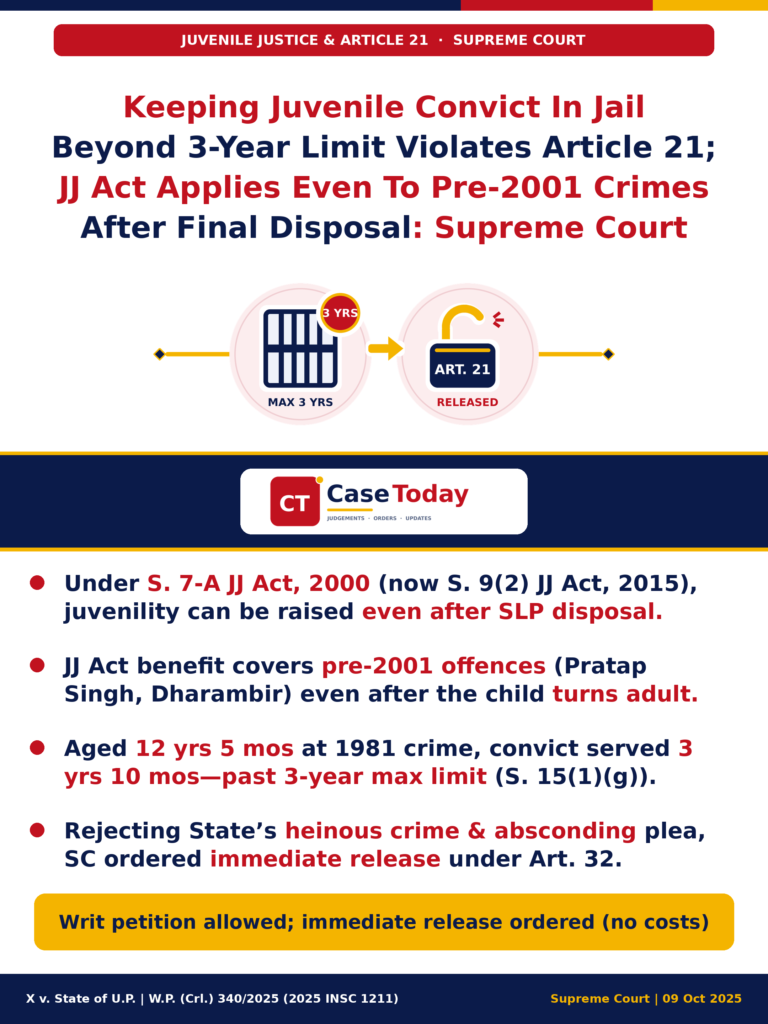
Keeping Juvenile Convict In Jail Beyond 3-Year Limit Violates Article 21; JJ Act Applies Even To Pre-2001 Crimes After Final Disposal: Supreme Court
Case: X (Juvenile In Conflict With Law) v. State of U.P. (Identity Anonymized), Writ Petition (Crl.) No. 340 of 2025 (2025 INSC 1211)
Court: Supreme Court of India
Coram: Hon’ble Mr. Justice Dipankar Datta and Hon’ble Mr. Justice Augustine George Masih
Date of Judgment: 09.10.2025
HEADNOTE
Keywords: Juvenile Justice (Care and Protection of Children) Act, 2000 – Sections 7-A, 15(1)(g), 20 & 49 – Juvenile Justice Act, 2015 – Section 9(2) Proviso – Children Act, 1960 – Section 24 – Constitution of India – Articles 21 & 32 – Claim Of Juvenility At Any Stage Including After Final Disposal Of SLP – Retrospective Benefit For Pre-2001 Offences – Maximum 3-Year Detention Exceeded – Undisputed Age Needs No Fresh Inquiry – Immediate Release Ordered
- Detaining A Juvenile Convict Beyond Maximum 3-Year Limit Violates Article 21 & Warrants Immediate Release Under Article 32: Where the petitioner was admittedly 12 years and 5 months old on the date of a 1981 murder incident and had already undergone 3 years, 10 months, and 28 days of custody—exceeding the 3-year maximum detention period permissible under Section 15(1)(g) of the Juvenile Justice Act, 2000—his continued incarceration curtailed personal liberty contrary to procedure established by law in clear breach of Article 21, entitling him to immediate release (paras 1, 7–8, 13–14).
- Section 7-A JJ Act, 2000 (Now S. 9(2) Proviso, JJ Act, 2015) Applies Retrospectively To Pre-2001 Offences Even After Final Disposal Of SLP: Relying on Pratap Singh v. State of Jharkhand (CB), Dharambir v. State (NCT of Delhi), Hari Ram v. State of Rajasthan, Lakhan Lal v. State of Bihar, and Vinod Katara v. State of U.P., the Court held that all persons below 18 years on the date of offence—even prior to 01.04.2001—must be treated as juveniles, and juvenility can be raised before any court at any stage, even after final disposal of an SLP under Article 136 and after the juvenile has turned adult (paras 3, 9–12).
- No Age Inquiry Needed When Age Is Undisputed; State’s Objections On 1960 Act, Heinous Offence & Absconding Rejected: Rejecting the State’s plea that the 1960 Children Act applied, that murder was a heinous offence (Shilpa Mittal), and that the petitioner had absconded between 2009 and 2022, the Court held that nothing in the 1960 Act barred relief, no fresh age inquiry was required since the petitioner’s age (12 years 5 months) was undisputed and already recorded in the 2009 Supreme Court order, the 1984 children’s home direction was no longer feasible, and his joint trial with adults had breached Section 24 of the 1960 Act (paras 5, 7–8, 12).
- Jail Authorities Directed To Act On Downloaded Copy Of Judgment Without Insisting On Certified Copy: Allowing the writ petition without costs, the Court ordered the petitioner’s immediate release if not wanted in any other case and directed the Senior Superintendent, Central Jail, Varanasi to act upon a downloaded copy of the judgment without insisting on a certified copy (paras 14–16).
BRIEF FACTS
An FIR under Sections 302/149, 147, and 148 IPC alleged that on 02.11.1981, the petitioner (then aged 12 years and 5 months; identity anonymized under the Juvenile Justice Act) along with five others assaulted the informant’s father with a knife and lathis, who died the next day. Arrested on 06.11.1981 and bailed on 08.12.1981, the petitioner was tried jointly with adults in Sessions Trial No. 8 of 1983 and convicted of murder on 14.08.1984 with the aid of Section 149 IPC without any specific role attributed to him. On 16.08.1984, noting he was a child under the Children Act, 1960, the Sessions Court directed he be sent to a children’s home for reformation instead of prison.
The Allahabad High Court (Lucknow Bench) acquitted all accused on 07.04.2000, but on the State’s appeal, the Supreme Court on 08.05.2009 (Criminal Appeal No. 276 of 2002) reversed the acquittal and restored the Sessions Court’s conviction and children’s home order, acknowledging his juvenility. The petitioner absconded and was arrested on 19.05.2022. Having remained in custody for 3 years, 10 months, and 28 days as certified on 14.08.2025, he approached the Supreme Court under Article 32 seeking immediate release under the Juvenile Justice Act, 2000.
KEY FINDINGS OF THE COURT
Note: The findings highlighted in yellow are the main findings most relied upon by the Court.
- Continued detention beyond 3 years violates Article 21; immediate release ordered. Because there was no dispute that the petitioner was a child (12 years 5 months old) on the date of offence and had already spent over 3 years in prison (3 years, 10 months, and 28 days)—exceeding the maximum permissible period under Section 15(1)(g) JJ Act, 2000—his personal liberty stood curtailed contrary to procedure established by law, constituting a clear breach of Article 21 requiring immediate release (paras 1, 7–8, 13–14).
- Section 7-A JJ Act, 2000 (now Section 9(2) proviso, JJ Act, 2015) applies to pre-2001 offences even after final disposal of an SLP. Applying Pratap Singh, Lakhan Lal, Dharambir, Hari Ram, and Vinod Katara, the Court affirmed that persons below 18 years on the date of offence even prior to 01.04.2001 must be treated as juveniles, and courts are obligated to recognize juvenility raised at any stage—even after final disposal of an SLP under Article 136—without needing a fresh inquiry where age is undisputed (paras 9–12).
- Children Act, 1960 creates no bar; joint trial breached Section 24 & children’s home order no longer feasible. No provision of the 1960 Act limited the Court’s authority to grant relief, sending a middle-aged convict to a children’s home was no longer feasible, and the State could not explain why Section 24 of the 1960 Act—barring joint trial of a child with adults—was breached (paras 8, 12).
RESULT
Case Title: X (Juvenile In Conflict With Law) v. State of U.P. (Identity Anonymized)
Reference: Writ Petition (Crl.) No. 340 of 2025 | 2025 INSC 1211
Appearance: For Petitioner: Mr. Parinav Gupta, Advocate. For Respondent (State of U.P.): Mr. Neeraj Shekar, Advocate.