

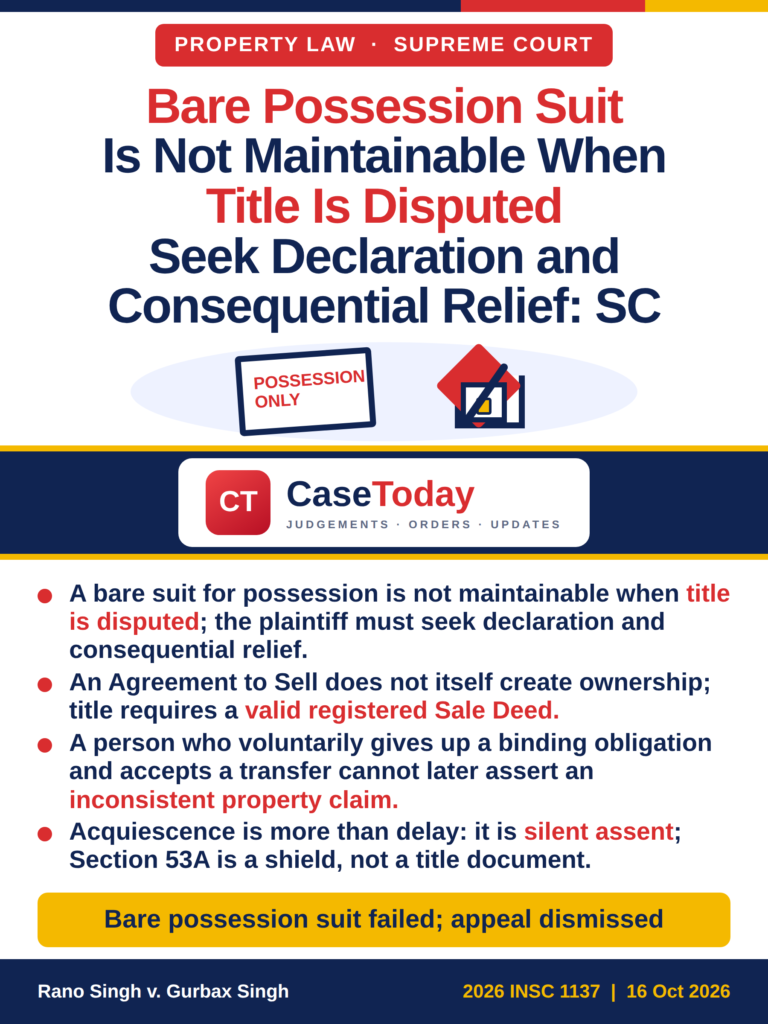
Bare Possession Suit Is Not Maintainable When Title Is Disputed
Seek Declaration and Consequential Relief: SC
Case: Smt. Rano Singh & Others v. Sh. Gurbax Singh (D) Through LRs & Others (Civil Appeal No. 7025 of 2012)
Citation: 2026 INSC 1137
Provisions: Sections 53A and 54, Transfer of Property Act, 1882; Articles 54, 59 and 64, Limitation Act, 1963; doctrine of acquiescence and estoppel
Coram: Justice Aravind Kumar and Justice Vipul M. Pancholi
Date of Judgment: 16 October 2026
HEADNOTE
Keywords: Transfer of Property Act – Agreement to sell – Registered sale deed – Title and ownership – Section 53A – Part performance – Acquiescence – Estoppel – Limitation – Possession – Relinquishment – Contractual obligation – Article 59 – Article 64
- Bare possession suit where title is disputed: When the plaintiff’s title is under dispute, a mere suit for recovery of possession is not maintainable without seeking the necessary declaration and consequential relief, including cancellation of the rival instrument where required.
- Agreement to sell is not title: An agreement to sell does not by itself create any interest, charge or ownership in immovable property. Title passes only through a valid registered sale deed, subject to the applicable law.
- Conduct can defeat a later claim: A party who voluntarily gives up a mandatory contractual obligation, requests or accepts transfer in favour of another, and does not challenge that position cannot later assert an inconsistent right. Such conduct can amount to acquiescence and estoppel.
- Section 53A is a shield, not a title document: The doctrine of part performance protects possession only when its statutory conditions are fulfilled. It does not confer ownership and cannot be used as a substitute for a registered sale deed.
- Limitation matters: A claim for specific performance, cancellation or recovery of possession must be brought within the applicable limitation period. Delay cannot revive rights that have been extinguished by law and conduct.
- Result: The Supreme Court upheld dismissal of the possession suit because the plaintiffs lacked title, were barred by limitation, were estopped by acquiescence and failed to establish part performance.
BRIEF FACTS
Sohan Singh was allotted a plot in Friends Colony, New Delhi under an Agreement to Sell dated 14 January 1952. The agreement required him to construct a house within three years as a condition for completing the transaction.
In 1954, before the construction period expired, Sohan Singh wrote to the Society stating that he could not construct the house and requesting that the plot be transferred to Gurbax Singh, described as his nephew. Gurbax Singh paid the dues, took possession, constructed the house and remained in continuous possession. A registered sale deed was later executed in his favour in 1960.
Sohan Singh did not revoke the letter or challenge the transfer during his lifetime. His legal heirs later filed a suit for possession, alleging that the transfer was fraudulent and that Sohan Singh had acquired ownership through the original agreement and part performance. The trial court and Delhi High Court dismissed the claim.
ISSUE
Whether the legal heirs could claim ownership and possession on the basis of an Agreement to Sell and alleged part performance, despite the absence of a registered sale deed in Sohan Singh’s favour, his written request for transfer to another person, prolonged inaction and the expiry of limitation.
KEY FINDINGS OF THE COURT
- A bare possession suit fails when title is disputed. The plaintiff must seek a declaration of title and the consequential relief required by the disputed instrument, rather than asking for possession alone.
- An Agreement to Sell does not transfer ownership. Under Section 54 of the Transfer of Property Act, a contract for sale only records an agreement that a sale will take place; it does not itself create an interest or charge in the property.
- The 1954 letter was a conscious abandonment. Sohan Singh expressly stated that he could not build the house and requested transfer to Gurbax Singh. He never revoked or challenged that position during his lifetime.
- Acquiescence independently operates as an equitable bar. Acquiescence is not merely delay; it is conduct, with knowledge of the facts and rights, that amounts to silent assent or acceptance of another’s inconsistent dealing.
- Section 53A could not help the plaintiffs. They did not satisfy the requirements of possession, furtherance and readiness and willingness. The provision is a shield for qualifying possession, not a mechanism for acquiring ownership.
- The suit was hopelessly delayed. The relevant periods for specific performance, cancellation and recovery of possession had expired long before the 1975 suit was filed.
- No cogent fraud was proved. The Court declined to accept the allegation that the registered sale deed was fraudulent or collusive in the absence of convincing evidence.
RESULT
Case Title: Smt. Rano Singh & Others v. Sh. Gurbax Singh (D) Through LRs & Others
Citation: 2026 INSC 1137
Judgment: New Delhi, 16 October 2026.