

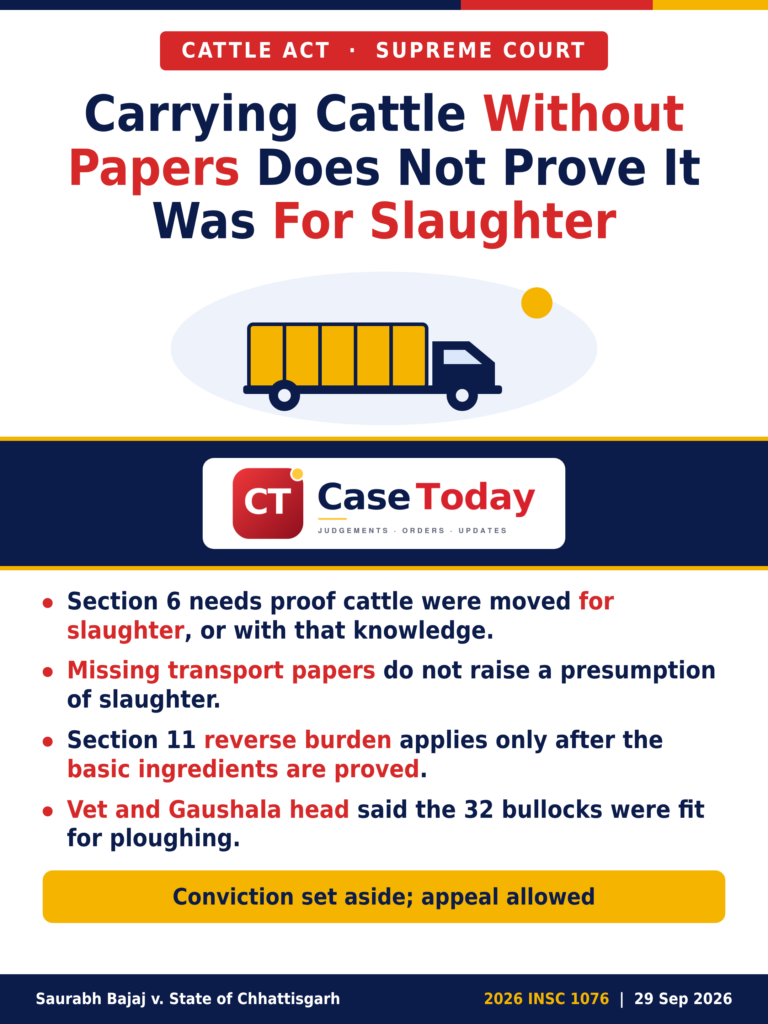
Carrying Cattle Without Documents Does Not Prove
It Was For Slaughter : Supreme Court
Case: Saurabh Bajaj v. State of Chhattisgarh & Ors. (Criminal Appeal arising out of SLP (Crl.) No. 16871 of 2026) – Order
Citation: 2026 INSC 1076
Coram: Justice J.B. Pardiwala and Justice K. Vinod Chandran
Date of Order: 29 September 2026
HEADNOTE
Keywords: Chhattisgarh Agricultural Cattle Preservation Act, 2004 – Sections 6, 10 and 11 – Transportation of Cattle – Intention of Slaughter – Reverse Burden of Proof – Absence of Transport Documents – Escort Vehicle – Seizure Witnesses – Veterinary Report
- Essential ingredient of Section 6: The offence is transport of cattle for slaughter, or with knowledge that they are likely to be slaughtered. A mere presumption of such intention by the seizing police officer is not proof.
- Reverse burden under Section 11: The presumption applies only after the essential ingredients of the offence are proved by the prosecution. Only then must the accused prove that the transport was not in violation of the Act.
- Absence of documents: That transport was not accompanied by documents does not raise a presumption that it was for slaughter. If a statute requires documents, the consequences should flow from that statute and cannot lead to an assumption of violation of this Act.
- Escort allegation: There was nothing substantial to prove that the Bolero car was escorting the truck.
- Fitness of the cattle: Where the veterinary doctor and the president of the Gaushala Committee stated that the cattle were fit for agriculture, such as ploughing, there is no reason to uphold the conviction.
BRIEF FACTS
The appellant, Saurabh Bajaj, was one of six accused convicted under the Chhattisgarh Agricultural Cattle Preservation Act, 2004for transporting cattle in violation of Section 6. It was alleged that 32 bullocks were being carried in a truck from Keduwa towards Odisha when the truck was stopped by PW3, a Head Constable, acting on information. The cattle were seized, and the driver and the cleaner were arrested. A Bolero car moving ahead of the truck was also detained on the allegation that it was escorting the truck, and its four occupants, including the appellant, were arrested.
The Trial Court sentenced the accused to one year’s rigorous imprisonment and a fine of Rs. 1,000 under Section 10. The First Appellate Court and the Revisional Court affirmed the conviction, and the High Court limited the sentence to the period already served. The appellant approached the Supreme Court challenging his conviction. The prosecution examined five witnesses, including a veterinary doctor (PW1, report Ex.P1), the head constable (PW3), the president of the Gaushala Committee (PW5), and two seizure witnesses (PWs 2 and 4).
KEY FINDINGS OF THE COURT
Note: The findings highlighted in yellow are the main findings of the Court most relied upon for the judgment.
- Slaughter intent was not proved. Section 6 requires transport for slaughter or with knowledge that the cattle were likely to be slaughtered. Apart from the Head Constable’s presumption, nothing on record showed the cattle were carried for slaughter. What was established was only that the truck was intercepted and the cattle seized (paras 7–8).
- Section 11 reverse burden is not automatic. The reverse presumption applies only if the essential ingredients of the offence are first proved before the Trial Court. The Court held that the High Court could not rely on Section 11 without that foundation (para 8).
- Missing transport documents do not prove slaughter. Absence of documents to validate the transport cannot lead to a presumption that it was for slaughter. If documents were required by another statute, consequences should flow under that statute and not an assumption of violation of this Act (para 8).
- Cattle were fit for farm use. The veterinary doctor’s report (Ex.P1) and the Gaushala president (PW5), who had custody of the cattle, both said the animals were fit and good for ploughing. The Court said there was “absolutely no reason” to uphold the conviction (paras 5, 9).
- Escort allegation unproved. There was nothing substantial to show that the Bolero car was escorting the truck. The truck driver’s plea that the car’s occupants hired the truck and owned the cattle was not taken before the Trial Court or in the Section 313 statement (para 7).
- Seizure witnesses. The two seizure witnesses turned hostile but accepted their signatures on the mahazar, and did not identify any of the accused (para 5).
RESULT
Case Title: Saurabh Bajaj v. State of Chhattisgarh & Ors.
Citation: 2026 INSC 1076
Appearance: Counsel are not named in the order.