

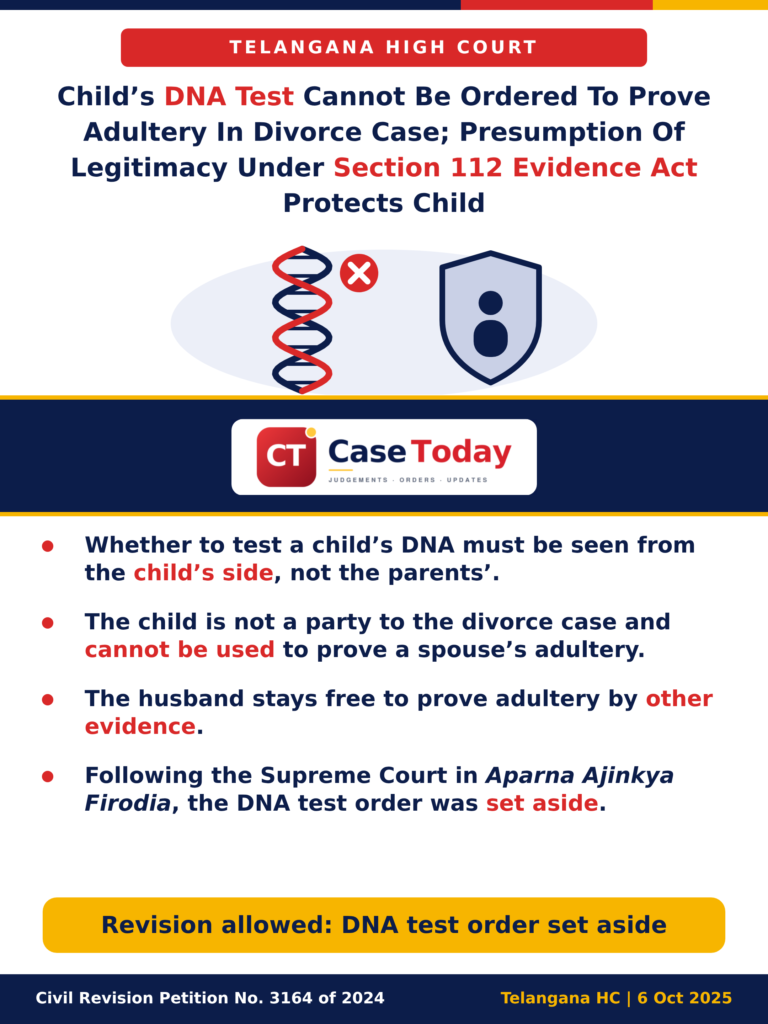
Child’s DNA Test Cannot Be Ordered To Prove Adultery In Divorce Case; Presumption Of Legitimacy Under Section 112 Evidence Act Protects Child: Telangana High Court
Case: Civil Revision Petition No. 3164 of 2024 (arising from I.A. No. 173 of 2024 in H.M.O.P. No. 39 of 2024, Senior Civil Judge, Jagtial)
Court: High Court for the State of Telangana at Hyderabad
Judge: Hon’ble Smt. Justice Renuka Yara
Delivered: 6 October 2025
HEADNOTE
- Child’s side, not the parents’: Whether a DNA test of a child should be permitted is to be analysed through the prism of the child and not of the parents (paras 11–12, applying Aparna Ajinkya Firodia v. Ajinkya Arun Firodia, (2024) 7 SCC 773).
- Child is not a party: The divorce petition is between the spouses. The child cannot be used as a pawn to show that the mother was living in adultery (paras 11–12).
- Other evidence remains open: The husband can still prove adultery by other evidence (para 12).
- Section 112 Evidence Act: The Court noted the Supreme Court’s guideline that a DNA test of a child born during a valid marriage may be directed only when there is sufficient prima facie material to dislodge the presumption of legitimacy under Section 112, and that it may not be directed if no plea of non-access has been raised (paras 10–11).
- Caution about privacy: Courts are extremely cautious about invading the privacy of a minor child, and the child’s welfare is taken into consideration over and above all other circumstances (para 10).
BRIEF FACTS
A husband filed H.M.O.P. No. 39 of 2024 before the Senior Civil Judge, Jagtial, for dissolution of marriage under Section 13(1)(i)(ia) of the Hindu Marriage Act, 1955, alleging that his wife had an extramarital relationship with another man and was quarrelsome. He said that on 26.05.2022 she declared that their minor child was not his but the other man’s. In that case he filed I.A. No. 173 of 2024 under Section 45 of the Indian Evidence Act, 1872, for a DNA test of himself and the child to establish paternity. The wife opposed, saying the husband could manipulate the laboratory and had already got a private DNA test and used it to turn her and the child out. The Trial Court allowed the application on 17.09.2024, holding that adultery has to be proved in a divorce petition on that ground. The wife filed this revision under Article 227.
LEGAL ISSUE
Whether, in a divorce petition based on adultery, the Trial Court could direct a DNA test of the minor child to prove paternity, despite the presumption of legitimacy under Section 112 of the Evidence Act and the Supreme Court’s guidelines in Aparna Ajinkya Firodia.
KEY FINDINGS OF THE COURT
- Reason for the Section 112 presumption: The Court observed that the Evidence Act of 1872 was enacted when DNA testing was not available, and paternity was inferred from access during a valid marriage. DNA tests are now granted only where necessary, with great caution (para 10).
- Trial Court’s approach: The Trial Court had relied on Nandlal Wasudeo Badwaik, Sharda v. Dharmpal, Goutam Kundu, Dipanwita Roy and Aparna Ajinkya Firodia, and held that adultery must be proved. The High Court did not agree with that outcome in view of Aparna (paras 6, 12).
REASONING
The wife’s counsel relied on Aparna Ajinkya Firodia and Section 112, saying the husband never said he had no access to the wife during the marriage. The Court quoted the Supreme Court’s observations that the question of a DNA test on a child is to be seen through the child’s eyes, that the child cannot be a pawn in a dispute over the mother’s conduct, and that the child’s right to identity should not be sacrificed. It applied this ratio directly to the present divorce petition and set aside the order (paras 7–12). The Court did not decide the merits of the adultery allegation.
RESULT
Case title: Civil Revision Petition No. 3164 of 2024
Appearance: M/s. Alluri Divakar Reddy, Advocate, for the revision petitioner (wife); Mr. Y. Bala Murali, Advocate, for respondent No. 1 (husband); none appeared for respondent No. 2.