

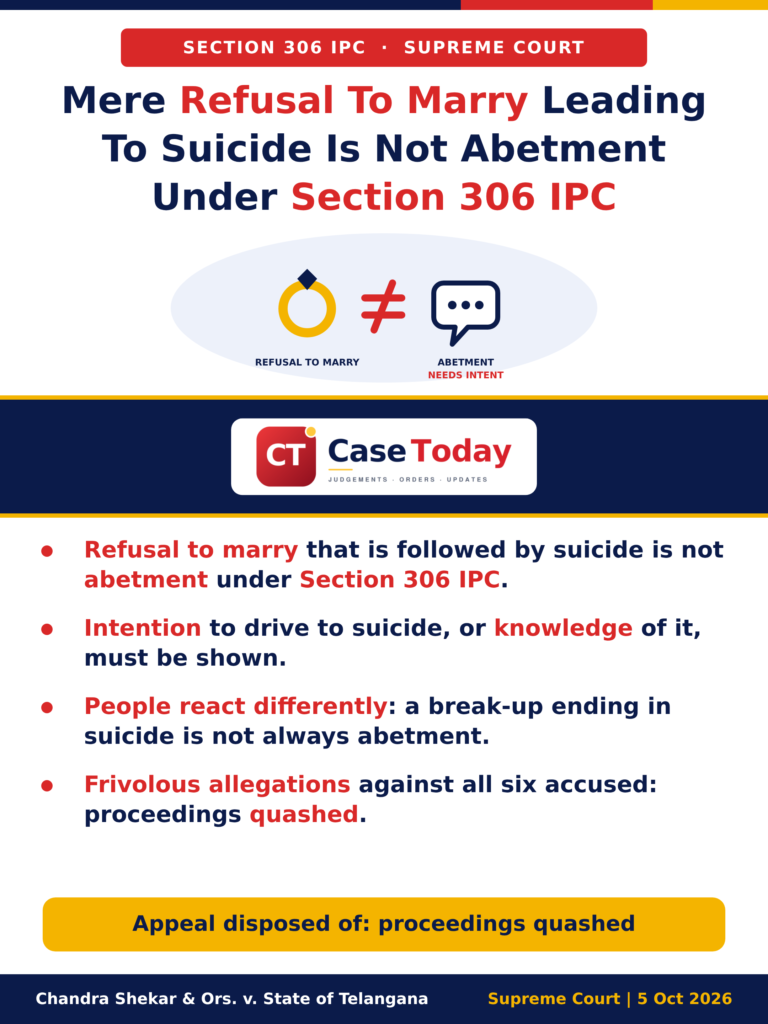
Mere Refusal To Marry Leading To Suicide
Is Not Abetment Under Section 306 IPC : Supreme Court
Case: Chittibarika Chandra Shekar & Ors. v. State of Telangana & Anr. (Criminal Appeal arising out of SLP (Crl.) No. 7239 of 2026) – Order
Court: Supreme Court of India
Citation: Not stated in the order
Coram: Justice J. B. Pardiwala and Justice K. Vinod Chandran
Date of Order: 5 October 2026
HEADNOTE
Keywords: Indian Penal Code, 1860 – Sections 306 and 34 – Abetment of Suicide – Instigation – Intention – Knowledge – Refusal to Marry – Break-up of Relationship – Quashing of Proceedings – Sessions Case No. 101 of 2024
- Refusal to marry is not abetment by itself: Even if the complainant’s version is fully believed, a refusal of marriage that was followed by the woman’s suicide cannot be termed abetment of suicide under Section 306 IPC. A break-up that ends in suicide is not always abetment.
- Intention or knowledge must be shown: The refusal to marry must have been made with the intention to drive the woman to suicide, or the accused must have had knowledge that she would take her life on such refusal. Without that, there is no abetment.
- Instigation is the core of abetment: The Court found no instigation by the accused to drive the deceased to suicide. The act was neither intended nor an abetment. People react differently to situations.
- Opposition by family and friends is not instigation here: The allegation that the accused’s family and friend spoke ill of the deceased or opposed the marriage was treated as no instigation to suicide.
- Frivolous prosecution is quashed: The Court was unable to sustain the prosecution on such frivolous allegations and quashed the proceedings against all six accused.
- Consequential directions: Accused in custody are to be released forthwith, if not required in another case, and the bail bonds of those on bail are cancelled.
BRIEF FACTS
Six accused were charged under Section 306 read with Section 34 IPC. The first appellant was in a relationship with the deceased, and they were living together in his house. The deceased’s siblings alleged that she died by suicide because he refused to marry her. The FIR was registered on the statement of her sister. It was admitted that the relationship was consensual, that they had lived together for three months, and that the first appellant’s family had accepted it.
The other accused were his father (second appellant), mother (sixth appellant), sister (third appellant), the sister’s proposed bridegroom (fifth appellant), and a friend (fourth appellant). It was alleged that the friend spoke ill of the deceased, and that the sister and parents urged the first appellant not to continue the relationship, as the proposed bridegroom had refused to marry the sister if the first appellant married the deceased. The appellants challenged the order dated 20.02.2026 of the Telangana High Court in Criminal Revision Case No. 763 of 2025, and sought quashing of Sessions Case No. 101 of 2024.
KEY FINDINGS OF THE COURT
Note: The findings highlighted in yellow are the main findings of the Court most relied upon for the judgment.
- A refusal to marry that is followed by suicide is not abetment of suicide. The Court said that at the worst, even if the informant is fully believed, there was a refusal of marriage which led to the woman committing suicide. People react differently to situations, and if a break-up ends in suicide, it cannot always be termed abetment (para 6).
- Intention to drive the woman to suicide, or knowledge of it, was absent. The refusal to marry was not made with an intention to drive her to death by suicide, and knowledge cannot be attributed to the accused that she would commit suicide on such refusal. The Court found no instigation by any of the appellants (para 6).
- The prosecution was quashed as based on frivolous allegations. The Court was unable to sustain the prosecution and quashed the proceedings in Sessions Case No. 101 of 2024pending before the II Additional Senior Civil Judge-cum-Additional Chief Judicial Magistrate, Medchal-Malkajgiri District at Kushaiguda (para 7).
- Admitted facts noted by the Court. The informant admitted a consensual relationship, that the couple lived together for three months, and that the accused’s family accepted it. The Court found it difficult to understand why the informant and her sister took the deceased away from that house (paras 3, 6).
- Release and bail bonds. Accused in custody are to be released forthwith unless required in any other case, and bail bonds of accused on bail stand cancelled (para 8).
RESULT
Case Title: Chittibarika Chandra Shekar & Ors. v. State of Telangana & Anr.
Citation: Not stated in the order
Appearance: For the appellants: Ms. Aparna Bhat, Senior Advocate, with Mr. Yash S. Vijay (AOR) and others. For the respondents: Ms. Devina Sehgal (AOR), M/s Shakil Ahmad Syed (AOR) and others, as recorded in the Record of Proceedings.
Chittibarika Chandra Shekar & Ors. v. State of Telangana & Anr.