

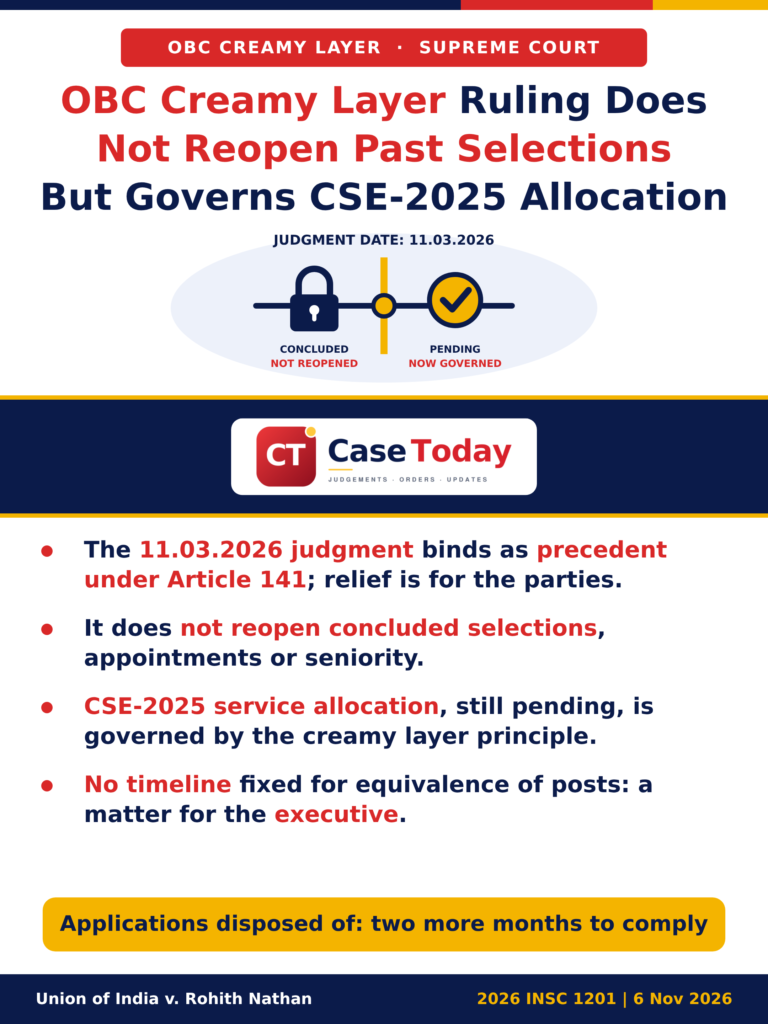
OBC Creamy Layer Ruling Does Not Reopen Past Selections
But Governs CSE-2025 Allocation : Supreme Court
Case: Union of India & Ors. v. Rohith Nathan & Anr., etc. (Miscellaneous Application Nos. 3313–3315 and 3316–3318 of 2026 in Civil Appeal Nos. 2827–2829 of 2018) – Order
Court: Supreme Court of India
Citation: 2026 INSC 1201
Coram: Justice Pamidighantam Sri Narasimha and Justice R. Mahadevan
Date of Order: 6 November 2026
HEADNOTE
Keywords: Article 141 – Binding Precedent – Stare Decisis – Prospective Operation – OBC Creamy Layer – Income/Wealth Test – Category VI, O.M. dated 08.09.1993 – DoPT Letter dated 14.10.2004 – Salary Income – Civil Services Examination 2025 – Supernumerary Posts – Miscellaneous Application – Clarification
- Binding principle is distinct from the relief: The judgment dated 11.03.2026 decided the rights of the parties before the Court. Its interpretation of the 1993 OM and 2004 Letter is a binding precedent under Article 141 and attracts stare decisis, but the operative relief is confined to the parties, including the intervenors.
- No reopening of concluded selections: The judgment does not direct the Union to revisit appointments, revise seniority, or redo service allocations already concluded. The ratio by itself is not a ground to reopen selections or appointments made before 11.03.2026.
- Similarly placed persons: Claims of persons who say they are similarly placed, and whose cases are pending before any Court, Tribunal or authority, are to be considered on their own merits by that forum. The interpretation in the judgment may be taken into consideration.
- Pending CSE-2025 allocation is covered: The result of the Civil Services Examination, 2025 was declared on 06.03.2026, but service allocation was not finalised. There is no reasonable justification to defer the judgment, so the creamy layer principle as interpreted governs allocation of services to OBC candidates. Selections made after 11.03.2026 are also governed by it.
- Paragraphs 42 to 44 read together: “Candidates” in para 43 means the intervenors in para 42. The Government may create supernumerary posts to accommodate the parties before the Court who fulfil the eligibility conditions.
- Applications are not a rehearing: Miscellaneous applications are only for clarifying scope or genuine difficulty in implementation. The Court declined to fix a timeline for establishing equivalence of posts, which is for the executive and legislature. The Government remains free to frame its creamy layer policy.
BRIEF FACTS
Candidates who cleared the Civil Services Examination were denied OBC (Non-Creamy Layer) benefits because the DoPT counted their parents’ income from Public Sector Undertakings under Category VI of the 1993 OM, read with the 2004 Letter, as no equivalence of PSU posts with Government posts had been fixed. The CAT ruled for the candidates, and the High Courts of Madras, Delhi and Kerala dismissed the Union’s writ petitions. By judgment dated 11.03.2026, the Supreme Court dismissed the Union’s Civil Appeal Nos. 2827–2829 of 2018 and directed that the claims of the respondent candidates and intervenors be considered and implemented within six months.
The Union of India then filed miscellaneous applications (delay condoned). It asked to finalise CSE-2025 service allocation on the earlier principles, for the judgment to apply only prospectively, and for two years to fix equivalence of posts. The Solicitor General said the CSE-2025 result was declared on 06.03.2026, five days before the judgment, and that more than 6.69 lakh reserved vacancies, including 3.70 lakh OBC vacancies, filled in ten years could be affected. The respondents and the intervenors opposed the applications.
KEY FINDINGS OF THE COURT
Note: The findings highlighted in yellow are the main findings of the Court most relied upon for the judgment.
- The 11.03.2026 judgment does not operate retrospectively. The Court found no observation or direction to revisit appointments, revise seniority or redo allocations. The applications proceeded on an erroneous assumption that the Union had to undertake a general exercise within six months. That period was for the respondent candidates and intervenors only, so no further time was needed for an exercise never directed. The DoPT had itself said in 2016 that selections were subject to the outcome of the appeals (paras 13, 15, 18(ii), 18(v)).
- CSE-2025 service allocation is governed by the judgment. As allocation was still pending, and the Union gave no convincing justification for deferring implementation, the creamy layer principle as interpreted shall govern allocation of services to OBC candidates selected in CSE-2025. Selections and allotments after 11.03.2026 follow the 1993 OM as interpreted (paras 18(vi), 18(ix)).
- Article 141 principle versus relief to parties. The binding legal principle is distinct from the operative relief. The original proceedings were between identified candidates, and the relief, including the direction on supernumerary posts, must be understood in that context. Non-parties may pursue their own claims before the competent forum (paras 11.1–11.3, 13, 18(v)).
- Paragraphs 42, 43 and 44 explained. Para 43 refers to the intervenors in para 42. The DoPT’s assurance on supernumerary posts, recorded in the 21st Report of the Parliamentary Committee on the Welfare of OBCs, allows the Government to accommodate the parties before the Court (paras 14, 18(iii)–(iv)).
- No timeline for policy; no rehearing. Equivalence of posts and consultation with stakeholders are matters for the executive and legislature. The Government remains at liberty to formulate its policy in accordance with the Constitution. The interpretation of the 1993 OM and 2004 Letter and the rejection of mechanical exclusion on salary income were not open to reconsideration (paras 11, 16–17, 18(vii)–(viii)).
RESULT
Case Title: Union of India & Ors. v. Rohith Nathan & Anr., etc.
Citation: 2026 INSC 1201
Appearance: Mr. Tushar Mehta, Solicitor General, for the Union of India; Mr. Prateek K. Chadha for Respondent No. 1 (Rohith Nathan); Mr. P. Wilson, Senior Counsel; Ms. Karina Chawla for Respondent No. 3 (G. Babu); Mr. Sanjay Hegde, Senior Counsel, for intervenors (Yashvardhan Singh and others); Miss Gauraan for intervenor M. Sindhuja. Other counsel are not named in the order.