

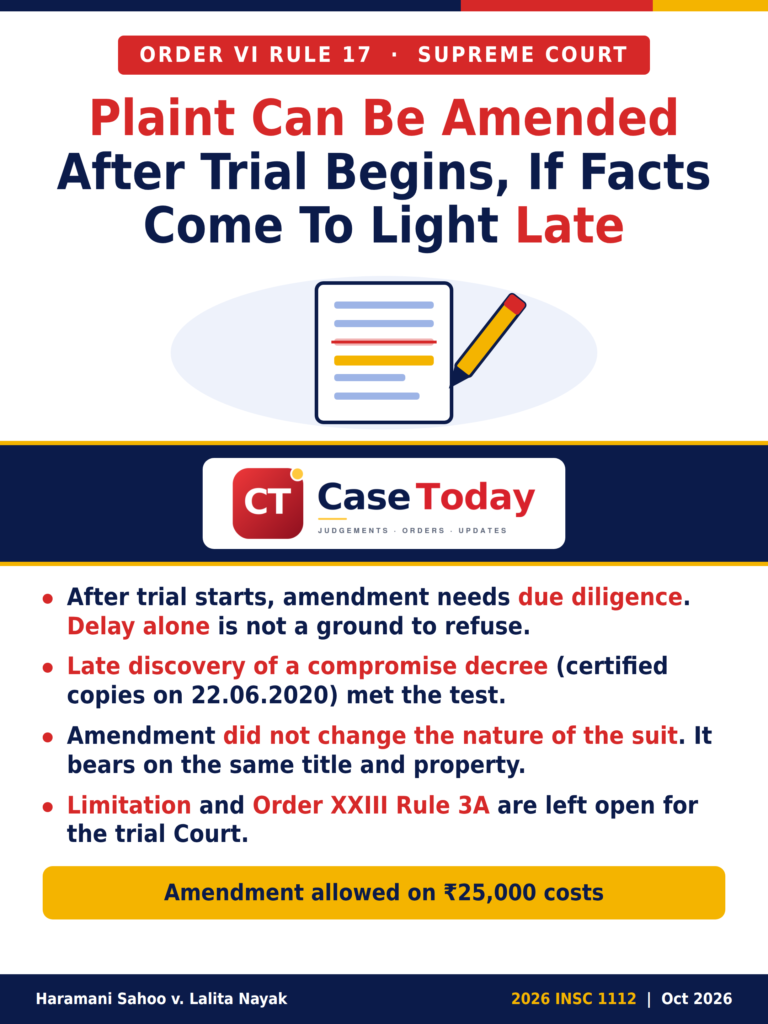
Case: Haramani Sahoo & Ors. v. Lalita Nayak & Ors. (Civil Appeal No. 13681 of 2026 arising out of SLP (C) No. 25635 of 2023)
Citation: 2026 INSC 1112
Coram: Justice B.V. Nagarathna and Justice R. Mahadevan (Judgment authored by Justice Mahadevan)
Date of Judgment: October 2026 (the exact date is not shown in the text of the judgment)
HEADNOTE
Keywords: Code of Civil Procedure, 1908 – Order VI Rule 17 and Proviso – Amendment of Plaint after Commencement of Trial – Due Diligence – Real Controversy Test – Nature and Character of Suit – Limitation – Order XXIII Rule 3A – Compromise Decree – Multiplicity of Proceedings – Costs
1. Amendment after trial begins: Once the trial has commenced, the proviso to Order VI Rule 17 requires the party to show that, despite due diligence, the matter could not have been raised earlier. A belated stage is not by itself determinative.
2. Late discovery satisfies due diligence: Where the proposed pleading rests on the subsequent discovery of a decree affecting part of the very suit property, the plaintiff was not a party to it, and the defendants did not disclose their vendors’ source of title, the explanation is not a mere omission or negligence.
3. Nature of suit: An amendment that only brings on record additional facts and consequential reliefs having a direct nexus with the existing controversy does not change the nature and character of the suit, even if it enlarges the questions to be decided.
4. Limitation and Order XXIII Rule 3A: Where limitation is arguable and depends on the date of knowledge, the amendment need not be rejected at the threshold. The question is left open for the trial Court unless the claim is ex facie barred.
5. Prejudice and multiplicity: Prejudice from having to meet additional pleadings can be cured by an additional written statement and costs. Refusal may split the title dispute into separate proceedings with the risk of inconsistent findings.
6. Permission is not acceptance: Allowing an amendment does not accept the averments or give the plaintiff any right in respect of the compromise decree.
BRIEF FACTS
The original plaintiff, Rabindranath Sahoo (now represented by his legal heirs), filed C.S. No. 86 of 2009 before the Senior Civil Judge, Second Court, Cuttack, seeking declaration of title, recovery of possession and rectification of sale deeds dated 15.02.1971 and 28.07.1978 for Hal Plot Nos. 3370/4045 and 3371/4050. Over the years he amended the plaint several times. After the defendants disclosed their records, he found that a compromise decree in T.S. No. 105 of 1998, to which he was not a party, had allotted part of Plot No. 3371/4050 to Defendant No. 8. He obtained certified copies of the plaint and decree on 22.06.2020.
He then sought an amendment under Order VI Rule 17 CPC to plead these facts and to have the decree declared null and void. The trial Court rejected the application on 21.09.2022, and the Orissa High Court declined to interfere on 10.04.2023 (C.M.P. No. 1091 of 2022). The respondents argued that the application came about 14 years after the suit and was barred by limitation and by Order XXIII Rule 3A. The legal heirs appealed to the Supreme Court.
KEY FINDINGS OF THE COURT
Note: The findings highlighted in yellow are the main findings of the Court most relied upon for the judgment.
1. Due diligence was satisfied. Since the trial had begun, the proviso applied. The Court found that the later discovery of the compromise decree, the plaintiff not being a party to it, and the non-disclosure of the vendors’ source of title were enough to accept the plea of due diligence at this stage. It was not necessary to finally decide the exact date of knowledge. Basavaraj v. Indira was distinguished on its own facts (paras 12–13.2, 21).
2. The amendment does not change the nature of the suit. The suit concerns title and possession of the same property. The amendment brings in facts about a decree affecting a portion of that property, so it has a direct nexus with the original cause of action. Enlarging the factual and legal questions is not a fundamental alteration (paras 14–14.1).
3. Limitation and Order XXIII Rule 3A left open; amendment allowed on costs. Relying on Ragu Thilak D. John, Sampat Kumar and Pankaja, the Court held that arguable limitation should be decided by the trial Court. The objection under Order XXIII Rule 3A, maintainability of the challenge to the decree and the binding nature of the decree were also left open. Considering the long delay, the amendment was allowed subject to costs (paras 15–18, 22).
4. Principles on amendment applied. The Court restated that the real controversy test is the basic test, relying on A.K. Gupta & Sons, Rajesh Kumar Aggarwal, Abdul Rahman, Revajeetu Builders, LIC v. Sanjeev Builders and Akkiraju Panduranga Rao. Courts should be liberal and avoid hyper-technical views, but must decline time-barred new claims or those that change the suit (paras 9–11.6).
5. Prejudice and multiplicity. The respondents’ prejudice arises only from having to meet more pleadings. It can be met by an additional written statement and costs. Refusal could split the dispute and lead to inconsistent findings on the same land (paras 19–20).
RESULT
Appeal allowed. The trial Court’s order dated 21.09.2022 and the High Court’s order dated 10.04.2023 were set aside, and the amendment application was allowed on payment of costs of Rs. 25,000 to the contesting respondents within two weeks. The appellants must carry out the amendments within four weeks after that, and the respondents may file additional written statements within the time fixed by the trial Court. All questions of limitation, maintainability, Order XXIII Rule 3A, the compromise decree, title and possession are left open (paras 23–25).
Case Title: Haramani Sahoo & Ors. v. Lalita Nayak & Ors.
Citation: 2026 INSC 1112