

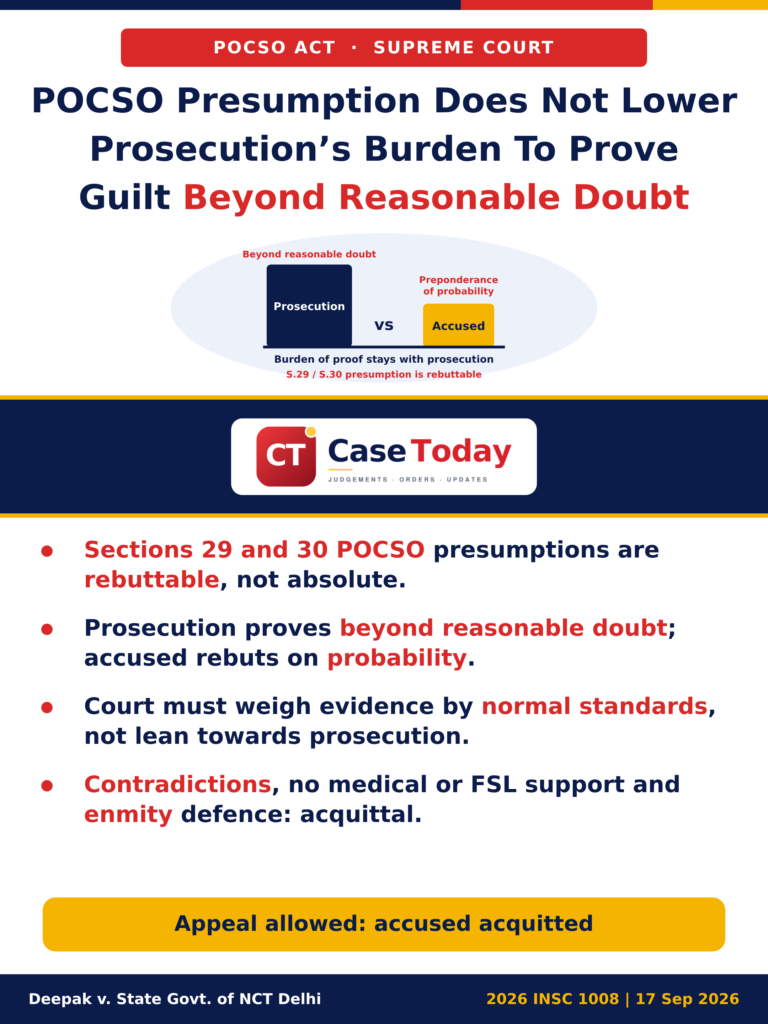
POCSO Presumption Does Not Lower Prosecution’s Burden
To Prove Guilt Beyond Reasonable Doubt : Supreme Court
Case: Deepak in JC v. State Govt. of NCT Delhi(Criminal Appeals arising out of SLP (Crl.) Nos. 21271-72 of 2025) – Judgment
Court: Supreme Court of India
Citation: 2026 INSC 1008
Coram: Justice Prashant Kumar Mishra and Justice N.V. Anjaria (Judgment by Justice N.V. Anjaria)
Date of Judgment: 17 September 2026
HEADNOTE
Keywords: Protection of Children from Sexual Offences Act, 2012 – Sections 29 and 30 – Statutory Presumption – Reverse Burden – Rebuttable Presumption – Proof Beyond Reasonable Doubt – Preponderance of Probability – Sterling Witness – Medical and FSL Evidence – Section 363 IPC – Section 6 POCSO – Fair Trial – Rai Sandeep alias Deepu v. State (NCT of Delhi) – Kali Ram v. State of Himachal Pradesh – Noor Aga v. State of Punjab
- POCSO presumption does not lower the prosecution’s burden to prove guilt beyond reasonable doubt: The presumptions under Sections 29 and 30 of the POCSO Act are rebuttable and only shift the evidential burden. The prosecution must still prove guilt beyond reasonable doubt, and the Court must weigh the evidence by normal standards, without leaning towards the prosecution because of the presumption (paras 7.4, 7.7, 9–9.2).
- Accused need only rebut on preponderance of probability: The accused is not required to prove his defence beyond reasonable doubt. He may rebut the presumption by discrediting the witnesses, showing inconsistencies and gaps, pointing to a mismatch of ocular and medical evidence, or raising a probable defence. Once rebutted, the presumption disappears (paras 7.5–7.5.2, 7.8.4).
- Presumptions are not absolute and cannot override fair trial: The presumption operates only after the prosecution establishes the foundational facts. It cannot discount the norms of fair trial under Article 21 of the Constitution (Navin Dhaniram Baraiye; Naresh Kumar alias Nitu v. State of H.P.) (paras 7.3, 7.6).
- Sole testimony must be of sterling quality: A conviction on the sole evidence of the prosecution witness needs a sterling witness, whose version is consistent from the first account to the trial and matches the medical and scientific evidence (Rai Sandeep alias Deepu; Ganesan). The complainant mother (PW-5) was not a sterling witness: her account had material improvements over the FIR, and the doctor (PW-1) was found unreliable (paras 5.2–5.8).
- Medical and FSL evidence ruled out penetrative assault: The doctor who examined the child found no injury and the hymen intact. The FSL found no semen, no male DNA and no blood on the pyjami. The Court distinguished State of U.P. v. Babul Nath(absence of injury or semen does not by itself disprove the offence), as here the evidence ruled out the prosecution theory (paras 5.3–5.5).
- Probable defence of enmity; conviction set aside: The mother admitted a common water connection shared by four houses and a quarrel over water. This made the defence that the complaint was motivated by enmityprobable. The conviction under Section 363 IPC and Section 6 POCSO was set aside(paras 6–6.2, 10).
BRIEF FACTS
The complaint dated 11.12.2015 was lodged at Kalkaji Police Station by the mother of a girl aged about 2.5 years. She said that on 09.12.2015, around 5.30 pm, the child went to the jhuggi of the appellant, next to theirs, and was later seen with him at Hans Raj City Park. The mother alleged that after returning home the child was distressed, that blood was seen on her pyjami, and that the child said the appellant had committed a penetrative act. FIR No. 1085 of 2015 was registered on 11.12.2015. A chargesheet was filed on 24.03.2016under Sections 363, 376 and 506 IPC and Sections 4 and 5 POCSO Act. Charges were framed on 12.07.2017 under Sections 363 and 506 IPC and Section 4 POCSO Act, and 13 witnesses were examined.
By judgment dated 21.08.2023 in Sessions Case No. 26 of 2016, the Additional Sessions Judge-01 (Special Court under POCSO), South-East, Saket Courts convicted the appellant under Section 363 IPC and Section 6 of the POCSO Act, and acquitted him under Section 506 IPC. He was sentenced to 10 years’ rigorous imprisonmentand fine of Rs. 5,000 under Section 6 POCSO, and one year’s rigorous imprisonment and fine of Rs. 3,000 under Section 363 IPC, with Rs. 7,000 of the fine to be paid to the victim. The Delhi High Court, by judgment dated 03.07.2025 (Criminal Appeal No. 1029 of 2023), dismissed his appeal. It relied on the Section 29 POCSO presumption and did not accept the FSL report, saying the mother may have washed the pyjami. The appellant came to the Supreme Court.
KEY FINDINGS OF THE COURT
Note: The findings highlighted in yellow are the main findings of the Court most relied upon for the judgment.
- Sections 29 and 30 POCSO create rebuttable presumptions that do not dilute the standard of proof. They are a departure from the presumption of innocence, but are not absoluteand shift only the evidential burden. The prosecution must still prove guilt beyond reasonable doubt, while the accused can rebut on preponderance of probability. If two views are possible, the one favouring the accused is adopted. Courts must not weigh evidence under the shadow of the presumption (paras 7–7.8.4, 8–9.2).
- The prosecution case was not proved: the mother was not a sterling witness. PW-5 and the doctor (PW-1) contradicted each other on the time of the visit (4–5 pm against 9.30 pm) and on who accompanied the child. PW-5 added at trial that the accused spoke of lighting a fire in the park and that the child described a penetrative act, neither of which was in the FIR. PW-1 kept no papers and no police witness confirmed his call (paras 5.2–5.2.5, 5.7–5.9).
- Medical and FSL evidence negated the theory of sexual assault. No injury or bloodstain was found by Dr. Varnit, the hymen was intact, the FSL found no semen, no male DNA and no blood on the pyjami, and PW-7 found nothing abnormal. The evidence showed not merely absence of penetration but negatived the theory of sexual assault, which distinguishes Babul Nath (paras 5.3–5.5).
- The defence of enmity over water sharing was probable. PW-5 admitted a common water connection for four houses and the quarrel over water sharing. With the weak prosecution evidence, the complaint could be seen as motivated and made out of enmity (paras 6–6.2).
- The accused rebutted the presumption. Even if Sections 29 and 30 first operated against him, the evidence showed inconsistencies, improbabilities and material contradictions, the medical evidence did not support the prosecution, and the defence was cogent. The prosecution failed to prove guilt beyond reasonable doubt (para 10).
RESULT
Case Title: Deepak in JC v. State Govt. of NCT Delhi
Citation: 2026 INSC 1008
Appearance: Mr. Pulkit Prakash, Advocate-on-Record, with other advocates, for the appellant; Mr. Davinder Pal Singh, Additional Solicitor General, assisted by other advocates, for the respondent.