

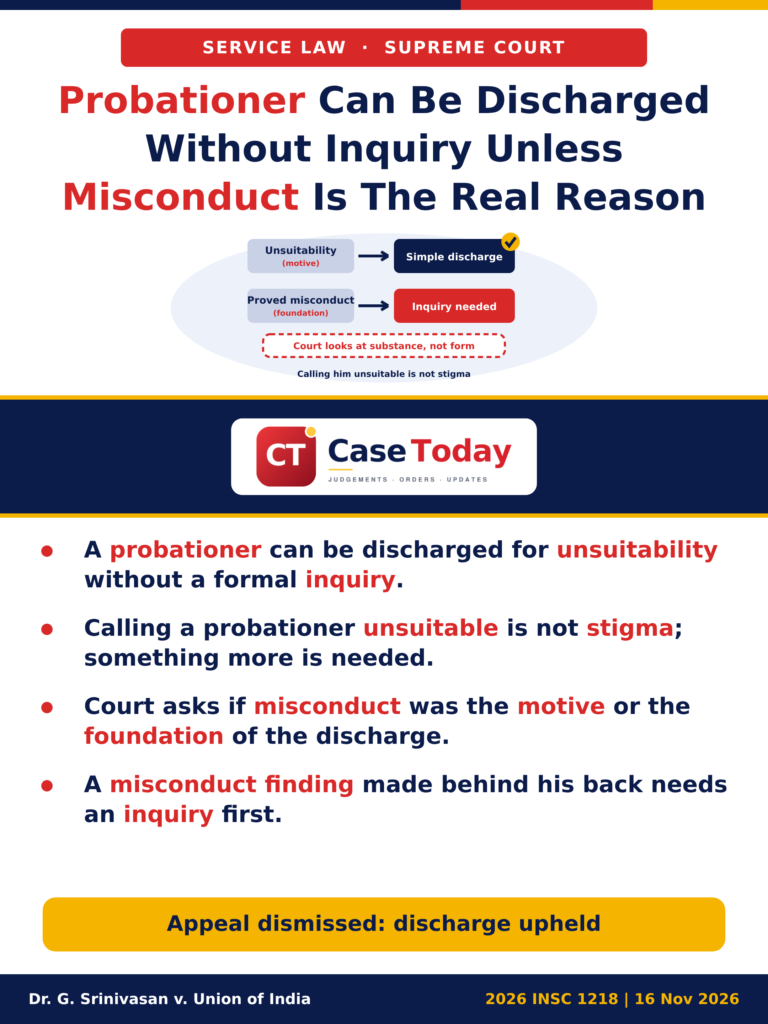
Probationer Can Be Discharged Without Inquiry Unless
Misconduct Is The Real Reason : Supreme Court
Case: Dr. G. Srinivasan v. Union of India & Ors.(Civil Appeal No. 479 of 2018) – Judgment
Court: Supreme Court of India
Citation: 2026 INSC 1218
Coram: Justice Dipankar Datta and Justice Sheel Nagu (Judgment by Justice Dipankar Datta)
Date of Judgment: 16 November 2026
HEADNOTE
Keywords: Service Law – Probation – Discharge of Probationer – Termination Simpliciter – Punitive Termination – Stigma – Motive and Foundation – Form and Substance – Lifting the Veil – Article 311(2) – Regulation 13.5, Indian Institute of Science – Ajit Singh v. State of Punjab – Samsher Singh v. State of Punjab – Dipti Prakash Banerjee v. Satyendranath Bose National Centre – Pavanendra Narayan Verma v. Sanjay Gandhi PGI
- A probationer can be discharged without inquiry unless misconduct is the real reason: A probationer has no right to continue and can be discharged for general unsuitability without a formal inquiry. The discharge is punitive only if, on a fair reading of the whole record, the real basis (the foundation) was a finding of misconduct made without inquiry. Where unsuitability was the real ground and misconduct was at most the motive, the order stands as termination simpliciter (paras 40, 45–49).
- Probation is a period of trial: Following Ajit Singh v. State of Punjab, probation lets the employer assess the employee’s suitability for the post. It allows the employer to weed out an undesirable employee by discharge without a formal inquiry and to confirm a suitable one (paras 1, 40(a)).
- Motive versus foundation: If there was no inquiry and no finding, and the employer simply did not want to continue the employee, a complaint is only the motive and the order is valid. But if findings of misconduct were reached behind the employee’s back or without a regular inquiry, the order is founded on the allegations and is bad (Dipti Prakash Banerjee; Chandra Prakash Shahi). The test is substantive, not mechanical, and needs a reading of the entire record (paras 27–29, 40(c)).
- When an order is stigmatic: the three-stage filter: Calling a probationer “unsuitable” or “unsatisfactory” is not stigma. Three questions are asked in order: does the order on its face impute something more than unsuitability; does the material show the foundation is a finding of misconduct; and does that foundation cause civil consequences affecting future employment. Stigma arises only if the second and third answers are yes. A grievance, complaint or adverse perception without moreis not enough (para 40(d)).
- The Pavanendra test is one of several tests: The Pavanendra Narayan Verma test treats a termination as punitive if there was a full-scale formal inquiry into allegations of misconductthat ended in a finding of guilt. It has not been doubted, but it is only one of the tests and not exhaustive. It must be read with the stigma testand the object of inquiry test (paras 30, 40(e)).
- Lifting the veil is limited; a regulation allowing discharge without reasons is valid: The Court may lift the veil only to see whether unsuitability is a cloak for punishment for a specific misconduct, not to re-assess suitability (para 40(b)). Regulation 13.5 of the Institute, allowing discharge on notice without assigning reasons, was held not arbitrary, and a probationer cannot insist on reasons in every case (paras 43–44).
BRIEF FACTS
The appellant, Dr. G. Srinivasan, was appointed Associate Professor in the Centre for Earth Sciences, Indian Institute of Science, Bangalore(the Institute), funded by the Central Government, under Advt. No. 5/2009 and a confirmation dated 06.01.2010. The appointment was contractual for an initial five years, with the first year on probation, and the Institute’s Scheme, Regulations and Bye-Laws governed it. He joined on 15.04.2011. A Committee of Professors recommended in May and June 2012 that his probation be extended by one year, which the Institute accepted on 27.06.2012. A newly constituted Committee, on 26.03.2013, recommended that his services be discontinued.
By an office memorandum dated 10.04.2013, issued under Regulation 13.5, his services were terminated with effect from the afternoon of 09.05.2013, on one month’s notice, without assigning reasons. His writ petition (No. 20022/2013) was dismissed by a Single Judge of the Karnataka High Court on 22.10.2013, and his writ appeal (No. 6539/2013) by the Division Benchon 23.11.2013. He filed the special leave petition only in 2016, when his five-year contract had practically expired, so the Court noted that he could at best salvage honour and reputation, not reinstatement. He argued that the termination, though plain in form, was punitive in substancebecause findings were recorded against him without notice or hearing and under the bias of the third respondent, that the extension of probation was improper, and that Regulation 13.5 was arbitrary. The Institute and the third respondent said it was an assessment of suitability.
KEY FINDINGS OF THE COURT
Note: The findings highlighted in yellow are the main findings of the Court most relied upon for the judgment.
- The Court laid down a framework to decide whether a probationer’s discharge is punitive. It looks at the object of probation, lifts the veil only within narrow limits, applies the motive-foundation test substantively, separates stigma from mere assessmentthrough the three-stage filter, and asks whether the discharge was a bona fide assessment of suitability or a punishment for a specific actwithout inquiry (para 40).
- The discharge followed an assessment of suitability, not a finding of misconduct. On the record, no specific allegation of misconduct was investigated and found proved, and no such finding was the foundation of the order. The mere circumstances that occasioned the assessment did not turn a plain order into a punitive one. The Court did not go into the underlying facts, as the issue was academic and discussing his conduct might affect his future prospects (paras 41, 45, 48–49).
- The order was not stigmatic. Applying Pavanendra, there was no full-scale formal inquiry and no finding of guilt, and the order attributes no misconduct or moral turpitude. The three-stage filter also showed no stigma: the authority formed its view from the records, could have ordered an inquiry or simply discharged him, and chose the second without civil consequences for him (paras 46–47).
- Regulation 13.5 is valid and was followed. The Institute reserved the power to terminate a probationer on notice without reasons, and the memorandum did so. The appellant did not show that the regulation is arbitrary or harsh (paras 42–44).
- The extension of probation, bias and cited cases did not help the appellant. He accepted the extension and continued working, and never sought a decision on his appeal in court, so he was not entitled to relief on that ground. Nothing in the records showed a specific charge of misconduct or intent to punish. The cases he relied on were on different facts(paras 48, 50, 52).
RESULT
Case Title: Dr. G. Srinivasan v. Union of India & Ors.
Citation: 2026 INSC 1218
Appearance: Mr. Jayant Bhushan, Senior Counsel, for the appellant; Mr. S. S. Ramdas, Senior Counsel, for the Institute (second respondent); Mr. Shanthkumar Mahale, Senior Counsel, for the third respondent.