

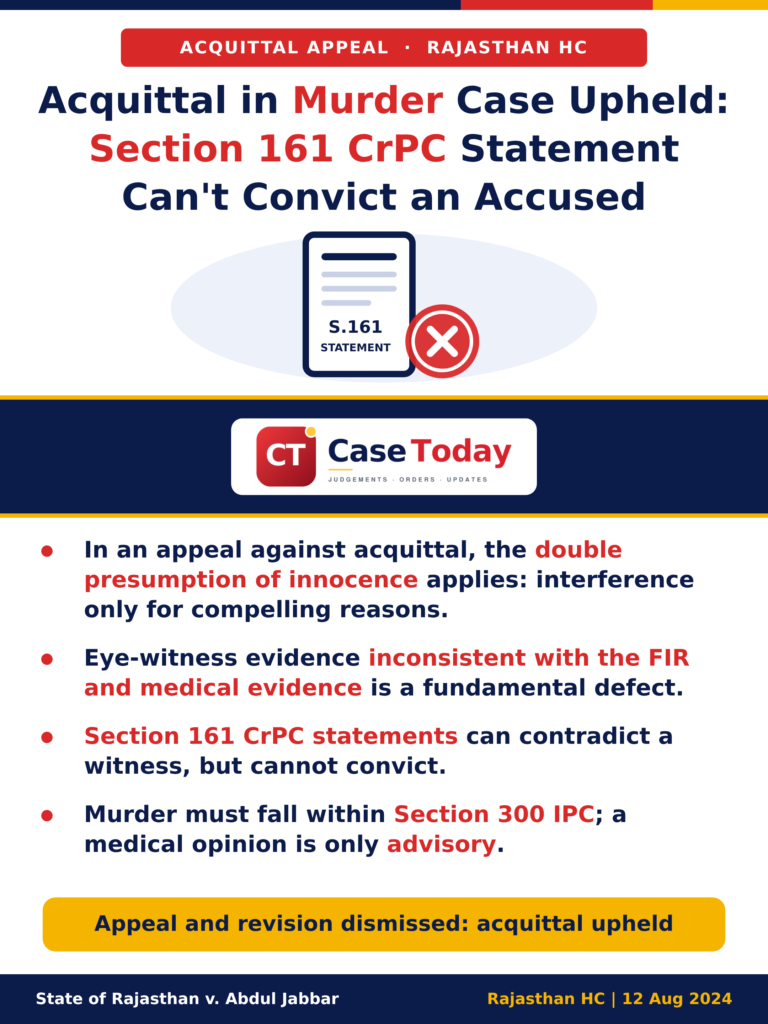
Section 161 CrPC Statements Cannot Convict; Acquittal In Murder Case Upheld: Rajasthan HC
Case: State of Rajasthan v. Abdul Jabbar (D.B. Criminal Appeal No. 384/1991, connected with D.B. Criminal Revision Petition No. 17/1992, 2024:RJ-JD:33521-DB)
Court: High Court of Judicature for Rajasthan at Jodhpur
Judge: Hon’ble Mr. Justice Shree Chandrashekhar and Hon’ble Mr. Justice Yogendra Kumar Purohit (judgment authored by Justice Shree Chandrashekhar)
Delivered: 12 August 2024
HEADNOTE
- Double presumption of innocence: An acquittal by the trial Court raises a double presumption of innocence in the accused’s favour. Where two views are possible, the High Court cannot interfere, and it may do so only in exceptional cases where there are compelling circumstances and the judgment is perverse (Kalyan v. State of U.P.; Bhadragiri Venkata Ravi v. High Court of A.P.).
- Direct evidence must be supported by medical evidence: Prosecution evidence is wanting in the most material part if the direct evidence is not supported by expert evidence (Maniram v. State of U.P.). Eye-witness testimony that was inconsistent with the medical evidence is a fundamental defect.
- Section 161 CrPC statements cannot convict: A witness’s statement to the police under Section 161 Cr.P.C. cannot be the basis of conviction, least of all for murder. It is used only to contradict the witness with a previous statement (Omkar Namdeo Jadhao).
- Omissions in the FIR matter: An informant’s failure to report vital aspects, including the presence of some witnesses, seriously affects the foundation of the prosecution case.
- Medical opinion is advisory: An expert is not a witness of fact, and the credibility of expert opinion depends on the reasons and materials behind it (State of H.P. v. Jai Lal). A suggestion that fist blows to the abdomen may rupture the spleen does not prove that the accused intentionally caused death.
- Murder must fall within Section 300 IPC: To convict for murder, the prosecution must bring the case within one of the four clauses of Section 300 of the Indian Penal Code.
BRIEF FACTS
On the fardbeyan of Salim, FIR No. 49/1988 was registered on 25.05.1988 at Police Station Sadar Kotwali, Jodhpur, under Sections 307 and 323 IPC. The informant said that Abdul Jabbar, who objected to the use of his land by the informant’s side, abused and assaulted him, tried to hit him with a stone, and then struck the informant’s mother Hanifa with fists around her abdomen. She became unconscious and died around 11:55 pm that night.
In Sessions Case No. 94/1988, the prosecution examined 12 witnesses, including the doctor (P.W.-10) who found a small abrasion on the forehead, about 1800 ml of blood in the abdomen and two injuries on the spleen. The defence said the accused was falsely implicated because the witnesses had an eye on his land. The Sessions Court acquitted him of the charges under Sections 302 and 323 IPC on 14.08.1991. The State appealed, and the informant filed a criminal revision.
LEGAL ISSUE
Whether the High Court should interfere with the acquittal for murder, where the eye-witnesses’ evidence was inconsistent with the FIR and the medical evidence and the prosecution could not show that fist blows caused the spleen rupture and death.
KEY FINDINGS OF THE COURT
- No proof of force sufficient to rupture the spleen: Relying on Modi’s textbook, the Court noted a normal spleen ruptures only from considerable force, such as broken ribs, and no evidence showed the ribs were broken or such force was used (paras 10–11, 17).
- Section 161 CrPC statements and FIR omissions: Statements under Section 161 CrPC cannot support a murder conviction, and the informant’s failure to mention vital aspects hit the foundation of the case (para 14).
- Careful scrutiny of witnesses: The maxim “falsus in uno falsus in omnibus” is not a sound rule in India, but where a witness is false in certain particulars, the Court must scrutinise the rest of that evidence with care and caution (para 7).
REASONING
The Court held that in a murder trial, the evidence of witnesses must be examined carefully, including whether a witness is a chance witness. It found the defence challenge to the presence of material witnesses was not speculative. Medical opinion is only advisory, and the prosecution had to prove that blows with considerable force broke the ribs and ruptured the spleen. Since there was no such evidence, and the witnesses were inconsistent with the FIR, the Sessions Court’s view was a possible view and not perverse.
RESULT
Case title: State of Rajasthan v. Abdul Jabbar (D.B. Criminal Appeal No. 384/1991)
Appearance: Mr. Mahipal Bishnoi, Public Prosecutor, for the State.