

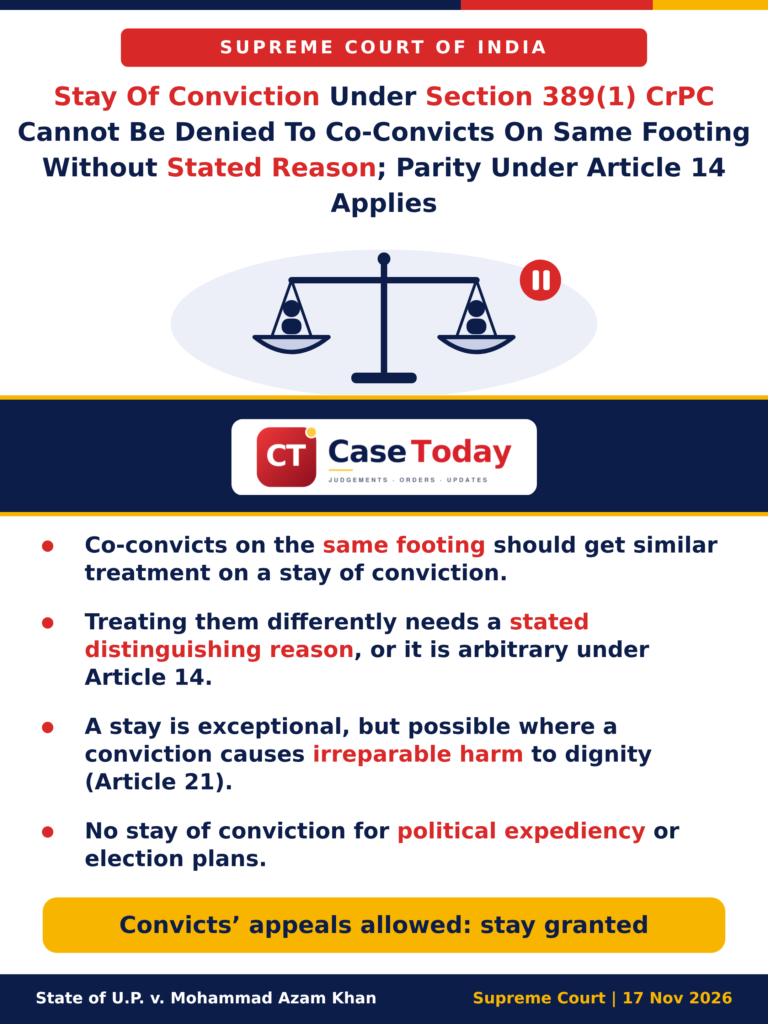
Stay Of Conviction Under Section 389(1) CrPC Cannot Be Denied To Co-Convicts On Same Footing
Without Stated Reason; Parity Under Article 14 Applies : Supreme Court
Case: State of U.P. v. Mohammad Azam Khan & Ors. (with connected appeals arising out of SLP (Crl.) Nos. 11030-11032 of 2025, 15970 of 2025 and 15969 of 2025) – Judgment
Court: Supreme Court of India (Criminal Appellate Jurisdiction)
Citation: 2026 INSC 1231 (Non-Reportable)
Coram: Justice Dipankar Datta and Justice Sheel Nagu (Judgment by Justice Dipankar Datta)
Date of Judgment: 17 November 2026
HEADNOTE
Keywords: Code of Criminal Procedure, 1973 – Section 389(1) read with Sections 397/401 – Stay of Conviction – Suspension of Sentence – Parity Among Co-Convicts – Article 14 – Article 21 – Article 136 – Criminal Conspiracy – Section 120-B IPC
- Stay of conviction differs from suspension of sentence: Suspension of sentence only defers execution of the penalty, while a stay of conviction keeps in abeyance the legal disability attached to a finding of guilt. Stay of conviction is an exceptional remedy needing compelling justification (para 9).
- Co-convicts on the same footing must get similar treatment: Equals ought to be treated equally under Article 14. If one convict gets a stay of conviction and similarly placed convicts are denied it, the distinguishing feature must be identified and expressly stated. An order silent on that point is arbitrary (para 19).
- Conviction affects dignity under Article 21: A conviction causes irreversible social stigma and prejudice to personal standing. Where it would cause irreparable damage that cannot be compensated even if the convict is later acquitted, an exceptional situation for a stay can arise (paras 20–22, citing Afjal Ansari v. State of U.P., (2024) 2 SCC 187).
- Discretion must balance both sides: The Court must balance the grave and irreversible consequences of conviction against the sanctity attached to a conviction until it is set aside (para 22).
- No stay for political expediency: A stay of conviction cannot be sought on grounds of political expediency, electoral ambitions or election campaigns (para 23).
- Brief reasons can suffice and Article 136 is not a re-appeal: Reasons for suspending the sentence, such as long custody, advanced age and absence of direct evidence of personally executing forged signatures, can be valid grounds for a stay of conviction. The Supreme Court does not interfere under Article 136 unless there is manifest perversity (paras 15–16).
BRIEF FACTS
The three convicts were tried for criminal conspiracy, cheating and forgery under Sections 120-B, 420, 467, 468 and 471 IPC over the alleged use of two conflicting birth certificates issued in the name of one of them. The FIR was registered on 03.01.2019 on a complaint of 17.12.2018. They were convicted on 18.10.2023, and the appellate Court affirmed the conviction on 23.12.2023.
In their revisions, the Allahabad High Court on 24.05.2024 suspended the sentences of all three and released them on bail, but stayed the conviction of only the senior accused, and refused the same relief to his son and wife. The State appealed against the stay granted to the senior accused, and the son and wife appealed against the refusal to stay their convictions.
KEY FINDINGS OF THE COURT
Note: The findings highlighted in yellow are the main findings of the Court most relied upon for the judgment.
- The refusal to stay the convictions of the son and wife violated the doctrine of parity. All three were convicted of one charge of criminal conspiracy under Section 120-B IPC on the same documentary evidence. No distinct overt act of forgery was attributed to the son or wife beyond being co-conspirators and alleged beneficiaries, and the High Court gave no coherent reason for treating them differently. Giving relief to one while denying it to the others was arbitrary and a patent error of jurisdiction (paras 18–19, 25–26).
- The State’s objections to the stay granted to the senior accused were rejected. The State argued that the High Court granted relief beyond the prayer and gave no separate reasons. The Court held that each convict had filed a separate application for stay of conviction, and the reasons for suspending his sentence (long custody, advanced age and no direct evidence of personally forging signatures) were valid grounds. There was no manifest perversity and no ground to interfere under Article 136 (paras 10–16, 24).
- A stay of conviction cannot be sought for political ends. The Court unequivocally rejected any plea for a stay of conviction based purely on political expediency, electoral ambitions or election campaigns, because statutory powers cannot be used to suit political calendars (para 23).
- Stay of conviction is exceptional but available where there is irreparable harm. The Court noted that Section 389(1) CrPC need not be read narrowly where the conviction would cause irreversible consequences, subject to societal interest being balanced (paras 20–22, quoting Afjal Ansari).
- The merits of the revisions are not affected. The High Court must decide the criminal revisions on their individual merits, uninfluenced by the observations made (para 28).
RESULT
Case Title: State of U.P. v. Mohammad Azam Khan & Ors.
Citation: 2026 INSC 1231 (Non-Reportable)
Appearance: Mr. K. M. Nataraj, learned Additional Solicitor General, for the State; Mr. Kapil Sibal, learned Senior Counsel, for the three convicts.