

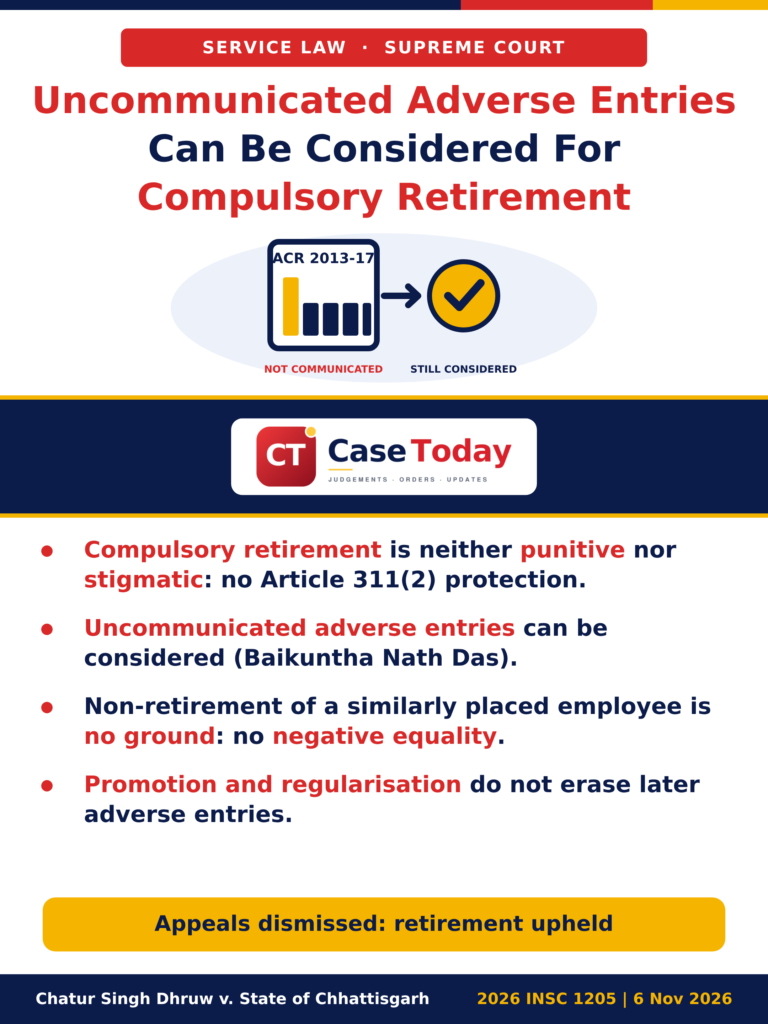
Uncommunicated Adverse Entries Can Be
Considered For Compulsory Retirement : Supreme Court
Case: Chatur Singh Dhruw v. State of Chhattisgarh & Ors. (Civil Appeals arising out of SLP (C) Nos. 24392 and 25201 of 2023) – Judgment
Court: Supreme Court of India
Citation: 2026 INSC 1205
Coram: Justice Manmohan and Justice Shree Chandrashekhar (Judgment by Justice Manmohan)
Date of Judgment: 6 November 2026
HEADNOTE
Keywords: Compulsory Retirement – Fundamental Rule 56 – Rule 42(1)(b), Chhattisgarh Civil Services (Pension) Rules, 1976 – Public Interest – Article 311(2) – Article 14 – Negative Equality – Annual Confidential Reports – Uncommunicated Adverse Entries – Baikuntha Nath Das – Dev Dutt – Screening Committee
- Compulsory retirement is not punitive or stigmatic: An order of compulsory retirementdoes not cast any aspersion or imply any finding of misconduct. The rule of audi alteram partem and the protection of Article 311(2) do not apply to it.
- Limited judicial review: The decision rests on the subjective satisfaction of the authority that retention is not in public interest, but it must be based on valid material. The Court does not re-weigh the material and interferes only where there is no evidence, non-application of mind, arbitrariness, perversity or mala fides.
- No negative equality: An employee cannot challenge compulsory retirement only because another similarly placed employee was not retired. Article 14 is a positive concept and does not allow a claim of negative equality.
- Uncommunicated adverse entries can be considered: An order of compulsory retirement is not liable to be quashed because uncommunicated adverse remarks were also taken into account (Baikuntha Nath Das). Dev Dutt and Sukhdev Singh concern promotionand do not apply.
- Promotion and regularisation do not erase later entries: The rule that adverse entries lose their sting after promotion covers only entries that pre-date the promotion. It does not cover entries recorded after promotion. Regularisation merely gives substantive status and is not an endorsement of efficiency.
- Not a device to bypass disciplinary action: The Screening Committee’s minutes are internal deliberations and do not make the order stigmatic. The review was an administrative exercise, and no departmental inquiry was pending or contemplated.
BRIEF FACTS
The appellants, Chatur Singh Dhruw and Manharan Lal Sahu, were appointed Peons (Class-IV) in the Legal Metrology Department, Raipur, in 1989 and 1993. They were promoted to Assistant Grade-III in 2012 and 2013, and their services were regularised on 19.06.2015. On 25.04.2017, the General Administration Department issued a Circular to review service records of employees who had completed 20 years of service or reached 50 years of age. The criteria included honesty and integrity, physical capacity, reputation and efficiency, and an overall record below “Good” (Grade B), with a check on whether the last five years of work were declining.
A Screening Committee met on 04.09.2017 and reviewed 14 clerical employees, using a numerical scale for their Annual Confidential Reports (A+ = 5 to D = 1). It recommended 5 employees for compulsory retirement, including the appellants, and 9 were retained. By orders dated 09.10.2017, the appellants were compulsorily retired under Fundamental Rule 56 and Rule 42(1)(b) of the Chhattisgarh Civil Services (Pension) Rules, 1976. The Single Judge declined to interfere on 23.08.2019 and the Division Bench of the Chhattisgarh High Court affirmed this on 12.04.2023. The appellants then came to the Supreme Court.
KEY FINDINGS OF THE COURT
Note: The findings highlighted in yellow are the main findings of the Court most relied upon for the judgment.
- Uncommunicated adverse entries and below-benchmark gradings may be taken into account. The Court followed Baikuntha Nath Das, which holds that compulsory retirement cannot be quashed merely because uncommunicated adverse remarks were considered. Dev Dutt and Sukhdev Singh, which require communication of every ACR entry, were rendered in the context of promotion and career progression and cannot be extended mechanically to compulsory retirement (paras 48–49).
- Parameters were uniformly applied, and similar treatment of others is not a ground. All 14 eligible employees were assessed on the same objective method. None of the 9 retained employees had the combination found in the appellants: an overall record below Grade B, sustained “C” gradings from 2013 to 2017, and adverse remarks. Three other employees were also recommended. The Court added that non-retirement of a similarly placed employee does not by itself make the action discriminatory (paras 29–38).
- The orders are neither punitive nor stigmatic. The orders only record that the appellants completed the required service and were retired in public interest with the State’s approval. The Court looks mainly at the order itself, and the Committee’s internal minutes do not add a stigma. No inquiry was pending, so the plea that it was a device to avoid disciplinary proceedings failed (paras 44–47).
- Promotion and regularisation did not wipe out later adverse entries. Both appellants were already in the promoted post when the ACRs for 2013 to 2017 were recorded. Those entries related to their performance in the promoted post and were directly relevant (paras 39–43).
- Scope of review and entire service record. The Committee first assessed the entire service record against the Grade B benchmark, and used the last five years’ ACRs as a corroborating check, as the Circular allows. The Court found relevant and cogent material and no arbitrariness, mala fides or perversity (paras 23–27, 37, 50).
RESULT
Case Title: Chatur Singh Dhruw v. State of Chhattisgarh & Ors.
Citation: 2026 INSC 1205
Appearance: Mr. Kaustubh Shukla, learned counsel, for the appellants; Mr. Rajat Nair, Additional Advocate General, for the State of Chhattisgarh. Other counsel are not named in the judgment.